
期刊文章
过刊浏览
- Volumes 108-119 (2025)
-
Volumes 96-107 (2025)
-
Volume 107
Pages 1-376 (December 2025)
-
Volume 106
Pages 1-336 (November 2025)
-
Volume 105
Pages 1-356 (October 2025)
-
Volume 104
Pages 1-332 (September 2025)
-
Volume 103
Pages 1-314 (August 2025)
-
Volume 102
Pages 1-276 (July 2025)
-
Volume 101
Pages 1-166 (June 2025)
-
Volume 100
Pages 1-256 (May 2025)
-
Volume 99
Pages 1-242 (April 2025)
-
Volume 98
Pages 1-288 (March 2025)
-
Volume 97
Pages 1-256 (February 2025)
-
Volume 96
Pages 1-340 (January 2025)
-
Volume 107
-
Volumes 84-95 (2024)
-
Volume 95
Pages 1-392 (December 2024)
-
Volume 94
Pages 1-400 (November 2024)
-
Volume 93
Pages 1-376 (October 2024)
-
Volume 92
Pages 1-316 (September 2024)
-
Volume 91
Pages 1-378 (August 2024)
-
Volume 90
Pages 1-580 (July 2024)
-
Volume 89
Pages 1-278 (June 2024)
-
Volume 88
Pages 1-350 (May 2024)
-
Volume 87
Pages 1-338 (April 2024)
-
Volume 86
Pages 1-312 (March 2024)
-
Volume 85
Pages 1-334 (February 2024)
-
Volume 84
Pages 1-308 (January 2024)
-
Volume 95
-
Volumes 72-83 (2023)
-
Volume 83
Pages 1-258 (December 2023)
-
Volume 82
Pages 1-204 (November 2023)
-
Volume 81
Pages 1-188 (October 2023)
-
Volume 80
Pages 1-202 (September 2023)
-
Volume 79
Pages 1-172 (August 2023)
-
Volume 78
Pages 1-146 (July 2023)
-
Volume 77
Pages 1-152 (June 2023)
-
Volume 76
Pages 1-176 (May 2023)
-
Volume 75
Pages 1-228 (April 2023)
-
Volume 74
Pages 1-200 (March 2023)
-
Volume 73
Pages 1-138 (February 2023)
-
Volume 72
Pages 1-144 (January 2023)
-
Volume 83
-
Volumes 60-71 (2022)
-
Volume 71
Pages 1-108 (December 2022)
-
Volume 70
Pages 1-106 (November 2022)
-
Volume 69
Pages 1-122 (October 2022)
-
Volume 68
Pages 1-124 (September 2022)
-
Volume 67
Pages 1-102 (August 2022)
-
Volume 66
Pages 1-112 (July 2022)
-
Volume 65
Pages 1-138 (June 2022)
-
Volume 64
Pages 1-186 (May 2022)
-
Volume 63
Pages 1-124 (April 2022)
-
Volume 62
Pages 1-104 (March 2022)
-
Volume 61
Pages 1-120 (February 2022)
-
Volume 60
Pages 1-124 (January 2022)
-
Volume 71
- Volumes 54-59 (2021)
- Volumes 48-53 (2020)
- Volumes 42-47 (2019)
- Volumes 36-41 (2018)
- Volumes 30-35 (2017)
- Volumes 24-29 (2016)
- Volumes 18-23 (2015)
- Volumes 12-17 (2014)
- Volume 11 (2013)
- Volume 10 (2012)
- Volume 9 (2011)
- Volume 8 (2010)
- Volume 7 (2009)
- Volume 6 (2008)
- Volume 5 (2007)
- Volume 4 (2006)
- Volume 3 (2005)
- Volume 2 (2004)
- Volume 1 (2003)
Volume 109
Preparation of cold-bonded ceramsite based on particle packing theory and high-efficiency utilization of granite powder
Hongqiang Li, Hui Li, Yueyao Zhao, Hongbo Cui, Wukui Zheng *
School of Materials Science and Engineering, Xi'an University of Architecture and Technology, Xi'an, 710055, China
10.1016/j.partic.2025.12.002
Volume 109,
February 2026,
Pages 86-98
Received 16 October 2025, Revised 26 November 2025, Accepted 4 December 2025, Available online 9 December 2025, Version of Record 22 December 2025.
E-mail:
zheng.wukui@xauat.edu.cn
Highlights
• MAA packing-curve design controls pellet porosity and strength.
• Lower RSS (better PSD fit) increases densities and reduces water uptake.
• Best window: bulk 1041 kg/m3, apparent 1669 kg/m3, water 11.86 %.
• Single-pellet crushing strength up to 5.76 MPa at optimal packing.
• Full PSD outperforms mono-sized blends in strength and absorption.
Abstract
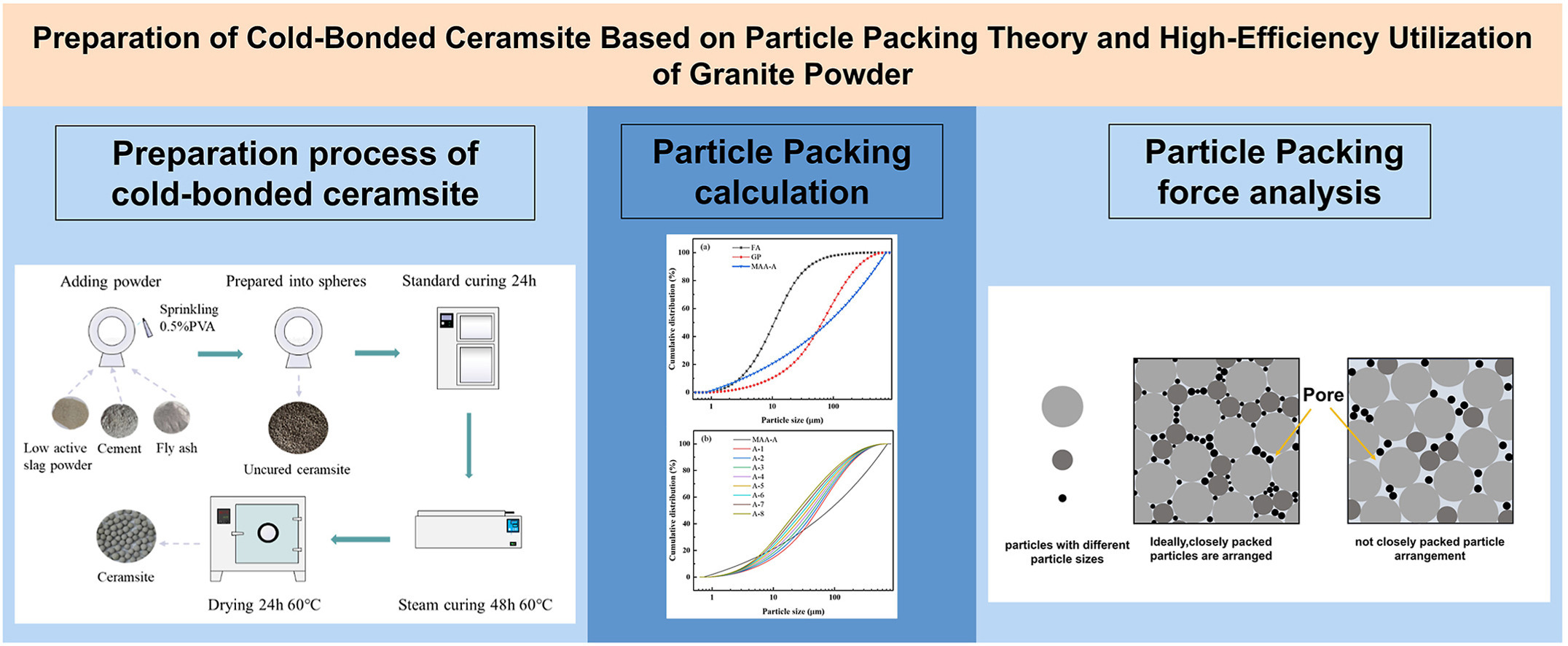
The utilization of granite powder (GP) is substantially limited by its low pozzolanic activity and inert structure, posing a significant challenge for its high-volume incorporation. This study conducts experimental research on cold-bonded ceramsite based on the GP–fly ash–cement system, adopting the modified Andreasen–Andersen (MAA) particle packing model as a tool for mix ratio design and evaluation. By designing multiple groups of different particle size combinations, the raw material particle gradation is made to produce controllable deviations from the MAA target curve within a certain range. RSS is used to quantitatively characterize the degree of deviation of the particle gradation from the MAA target curve, and the influence mechanism of this deviation on the physical properties and pore structure of ceramsite is systematically analyzed. The results indicated that an RSS value of 6736 yielded the most compact ceramsite structure, which exhibited a cylinder compressive strength of 5.76 MPa, a bulk density of 1041 kg/m3, and a water absorption as low as 12.65 %. Further particle size fractionation experiments revealed that single-size raw material systems performed significantly worse than full-range particle distributions. The latter facilitated the formation of a skeleton–filler collaborative structure, thereby enhancing compactness and mechanical stability. Compared with existing utilization pathways of GP, the proposed structure-regulated preparation strategy for cold-bonded ceramsite enables up to 85 % incorporation of GP and delivers comprehensive performance improvement without reliance on high-temperature sintering or alkali activation. This approach demonstrates considerable engineering feasibility and application potential, providing a novel perspective and theoretical foundation for the high-efficiency valorization of low-activity solid wastes.
Graphical abstract
Keywords
Particle packing theory; Granite powder; Cold-bonded ceramsite; Performance optimization
文章导读