
期刊文章
-
文章精选
- 当期目录
-
过刊浏览
-
Volumes 108-119 (2025)
-
Volumes 96-107 (2025)
Pages 1-332 (September 2025)
-
Volumes 84-95 (2024)
-
Volumes 72-83 (2023)
-
Volumes 60-71 (2022)
-
Volumes 54-59 (2021)
-
Volumes 48-53 (2020)
-
Volumes 42-47 (2019)
-
Volumes 36-41 (2018)
-
Volumes 30-35 (2017)
-
Volumes 24-29 (2016)
-
Volumes 18-23 (2015)
-
Volumes 12-17 (2014)
-
Volume 11 (2013)
-
Volume 10 (2012)
-
Volume 9 (2011)
-
Volume 8 (2010)
-
Volume 7 (2009)
-
Volume 6 (2008)
-
Volume 5 (2007)
-
Volume 4 (2006)
-
Volume 3 (2005)
-
Volume 2 (2004)
-
Volume 1 (2003)
-
Volumes 108-119 (2025)
-
高被引
-
高下载
-
特邀文章
-
专刊合集
-
待刊文章
高被引
Cheng, G., Zhang, M., Lu, Y., Zhang, Y., Lin, B., & Von Lau, E. (2024). A novel method for the green utilization of waste fried oil. Particuology, 84, 1-11. https://doi.org/10.1016/j.partic.2023.02.019
A novel method for the green utilization of waste fried oil
Gan Cheng a b c *, Mengni Zhang a, Yang Lu a, Yanhui Zhang a, Bin Lin a, Ee Von Lau d
a College of Chemistry and Chemical Engineering, Henan Polytechnic University, Jiaozuo, 454003, China
b Henan Key Laboratory for Green and Efficient Mining & Comprehensive Utilization of Mineral Resources, Henan Polytechnic University, Jiaozuo, 454003, China
c Collaborative Innovation Center of Coal Work Safety and Clean High Efficiency Utilization, Henan Polytechnic University, Jiaozuo, 454003, China
d School of Engineering, Monash University Malaysia, Subang Jaya, Selangor, 47500, Malaysia
10.1016/j.partic.2023.02.019
Volume 84,
January 2024,
Pages 1-11
Received 8 December 2022, Revised 2 February 2023, Accepted 18 February 2023, Available online 12 March 2023, Version of Record 21 March 2023.
E-mail:
chenggan464@126.com
Highlights
• Waste fried oil and orange peel were used as low-cost material for detergents production.
• Three useful, cheap and good quality detergents such as soap, liquid soap and soap powder were obtained by saponification.
• The detergents met the standards of strong decontamination ability, stable performance, gentle to skin and non-toxic.
Abstract
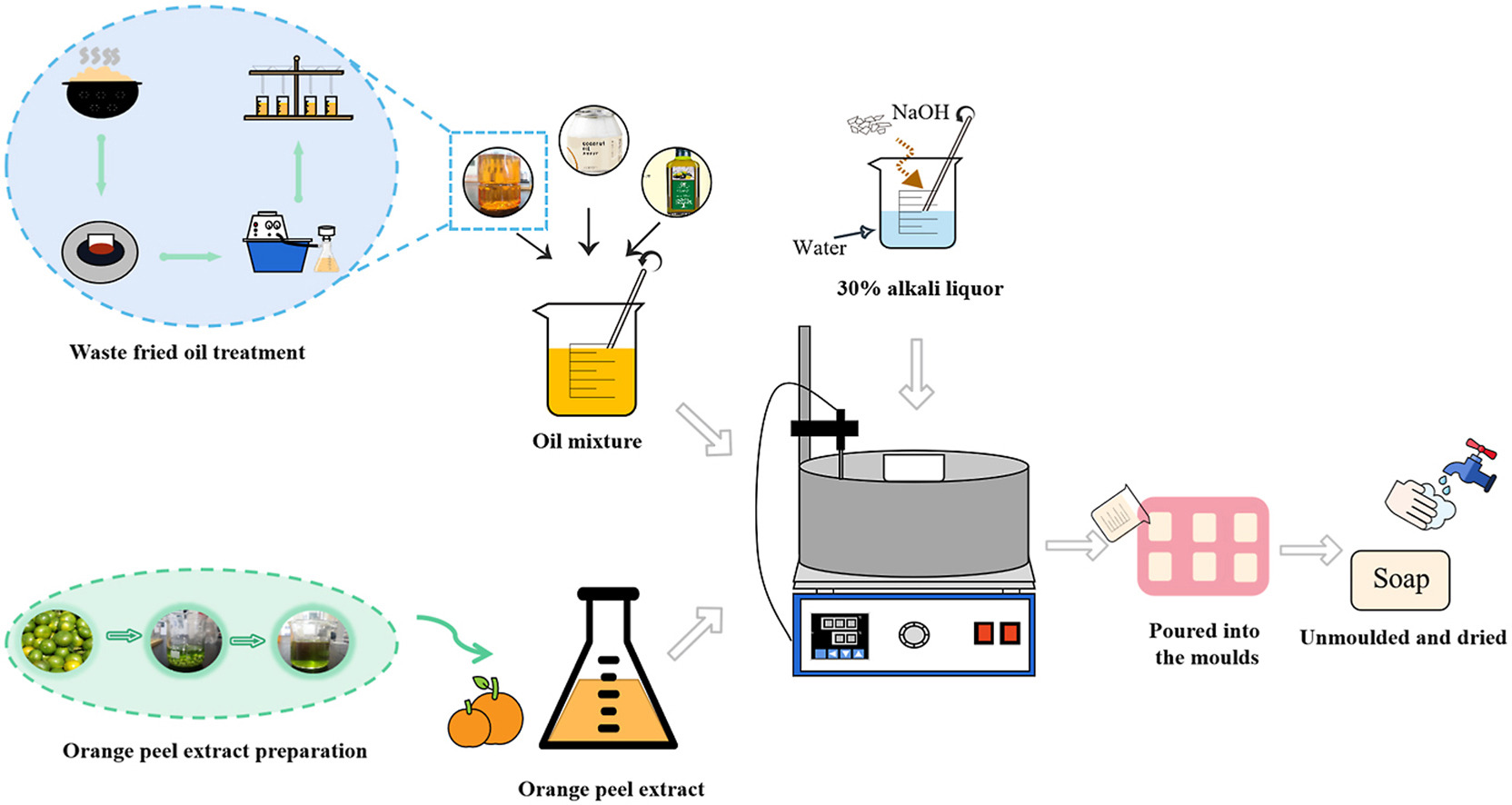
Waste fried oil was studied to prepare three different types of detergent such as soap, liquid soap and soap powder via saponification process. The preparation conditions of soap base were optimized by orthogonal experiment. The specific preparation processes included waste fried oil treatment, orange peel extract preparation, saponification, demoulding and drying. Results showed that the optimal conditions for saponification were as follows: ratio of pure waste fried oil to coconut oil = 6:4, alkali liquor (NaOH) mass fraction 30%, saponification temperature 70 °C, orange peel extract concentration 15%. The mature soap was then used to make liquid soap and soap powder by surfactant (sodium dodecylbenzene sulfonate, coconut diethanol amide) addition, followed by grinding. The prepared detergent conforms to the production standard of strong decontamination ability, possesses stable performance, is gentle to skin and non-toxic.
Graphical abstract
Keywords
Waste fried oil; Detergent; Saponification; Decolorization
文章导读