
期刊文章
过刊浏览
- Volumes 108-119 (2025)
-
Volumes 96-107 (2025)
-
Volume 107
Pages 1-376 (December 2025)
-
Volume 106
Pages 1-336 (November 2025)
-
Volume 105
Pages 1-356 (October 2025)
-
Volume 104
Pages 1-332 (September 2025)
-
Volume 103
Pages 1-314 (August 2025)
-
Volume 102
Pages 1-276 (July 2025)
-
Volume 101
Pages 1-166 (June 2025)
-
Volume 100
Pages 1-256 (May 2025)
-
Volume 99
Pages 1-242 (April 2025)
-
Volume 98
Pages 1-288 (March 2025)
-
Volume 97
Pages 1-256 (February 2025)
-
Volume 96
Pages 1-340 (January 2025)
-
Volume 107
-
Volumes 84-95 (2024)
-
Volume 95
Pages 1-392 (December 2024)
-
Volume 94
Pages 1-400 (November 2024)
-
Volume 93
Pages 1-376 (October 2024)
-
Volume 92
Pages 1-316 (September 2024)
-
Volume 91
Pages 1-378 (August 2024)
-
Volume 90
Pages 1-580 (July 2024)
-
Volume 89
Pages 1-278 (June 2024)
-
Volume 88
Pages 1-350 (May 2024)
-
Volume 87
Pages 1-338 (April 2024)
-
Volume 86
Pages 1-312 (March 2024)
-
Volume 85
Pages 1-334 (February 2024)
-
Volume 84
Pages 1-308 (January 2024)
-
Volume 95
-
Volumes 72-83 (2023)
-
Volume 83
Pages 1-258 (December 2023)
-
Volume 82
Pages 1-204 (November 2023)
-
Volume 81
Pages 1-188 (October 2023)
-
Volume 80
Pages 1-202 (September 2023)
-
Volume 79
Pages 1-172 (August 2023)
-
Volume 78
Pages 1-146 (July 2023)
-
Volume 77
Pages 1-152 (June 2023)
-
Volume 76
Pages 1-176 (May 2023)
-
Volume 75
Pages 1-228 (April 2023)
-
Volume 74
Pages 1-200 (March 2023)
-
Volume 73
Pages 1-138 (February 2023)
-
Volume 72
Pages 1-144 (January 2023)
-
Volume 83
-
Volumes 60-71 (2022)
-
Volume 71
Pages 1-108 (December 2022)
-
Volume 70
Pages 1-106 (November 2022)
-
Volume 69
Pages 1-122 (October 2022)
-
Volume 68
Pages 1-124 (September 2022)
-
Volume 67
Pages 1-102 (August 2022)
-
Volume 66
Pages 1-112 (July 2022)
-
Volume 65
Pages 1-138 (June 2022)
-
Volume 64
Pages 1-186 (May 2022)
-
Volume 63
Pages 1-124 (April 2022)
-
Volume 62
Pages 1-104 (March 2022)
-
Volume 61
Pages 1-120 (February 2022)
-
Volume 60
Pages 1-124 (January 2022)
-
Volume 71
- Volumes 54-59 (2021)
- Volumes 48-53 (2020)
- Volumes 42-47 (2019)
- Volumes 36-41 (2018)
- Volumes 30-35 (2017)
- Volumes 24-29 (2016)
- Volumes 18-23 (2015)
- Volumes 12-17 (2014)
- Volume 11 (2013)
- Volume 10 (2012)
- Volume 9 (2011)
- Volume 8 (2010)
- Volume 7 (2009)
- Volume 6 (2008)
- Volume 5 (2007)
- Volume 4 (2006)
- Volume 3 (2005)
- Volume 2 (2004)
- Volume 1 (2003)
Volume 106
Zhao, M., Zheng, C., Wang, C., Gan, Y., Wang, F., Yang, J., . . . Wang, T.-J. (2025). Enhancing silicone rubber performance through surface grafting of γ-MPS onto nano-SiO2 particles. Particuology, 106, 145-155. https://doi.org/10.1016/j.partic.2025.08.021
Enhancing silicone rubber performance through surface grafting of γ-MPS onto nano-SiO2 particles
Mei Zhao a, Chenglin Zheng a, Chenghui Wang b, Yuxin Gan a, Fangke Wang b, Jun Yang b, Rui Tan a, Ting-Jie Wang a *
a Department of Chemical Engineering, Tsinghua University, Beijing, 100084, China
b Fujian Yuanxiang New Materials Co., Ltd., Nanping, 354000, China
10.1016/j.partic.2025.08.021
Volume 106,
https://www.sciencedirect.com/science/article/pii/S1674200125002317,
Pages 145-155
November 2025
E-mail:
wangtj@tsinghua.edu.cn
Highlights
• Developed a modification route combining hydrolysis, spray drying, and heating.
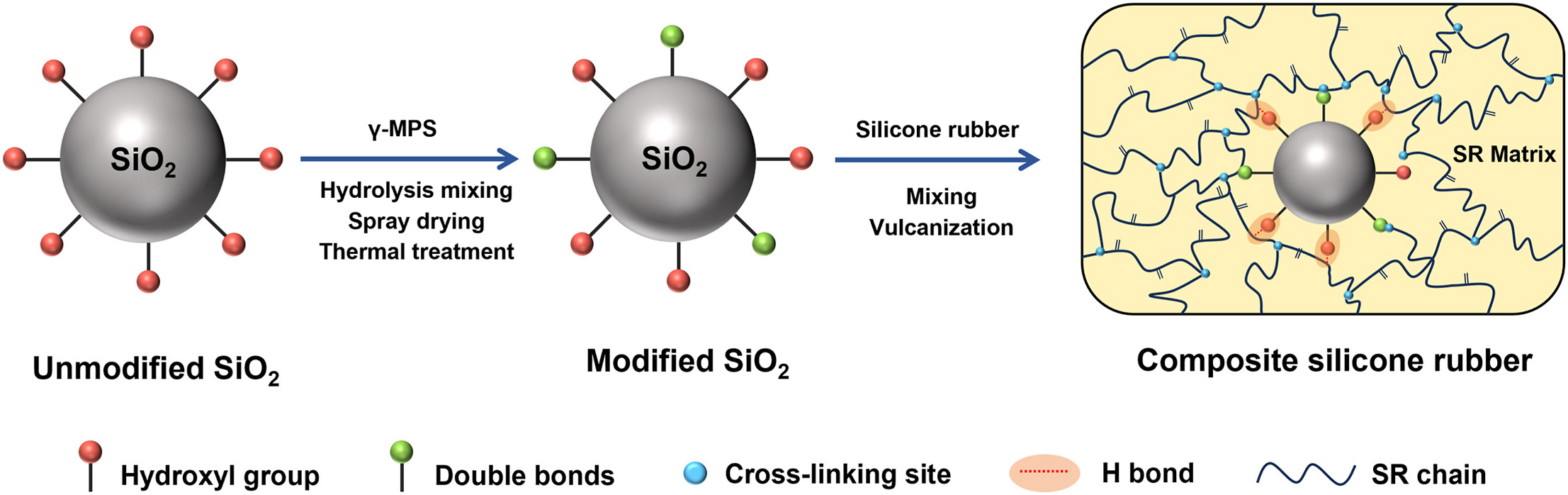
• Grafted double bonds react with SR side chains forming cross-links network.
• Optimal SiO2 dispersion and SR tensile strength obtained through γ-MPS modification.
• Excess γ-MPS caused agglomeration and multilayer grafting, reducing strength.
Abstract
The reinforcing of silicone rubber using nano-SiO2 is currently constrained by the weak interfacial interactions dominated by hydrogen bonding and van der Waals forces between particles and the matrix. This limitation hinders the development of silicone rubbers with high-strength and high-transparency. In this study, a novel organic modification approach involving "hydrolysis mixing, spray drying, and thermal treatment" was developed to graft γ-(methacryloxypropyl)trimethoxysilane (γ-MPS), containing double-bonds, onto the surface of precipitated SiO2 particles. During curing, these surface-grafted double-bonds react with the double-bonds on the silicone rubber side chains, forming an interfacial cross-linking network between inorganic particles and the organic matrix. Experimental results show that composites incorporating SiO2 particles modified with 2 wt% γ-MPS adding exhibit the highest tensile strength of 9.47 MPa, attributed to the optimal particle dispersion and formation of interfacial cross-linked network. Particle dispersion which is quantified by a dispersion index reached the lowest values at 2 % γ-MPS, indicating the uniform dispersion. Consistently, curing rheology showed the maximum effective torque reaching 3.16 dN m at 2 %, reflecting the highest double bond interfacial cross-link density. Silicone rubber composites with 0.5 %–2 % γ-MPS modified particles exhibit optimal tensile strength and transparency. However, the increasing amount of γ-MPS leads to intensified condensation of hydrolyzed silane species, resulting in particle agglomeration and multilayer grafting on the particle surfaces, which adversely affects mechanical performance and transparency. To prepare high-strength and high-transparency silicone rubber, effective suppression of the condensation of silane coupling agent hydrolysis products and achievement of monolayer grafting on particle surfaces are necessary.
Graphical abstract
Keywords
Nano-SiO2; Silicone rubber; Organic modification; Cross-linking; Dispersion
文章导读