
期刊文章
过刊浏览
- Volumes 108-119 (2025)
-
Volumes 96-107 (2025)
-
Volume 107
Pages 1-376 (December 2025)
-
Volume 106
Pages 1-336 (November 2025)
-
Volume 105
Pages 1-356 (October 2025)
-
Volume 104
Pages 1-332 (September 2025)
-
Volume 103
Pages 1-314 (August 2025)
-
Volume 102
Pages 1-276 (July 2025)
-
Volume 101
Pages 1-166 (June 2025)
-
Volume 100
Pages 1-256 (May 2025)
-
Volume 99
Pages 1-242 (April 2025)
-
Volume 98
Pages 1-288 (March 2025)
-
Volume 97
Pages 1-256 (February 2025)
-
Volume 96
Pages 1-340 (January 2025)
-
Volume 107
-
Volumes 84-95 (2024)
-
Volume 95
Pages 1-392 (December 2024)
-
Volume 94
Pages 1-400 (November 2024)
-
Volume 93
Pages 1-376 (October 2024)
-
Volume 92
Pages 1-316 (September 2024)
-
Volume 91
Pages 1-378 (August 2024)
-
Volume 90
Pages 1-580 (July 2024)
-
Volume 89
Pages 1-278 (June 2024)
-
Volume 88
Pages 1-350 (May 2024)
-
Volume 87
Pages 1-338 (April 2024)
-
Volume 86
Pages 1-312 (March 2024)
-
Volume 85
Pages 1-334 (February 2024)
-
Volume 84
Pages 1-308 (January 2024)
-
Volume 95
-
Volumes 72-83 (2023)
-
Volume 83
Pages 1-258 (December 2023)
-
Volume 82
Pages 1-204 (November 2023)
-
Volume 81
Pages 1-188 (October 2023)
-
Volume 80
Pages 1-202 (September 2023)
-
Volume 79
Pages 1-172 (August 2023)
-
Volume 78
Pages 1-146 (July 2023)
-
Volume 77
Pages 1-152 (June 2023)
-
Volume 76
Pages 1-176 (May 2023)
-
Volume 75
Pages 1-228 (April 2023)
-
Volume 74
Pages 1-200 (March 2023)
-
Volume 73
Pages 1-138 (February 2023)
-
Volume 72
Pages 1-144 (January 2023)
-
Volume 83
-
Volumes 60-71 (2022)
-
Volume 71
Pages 1-108 (December 2022)
-
Volume 70
Pages 1-106 (November 2022)
-
Volume 69
Pages 1-122 (October 2022)
-
Volume 68
Pages 1-124 (September 2022)
-
Volume 67
Pages 1-102 (August 2022)
-
Volume 66
Pages 1-112 (July 2022)
-
Volume 65
Pages 1-138 (June 2022)
-
Volume 64
Pages 1-186 (May 2022)
-
Volume 63
Pages 1-124 (April 2022)
-
Volume 62
Pages 1-104 (March 2022)
-
Volume 61
Pages 1-120 (February 2022)
-
Volume 60
Pages 1-124 (January 2022)
-
Volume 71
- Volumes 54-59 (2021)
- Volumes 48-53 (2020)
- Volumes 42-47 (2019)
- Volumes 36-41 (2018)
- Volumes 30-35 (2017)
- Volumes 24-29 (2016)
- Volumes 18-23 (2015)
- Volumes 12-17 (2014)
- Volume 11 (2013)
- Volume 10 (2012)
- Volume 9 (2011)
- Volume 8 (2010)
- Volume 7 (2009)
- Volume 6 (2008)
- Volume 5 (2007)
- Volume 4 (2006)
- Volume 3 (2005)
- Volume 2 (2004)
- Volume 1 (2003)
Volume 108
Sun, L., Gao, Y., Yuan, Q., Wang, Y., & Tang, X. (2026). Effect of particle shape on creep behavior of calcareous sand and the underlying mechanism. Particuology, 108, 1-13. https://doi.org/10.1016/j.partic.2025.11.003
Effect of particle shape on creep behavior of calcareous sand and the underlying mechanism
Le Sun a, Yan Gao a b *, Quan Yuan c, Yanlun Wang a, Xudong Tang a
a School of Earth Sciences and Engineering, Sun Yat-sen University, Zhuhai, 519080, China
b Southern Marine Science and Engineering Guangdong Laboratory, Zhuhai, China
c Guangzhou Metro Design and Research Institute CO., LTD., Guangzhou, 510010, China
10.1016/j.partic.2025.11.003
Volume 108,
January 2026,
Pages 1-13
Received 25 September 2025, Revised 6 November 2025, Accepted 9 November 2025, Available online 14 November 2025, Version of Record 3 December 2025.
E-mail:
gaoyan25@mail.sysu.edu.cn
Highlights
• Particle shape is the key factor controlling calcareous sand creep behavior.
• Lump-shaped sand has the best creep resistance and longest structural effect.
• Unique breakage modes in dendritic and biogenic debris sand cause creep failure.
• Creep alters particle morphology, changing fractal dimension and aspect ratio.
• Particle morphology controls creep via breakage mode, degree, and structure.
Abstract
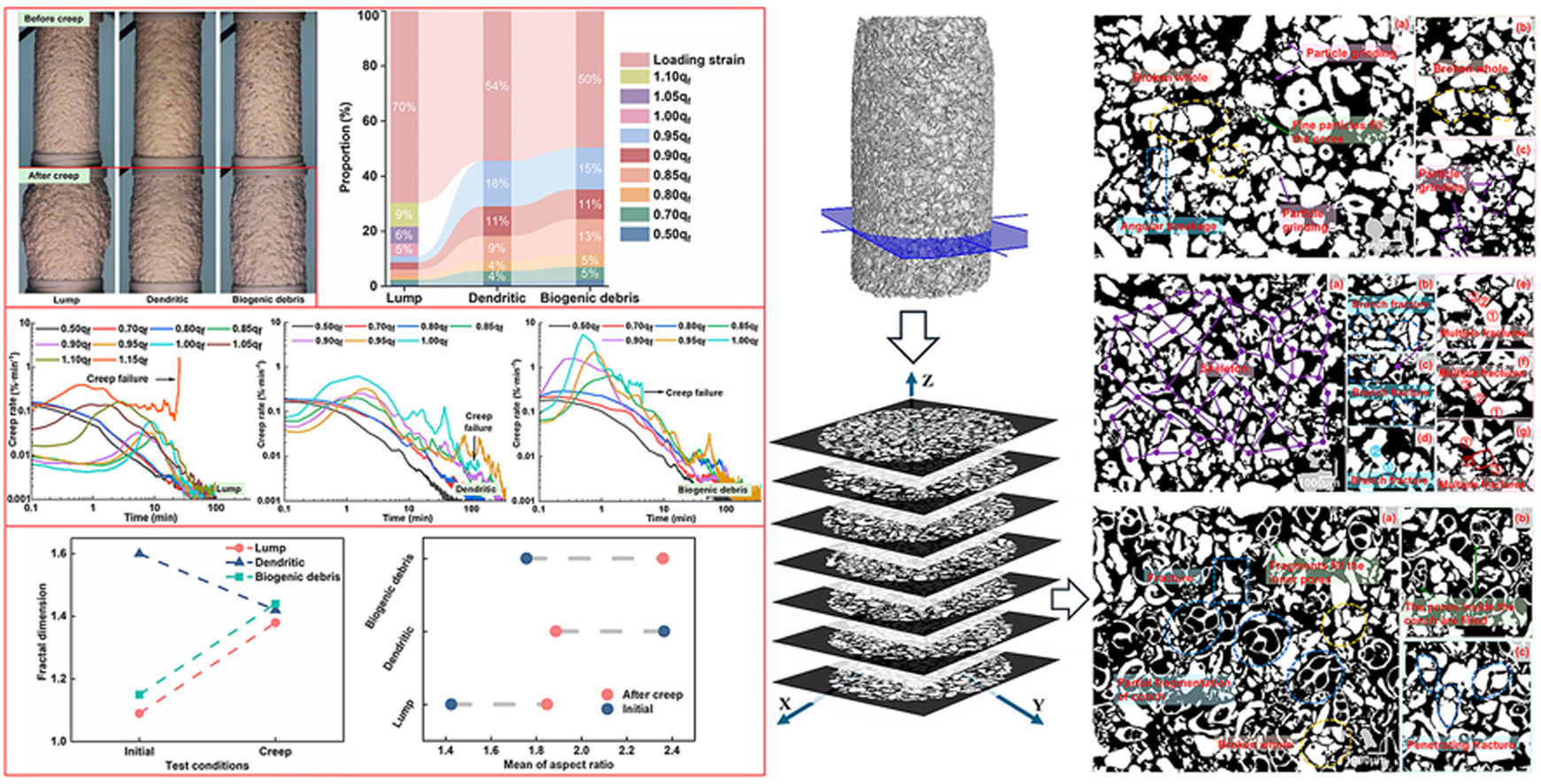
This study investigates the creep characteristics of calcareous sand with three realistic and typical particle shapes (lump, dendritic, and biogenic debris) under different deviatoric stress ratios through multistage loading triaxial creep tests. The particle breakage patterns and creep mechanisms of calcareous sands are revealed based on CT scanning. The results demonstrate that lump-shaped calcareous sand exhibits the smallest axial creep deformation, the longest duration of creep structural effect, and the latest occurrence of creep failure stage, manifesting as volumetric expansion. Dendritic calcareous sand shows intermediate axial creep deformation, significantly shortened creep structural effect duration, and slight volumetric contraction. Biogenic debris calcareous sand presents the largest axial creep deformation, the shortest creep structural effect duration, and considerable volumetric contraction. After creep, lump-shaped calcareous sand displays the least particle breakage, dominated by particle grinding and overall breakage modes; dendritic calcareous sand exhibits intermediate particle breakage, primarily through particle fracture; while biogenic debris calcareous sand suffers the most severe breakage, characterized by penetrating fractures and overall breakage modes. The shape characteristics of all three particle morphologies are significantly affected by creep. After creep, the fractal dimension and mean aspect ratio of both lump-shaped and biogenic debris calcareous sands increase, whereas those of dendritic calcareous sand decrease. Particle shape ultimately determines creep behavior differences by regulating force chain distribution, breakage modes, and breakage degree. This study elucidates the variations and control mechanisms in creep deformation among three particle shapes of calcareous sand, providing theoretical foundations for marine engineering design.
Graphical abstract
Keywords
Calcareous sand; Particle shape; Creep characteristics; Fracture mode; Meso-mechanism
文章导读