
期刊文章
过刊浏览
- Volumes 108-119 (2025)
-
Volumes 96-107 (2025)
-
Volume 107
Pages 1-376 (December 2025)
-
Volume 106
Pages 1-336 (November 2025)
-
Volume 105
Pages 1-356 (October 2025)
-
Volume 104
Pages 1-332 (September 2025)
-
Volume 103
Pages 1-314 (August 2025)
-
Volume 102
Pages 1-276 (July 2025)
-
Volume 101
Pages 1-166 (June 2025)
-
Volume 100
Pages 1-256 (May 2025)
-
Volume 99
Pages 1-242 (April 2025)
-
Volume 98
Pages 1-288 (March 2025)
-
Volume 97
Pages 1-256 (February 2025)
-
Volume 96
Pages 1-340 (January 2025)
-
Volume 107
-
Volumes 84-95 (2024)
-
Volume 95
Pages 1-392 (December 2024)
-
Volume 94
Pages 1-400 (November 2024)
-
Volume 93
Pages 1-376 (October 2024)
-
Volume 92
Pages 1-316 (September 2024)
-
Volume 91
Pages 1-378 (August 2024)
-
Volume 90
Pages 1-580 (July 2024)
-
Volume 89
Pages 1-278 (June 2024)
-
Volume 88
Pages 1-350 (May 2024)
-
Volume 87
Pages 1-338 (April 2024)
-
Volume 86
Pages 1-312 (March 2024)
-
Volume 85
Pages 1-334 (February 2024)
-
Volume 84
Pages 1-308 (January 2024)
-
Volume 95
-
Volumes 72-83 (2023)
-
Volume 83
Pages 1-258 (December 2023)
-
Volume 82
Pages 1-204 (November 2023)
-
Volume 81
Pages 1-188 (October 2023)
-
Volume 80
Pages 1-202 (September 2023)
-
Volume 79
Pages 1-172 (August 2023)
-
Volume 78
Pages 1-146 (July 2023)
-
Volume 77
Pages 1-152 (June 2023)
-
Volume 76
Pages 1-176 (May 2023)
-
Volume 75
Pages 1-228 (April 2023)
-
Volume 74
Pages 1-200 (March 2023)
-
Volume 73
Pages 1-138 (February 2023)
-
Volume 72
Pages 1-144 (January 2023)
-
Volume 83
-
Volumes 60-71 (2022)
-
Volume 71
Pages 1-108 (December 2022)
-
Volume 70
Pages 1-106 (November 2022)
-
Volume 69
Pages 1-122 (October 2022)
-
Volume 68
Pages 1-124 (September 2022)
-
Volume 67
Pages 1-102 (August 2022)
-
Volume 66
Pages 1-112 (July 2022)
-
Volume 65
Pages 1-138 (June 2022)
-
Volume 64
Pages 1-186 (May 2022)
-
Volume 63
Pages 1-124 (April 2022)
-
Volume 62
Pages 1-104 (March 2022)
-
Volume 61
Pages 1-120 (February 2022)
-
Volume 60
Pages 1-124 (January 2022)
-
Volume 71
- Volumes 54-59 (2021)
- Volumes 48-53 (2020)
- Volumes 42-47 (2019)
- Volumes 36-41 (2018)
- Volumes 30-35 (2017)
- Volumes 24-29 (2016)
- Volumes 18-23 (2015)
- Volumes 12-17 (2014)
- Volume 11 (2013)
- Volume 10 (2012)
- Volume 9 (2011)
- Volume 8 (2010)
- Volume 7 (2009)
- Volume 6 (2008)
- Volume 5 (2007)
- Volume 4 (2006)
- Volume 3 (2005)
- Volume 2 (2004)
- Volume 1 (2003)
Volume 108
Wei, R., Liu, Y., Wu, H., Peng, Z., Kang, Y., Xue, Q., & Zuo, H. (2026). Promoting simulation reliability for burden distribution of blast furnace: Parameters measurement and calibration of lump ores. Particuology, 108, 14-24. https://doi.org/10.1016/j.partic.2025.11.009
Promoting simulation reliability for burden distribution of blast furnace: Parameters measurement and calibration of lump ores
Runpei Wei, Yu Liu, Hao Wu, Zile Peng, Yue Kang, Qingguo Xue, Haibin Zuo *
State Key Laboratory of Advanced Metallurgy, University of Science and Technology Beijing, Beijing, 100083, China
10.1016/j.partic.2025.11.009
Volume 108,
January 2026,
Pages 14-24
Received 15 September 2025, Revised 25 October 2025, Accepted 17 November 2025, Available online 20 November 2025, Version of Record 3 December 2025.
E-mail:
zuohaibin@ustb.edu.cn
Highlights
• Physical parameters of lump ore were systematically calibrated for the first time.
• Intrinsic and contact parameters of hematite and limonite were obtained.
• Simplifying the particle model using spherical particles to improve DEM simulation efficiency.
• Experimental methods for testing contact parameters between different particle types were refined.
Abstract
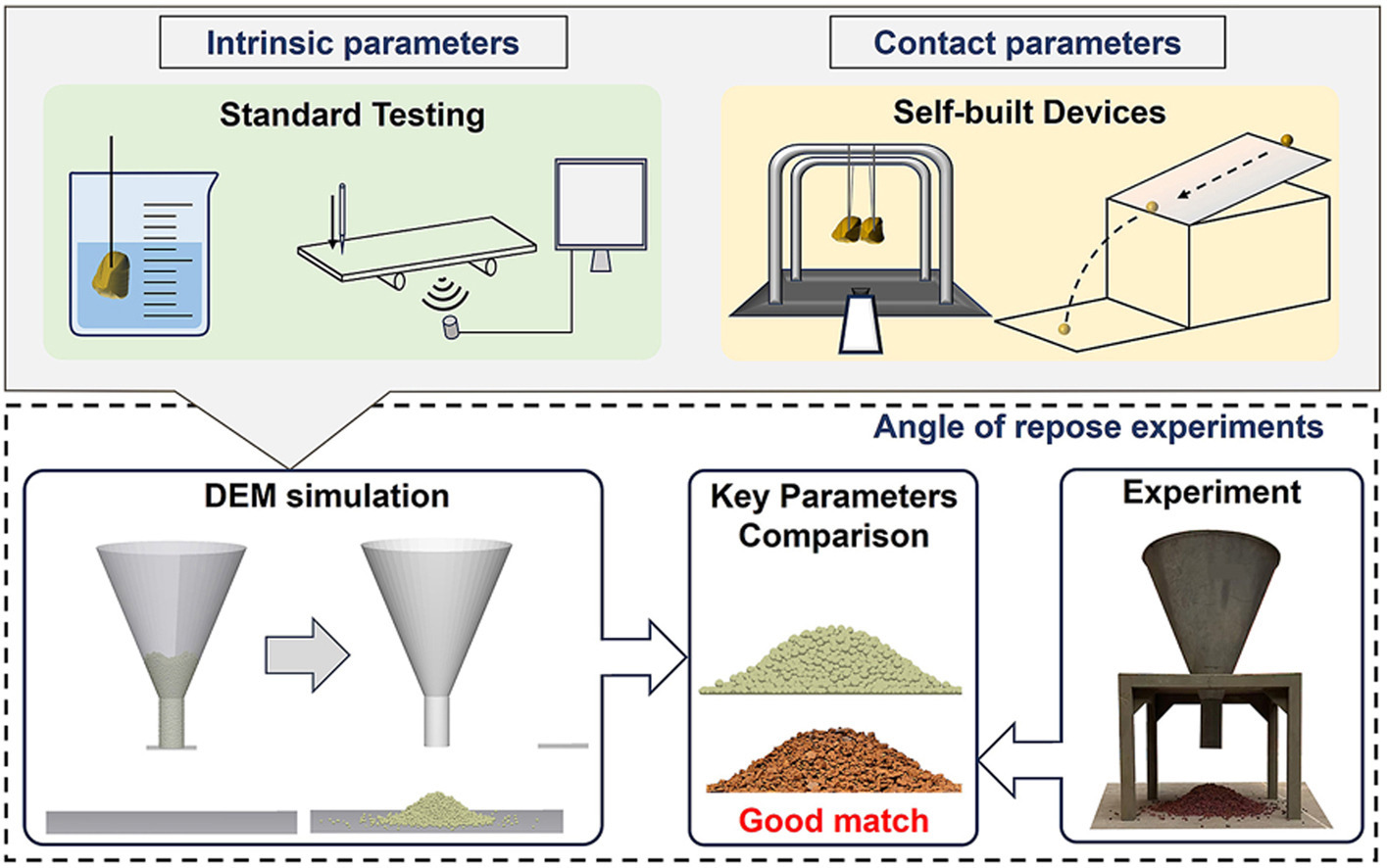
With the increasing proportion of low-carbon burden, represented by lump ores, charged into blast furnaces, the lack of fundamental physical property parameters became a key constraint on in-depth research of burden distribution through numerical simulation. In this study, the intrinsic and contact parameters of lump ores were systematically investigated for the first time. Two typical types, hematite and limonite, which are the most commonly used lump ores in blast furnaces, were selected as the research objects. The intrinsic parameters of the two lump ores, including density, Poisson's ratio, and elastic modulus, were determined according to standard testing methods. Physical experiments were designed to measure contact parameters, through which the coefficients of rolling friction, static friction, and restitution between lump ores, as well as between each ore and steel plate or cement board, were obtained. Parameter calibration was subsequently carried out using discrete element method simulations, ultimately obtaining the representative values for these physical parameters. This study laid the foundation for accurate simulation of lump ore granular motion in ironmaking processes. The methodologies developed or refined in this study have significantly reduced the difficulty of obtaining relevant parameters and avoided the use of data lacking actual physical meaning.
Graphical abstract
Keywords
Lump ore; Discrete element method; CalibrationIntrinsic parameter; Contact parameter
文章导读