
期刊文章
过刊浏览
- Volumes 108-119 (2025)
-
Volumes 96-107 (2025)
-
Volume 107
Pages 1-376 (December 2025)
-
Volume 106
Pages 1-336 (November 2025)
-
Volume 105
Pages 1-356 (October 2025)
-
Volume 104
Pages 1-332 (September 2025)
-
Volume 103
Pages 1-314 (August 2025)
-
Volume 102
Pages 1-276 (July 2025)
-
Volume 101
Pages 1-166 (June 2025)
-
Volume 100
Pages 1-256 (May 2025)
-
Volume 99
Pages 1-242 (April 2025)
-
Volume 98
Pages 1-288 (March 2025)
-
Volume 97
Pages 1-256 (February 2025)
-
Volume 96
Pages 1-340 (January 2025)
-
Volume 107
-
Volumes 84-95 (2024)
-
Volume 95
Pages 1-392 (December 2024)
-
Volume 94
Pages 1-400 (November 2024)
-
Volume 93
Pages 1-376 (October 2024)
-
Volume 92
Pages 1-316 (September 2024)
-
Volume 91
Pages 1-378 (August 2024)
-
Volume 90
Pages 1-580 (July 2024)
-
Volume 89
Pages 1-278 (June 2024)
-
Volume 88
Pages 1-350 (May 2024)
-
Volume 87
Pages 1-338 (April 2024)
-
Volume 86
Pages 1-312 (March 2024)
-
Volume 85
Pages 1-334 (February 2024)
-
Volume 84
Pages 1-308 (January 2024)
-
Volume 95
-
Volumes 72-83 (2023)
-
Volume 83
Pages 1-258 (December 2023)
-
Volume 82
Pages 1-204 (November 2023)
-
Volume 81
Pages 1-188 (October 2023)
-
Volume 80
Pages 1-202 (September 2023)
-
Volume 79
Pages 1-172 (August 2023)
-
Volume 78
Pages 1-146 (July 2023)
-
Volume 77
Pages 1-152 (June 2023)
-
Volume 76
Pages 1-176 (May 2023)
-
Volume 75
Pages 1-228 (April 2023)
-
Volume 74
Pages 1-200 (March 2023)
-
Volume 73
Pages 1-138 (February 2023)
-
Volume 72
Pages 1-144 (January 2023)
-
Volume 83
-
Volumes 60-71 (2022)
-
Volume 71
Pages 1-108 (December 2022)
-
Volume 70
Pages 1-106 (November 2022)
-
Volume 69
Pages 1-122 (October 2022)
-
Volume 68
Pages 1-124 (September 2022)
-
Volume 67
Pages 1-102 (August 2022)
-
Volume 66
Pages 1-112 (July 2022)
-
Volume 65
Pages 1-138 (June 2022)
-
Volume 64
Pages 1-186 (May 2022)
-
Volume 63
Pages 1-124 (April 2022)
-
Volume 62
Pages 1-104 (March 2022)
-
Volume 61
Pages 1-120 (February 2022)
-
Volume 60
Pages 1-124 (January 2022)
-
Volume 71
- Volumes 54-59 (2021)
- Volumes 48-53 (2020)
- Volumes 42-47 (2019)
- Volumes 36-41 (2018)
- Volumes 30-35 (2017)
- Volumes 24-29 (2016)
- Volumes 18-23 (2015)
- Volumes 12-17 (2014)
- Volume 11 (2013)
- Volume 10 (2012)
- Volume 9 (2011)
- Volume 8 (2010)
- Volume 7 (2009)
- Volume 6 (2008)
- Volume 5 (2007)
- Volume 4 (2006)
- Volume 3 (2005)
- Volume 2 (2004)
- Volume 1 (2003)
Volume 108
Gao, C., Zhang, X., Wang, P., Li, Y., Chu, D., Bai, W., & He, Y. (2026). Mechanistic analysis of drag force model for carbon nanotube fluidized bed based on CFD-DEM with multiscale analysis. Particuology, 108, 25-40. https://doi.org/10.1016/j.partic.2025.11.011
Mechanistic analysis of drag force model for carbon nanotube fluidized bed based on CFD-DEM with multiscale analysis
Chenyu Gao a, Xijun Zhang a, Peng Wang a c, Yan Li c, Dianming Chu a d *, Wenjuan Bai a d *, Yan He a b *
a Shandong Engineering Laboratory for Preparation and Application of High-performance Carbon-Materials, College of Electromechanical Engineering, Qingdao University of Science and Technology, Qingdao, 266061, China
b Shandong Provincial Key Laboratory of Advanced Energy Storage Technology, Qingdao University, Qingdao, 266071, China
c Shandong Dazhan Nano Materials Co., Ltd, Binzhou, 256220, China
d Shandong Province Key Laboratory of Rubber-Based High-Performance Composites and Advanced Manufacturing, Jining, 272100, China
10.1016/j.partic.2025.11.011
Volume 108,
January 2026,
Pages 25-40
Received 4 September 2025, Revised 4 November 2025, Accepted 15 November 2025, Available online 26 November 2025, Version of Record 3 December 2025.
E-mail:
chudianming@qust.edu.cn; bwj@qust.edu.cn; heyan@qust.edu.cn
Highlights
• CFD-DEM-multiscale framework deciphers drag in agglomerative CNTs fluidization.
• Gidaspow model best describes dense-dilute phase dynamics in CNTs fluidized bed.
• System-averaged particle energy nonlinearly modulates reactor-scale fluidization uniformity.
Abstract
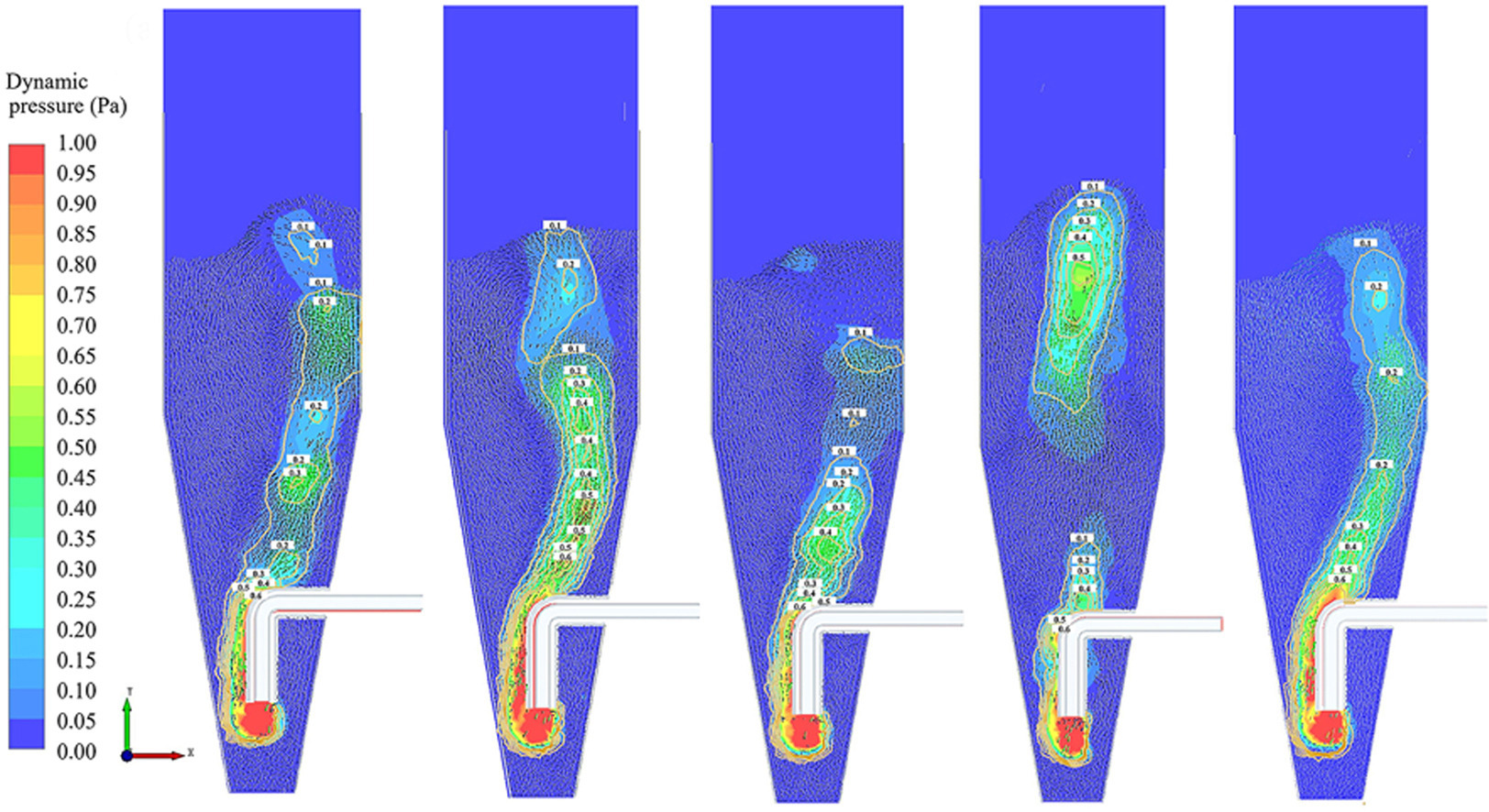
This study investigates the fluidization of aggregative carbon nanotubes (CNTs) by integrating the computational fluid dynamics-discrete element method (CFD-DEM) with a novel multiscale analysis framework. Systematic comparisons with high-speed imaging experiments reveal that Gidaspow model's piecewise formulation delivers optimal simulation performance in the dense-dilute transition zone, but it overestimates the stable fluidization pressure drop by 19.7 % due to the Ergun equation's overprediction of viscous dissipation. Furthermore, multiscale analysis demonstrates that system-averaged particle energy (kinetic, gravitational potential, and rotational energy) nonlinearly modulates reactor-scale fluidization uniformity (R2=0.6901–0.8570). This paper elucidates the underlying mechanisms behind the discrepancies in simulation results among various traditional drag models, thereby providing mechanistic insights and data-driven guidance for model selection in laboratory-scale simulations of particle fluidization.
Graphical abstract
Keywords
Numerical simulation; Interphase drag force; Multiscale analysis; CNTs; Fluidized bed
文章导读