
期刊文章
过刊浏览
- Volumes 108-119 (2025)
-
Volumes 96-107 (2025)
-
Volume 107
Pages 1-376 (December 2025)
-
Volume 106
Pages 1-336 (November 2025)
-
Volume 105
Pages 1-356 (October 2025)
-
Volume 104
Pages 1-332 (September 2025)
-
Volume 103
Pages 1-314 (August 2025)
-
Volume 102
Pages 1-276 (July 2025)
-
Volume 101
Pages 1-166 (June 2025)
-
Volume 100
Pages 1-256 (May 2025)
-
Volume 99
Pages 1-242 (April 2025)
-
Volume 98
Pages 1-288 (March 2025)
-
Volume 97
Pages 1-256 (February 2025)
-
Volume 96
Pages 1-340 (January 2025)
-
Volume 107
-
Volumes 84-95 (2024)
-
Volume 95
Pages 1-392 (December 2024)
-
Volume 94
Pages 1-400 (November 2024)
-
Volume 93
Pages 1-376 (October 2024)
-
Volume 92
Pages 1-316 (September 2024)
-
Volume 91
Pages 1-378 (August 2024)
-
Volume 90
Pages 1-580 (July 2024)
-
Volume 89
Pages 1-278 (June 2024)
-
Volume 88
Pages 1-350 (May 2024)
-
Volume 87
Pages 1-338 (April 2024)
-
Volume 86
Pages 1-312 (March 2024)
-
Volume 85
Pages 1-334 (February 2024)
-
Volume 84
Pages 1-308 (January 2024)
-
Volume 95
-
Volumes 72-83 (2023)
-
Volume 83
Pages 1-258 (December 2023)
-
Volume 82
Pages 1-204 (November 2023)
-
Volume 81
Pages 1-188 (October 2023)
-
Volume 80
Pages 1-202 (September 2023)
-
Volume 79
Pages 1-172 (August 2023)
-
Volume 78
Pages 1-146 (July 2023)
-
Volume 77
Pages 1-152 (June 2023)
-
Volume 76
Pages 1-176 (May 2023)
-
Volume 75
Pages 1-228 (April 2023)
-
Volume 74
Pages 1-200 (March 2023)
-
Volume 73
Pages 1-138 (February 2023)
-
Volume 72
Pages 1-144 (January 2023)
-
Volume 83
-
Volumes 60-71 (2022)
-
Volume 71
Pages 1-108 (December 2022)
-
Volume 70
Pages 1-106 (November 2022)
-
Volume 69
Pages 1-122 (October 2022)
-
Volume 68
Pages 1-124 (September 2022)
-
Volume 67
Pages 1-102 (August 2022)
-
Volume 66
Pages 1-112 (July 2022)
-
Volume 65
Pages 1-138 (June 2022)
-
Volume 64
Pages 1-186 (May 2022)
-
Volume 63
Pages 1-124 (April 2022)
-
Volume 62
Pages 1-104 (March 2022)
-
Volume 61
Pages 1-120 (February 2022)
-
Volume 60
Pages 1-124 (January 2022)
-
Volume 71
- Volumes 54-59 (2021)
- Volumes 48-53 (2020)
- Volumes 42-47 (2019)
- Volumes 36-41 (2018)
- Volumes 30-35 (2017)
- Volumes 24-29 (2016)
- Volumes 18-23 (2015)
- Volumes 12-17 (2014)
- Volume 11 (2013)
- Volume 10 (2012)
- Volume 9 (2011)
- Volume 8 (2010)
- Volume 7 (2009)
- Volume 6 (2008)
- Volume 5 (2007)
- Volume 4 (2006)
- Volume 3 (2005)
- Volume 2 (2004)
- Volume 1 (2003)
Volume 108
Deng, C., Mao, Y., He, T., Dong, L., Shen, P., & Liu, D. (2026). A review of classical theories and characterization techniques for the mineral particle wettability in flotation process. Particuology, 108, 54-67. https://doi.org/10.1016/j.partic.2025.11.005
A review of classical theories and characterization techniques for the mineral particle wettability in flotation process
Chengping Deng a, Yuqiang Mao a b *, Teng He a, Liuyang Dong a, Peilun Shen a, Dianwen Liu a c *
a State Key Laboratory of Complex Nonferrous Metal Resources Clean Utilization, Yunnan Key Laboratory of Green Separation and Enrichment of Strategic Mineral Resources, Faculty of Land Resources Engineering, Kunming University of Science and Technology, Kunming, 650093, China
b Key Laboratory of Coal Processing and Efficient Utilization, Ministry of Education, School of Chemical Engineering and Technology, China University of Mining and Technology, Xuzhou, 221116, China
c Southwest United Graduate School, Kunming, 650092, China
10.1016/j.partic.2025.11.005
Volume 108,
January 2026,
Pages 54-67
Received 8 October 2025, Revised 1 November 2025, Accepted 6 November 2025, Available online 15 November 2025, Version of Record 3 December 2025.
E-mail:
cumtmyq@163.com; dianwenliu1@kust.edu.cn
Highlights
• Application boundaries of Young, Wenzel, and Cassie-Baxter models were different.
• Traditional and novel methods characterizing surface wettability were reviewed.
• Contact angle has issue like hysteresis and pinning during wettability measurement.
• In-depth study on mineral heterogeneous surface will improve wettability theory.
• AFM and molecular dynamics simulations (MDS) will help study mineral wettability.
Abstract
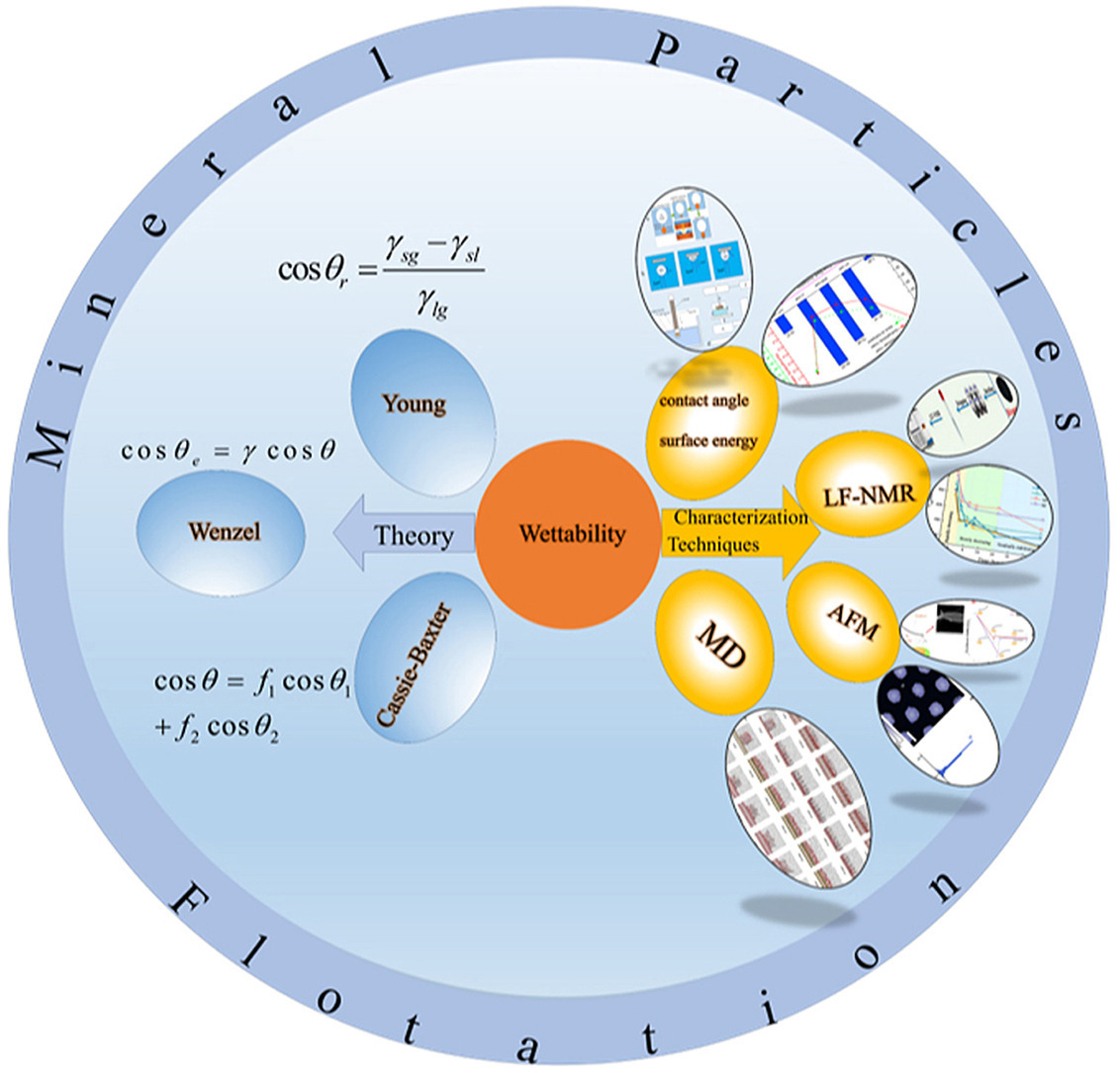
Surface wettability of mineral particles is the key interface characteristic to control the flotation separation process. This work systematically summarized the classic theories and characterization techniques of wettability commonly used in the mineral flotation process. The Young's equation, Wenzel and Cassie-Baxter models were separately applied in interpreting the wetting behaviors of droplets on smooth under ideal conditions, rough and heterogeneous surfaces of mineral particles. Meanwhile, some novel analytical techniques of wettability, such as surface energy, low-field nuclear magnetic resonance (LF-NMR), molecular dynamics simulations (MDS), etc., have been gradually developed and adopted. The shortcomings in surface wettability research for mineral flotation were reviewed, such as contact angle hysteresis, pinning effects, and the difficulty in characterizing dynamic wetting processes on complex heterogeneous mineral surfaces. Future research should integrate traditional and novel characterization methods to overcome challenges in heterogeneous wetting on complex mineral surfaces. This review is crucial for deeply understanding the mineral surface wettability and further improving the flotation separation efficiency of mineral particles.
Graphical abstract
Keywords
Mineral particles; Wettability; Flotation; Theories; Characterization techniques
文章导读