
期刊文章
过刊浏览
- Volumes 108-119 (2025)
-
Volumes 96-107 (2025)
-
Volume 107
Pages 1-376 (December 2025)
-
Volume 106
Pages 1-336 (November 2025)
-
Volume 105
Pages 1-356 (October 2025)
-
Volume 104
Pages 1-332 (September 2025)
-
Volume 103
Pages 1-314 (August 2025)
-
Volume 102
Pages 1-276 (July 2025)
-
Volume 101
Pages 1-166 (June 2025)
-
Volume 100
Pages 1-256 (May 2025)
-
Volume 99
Pages 1-242 (April 2025)
-
Volume 98
Pages 1-288 (March 2025)
-
Volume 97
Pages 1-256 (February 2025)
-
Volume 96
Pages 1-340 (January 2025)
-
Volume 107
-
Volumes 84-95 (2024)
-
Volume 95
Pages 1-392 (December 2024)
-
Volume 94
Pages 1-400 (November 2024)
-
Volume 93
Pages 1-376 (October 2024)
-
Volume 92
Pages 1-316 (September 2024)
-
Volume 91
Pages 1-378 (August 2024)
-
Volume 90
Pages 1-580 (July 2024)
-
Volume 89
Pages 1-278 (June 2024)
-
Volume 88
Pages 1-350 (May 2024)
-
Volume 87
Pages 1-338 (April 2024)
-
Volume 86
Pages 1-312 (March 2024)
-
Volume 85
Pages 1-334 (February 2024)
-
Volume 84
Pages 1-308 (January 2024)
-
Volume 95
-
Volumes 72-83 (2023)
-
Volume 83
Pages 1-258 (December 2023)
-
Volume 82
Pages 1-204 (November 2023)
-
Volume 81
Pages 1-188 (October 2023)
-
Volume 80
Pages 1-202 (September 2023)
-
Volume 79
Pages 1-172 (August 2023)
-
Volume 78
Pages 1-146 (July 2023)
-
Volume 77
Pages 1-152 (June 2023)
-
Volume 76
Pages 1-176 (May 2023)
-
Volume 75
Pages 1-228 (April 2023)
-
Volume 74
Pages 1-200 (March 2023)
-
Volume 73
Pages 1-138 (February 2023)
-
Volume 72
Pages 1-144 (January 2023)
-
Volume 83
-
Volumes 60-71 (2022)
-
Volume 71
Pages 1-108 (December 2022)
-
Volume 70
Pages 1-106 (November 2022)
-
Volume 69
Pages 1-122 (October 2022)
-
Volume 68
Pages 1-124 (September 2022)
-
Volume 67
Pages 1-102 (August 2022)
-
Volume 66
Pages 1-112 (July 2022)
-
Volume 65
Pages 1-138 (June 2022)
-
Volume 64
Pages 1-186 (May 2022)
-
Volume 63
Pages 1-124 (April 2022)
-
Volume 62
Pages 1-104 (March 2022)
-
Volume 61
Pages 1-120 (February 2022)
-
Volume 60
Pages 1-124 (January 2022)
-
Volume 71
- Volumes 54-59 (2021)
- Volumes 48-53 (2020)
- Volumes 42-47 (2019)
- Volumes 36-41 (2018)
- Volumes 30-35 (2017)
- Volumes 24-29 (2016)
- Volumes 18-23 (2015)
- Volumes 12-17 (2014)
- Volume 11 (2013)
- Volume 10 (2012)
- Volume 9 (2011)
- Volume 8 (2010)
- Volume 7 (2009)
- Volume 6 (2008)
- Volume 5 (2007)
- Volume 4 (2006)
- Volume 3 (2005)
- Volume 2 (2004)
- Volume 1 (2003)
Volume 108
Gong, Y., Zhao, B., Zhao, W., Wang, X., Guo, Q., Wang, Y., . . . Yu, G. (2026). Numerical simulation on the reaction characteristics of a coal-water slurry particle during entrained-flow gasification process. Particuology, 108, 68-82. https://doi.org/10.1016/j.partic.2025.11.012
Numerical simulation on the reaction characteristics of a coal-water slurry particle during entrained-flow gasification process
Yan Gong a *, Bo Zhao a, Wenjing Zhao a, Xuning Wang a, Qinghua Guo a, Yifei Wang a, Jin Bai b, Guangsuo Yu a c
a Institute of Clean Coal Technology, East China University of Science and Technology, Shanghai, 200237, China
b State Key Laboratory of Coal Conversion, Institute of Coal Chemistry, Chinese Academy of Sciences, Taiyuan, 030001, China
c State Key Laboratory of High-efficiency Utilization of Coal and Green Chemical Engineering, Ningxia University, Yinchuan, 750021, China
10.1016/j.partic.2025.11.012
Volume 108,
January 2026,
Pages 68-82
Received 27 August 2025, Revised 1 November 2025, Accepted 17 November 2025, Available online 26 November 2025, Version of Record 3 December 2025.
E-mail:
yangong@ecust.edu.cn
Highlights
• A multi-scale simulation framework for decoupling the CWS particle is established.
• CWS particle model is refined and features differentiated interaction design.
• Key dynamic laws and coupling effects of CWS particle reactions are proposed.
• Influence of H2O content on the reaction of CWS particle is related to O2.
• Structure of single particle exerts weaker influence than inter-particle effects.
Abstract
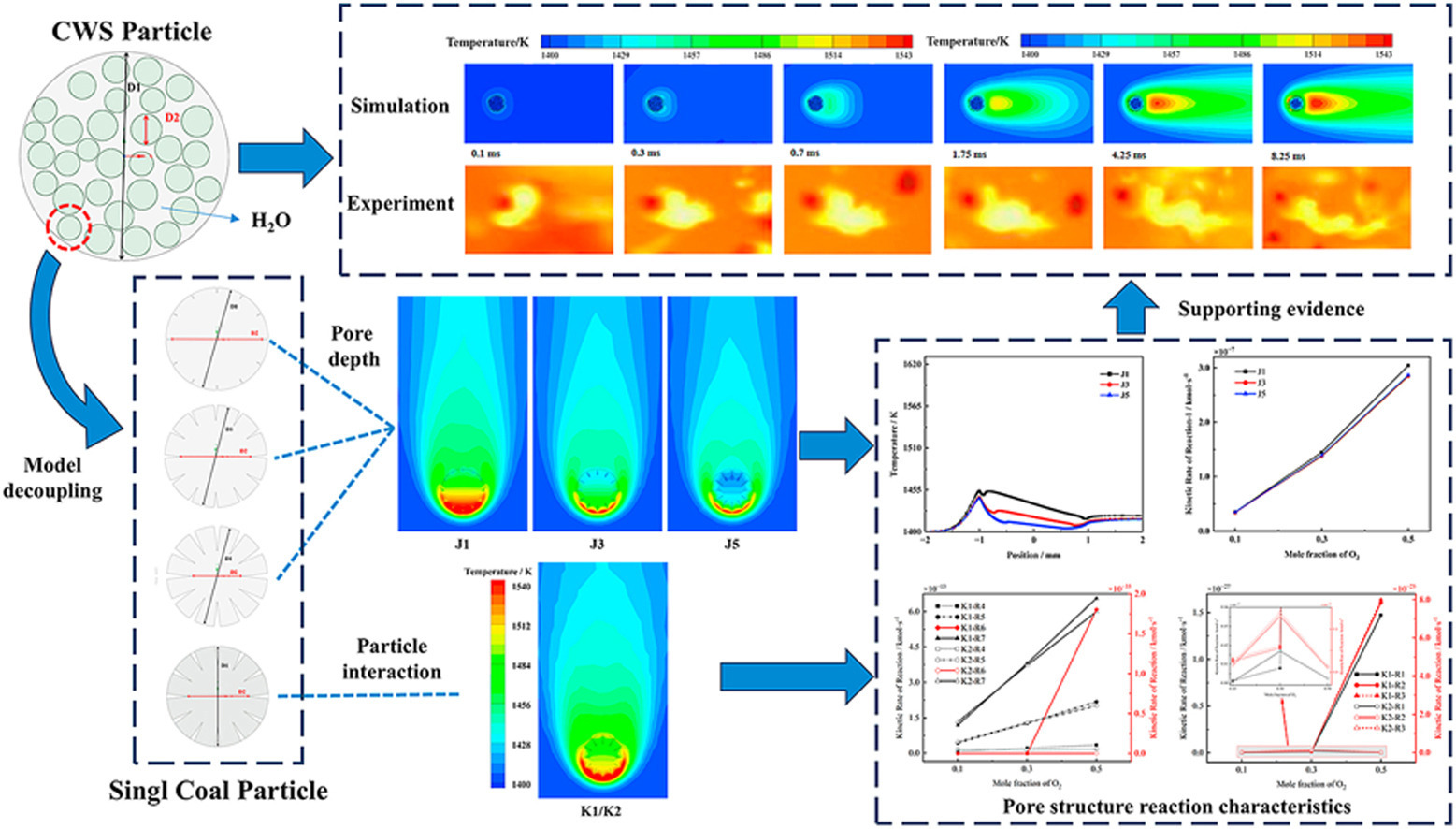
Gasification technology serves as the cornerstone of the modern coal chemical industry. High-temperature particles in entrained-flow gasifiers act as the primary reaction medium, whose reactivity is inherently dependent on particle size, porosity, and local reaction environment. Current experimental investigations on particles within gasifiers predominantly rely on visualization systems, yet face significant challenges in precise particle tracking and quantitative analysis, particularly in diagnosing volatile release processes. This study employed computational fluid dynamics (CFD) numerical simulations to develop a multiphase model to isolate single particle behavior from bulk particle group during coupled combustion-gasification process of coal-water slurry (CWS). Discrete coal particle models with varying configurations were developed to compare reaction characteristics between isolated and interacting particles, while analyzing temperature fields and reaction rate distributions across three porosity levels. Verification demonstrated that the implemented models effectively described the reaction characteristics of coal particles. Results reveal strong correlation between the temperature field distribution and the volatile molar fraction in CWS particle, with H2, H2O, and CO accumulation observed at particle cores. Coupling effects of heat and mass transfer between particles significantly influence reaction rates and thermal profiles, governed by the particle spacing and heat/mass transfer efficiency, whereas the effects of porosity remain relatively minor.
Graphical abstract
Keywords
Coal gasification; Numerical simulation; Coal-water slurry particles; Single particle model; Particle reaction characteristics
文章导读