
期刊文章
过刊浏览
- Volumes 108-119 (2025)
-
Volumes 96-107 (2025)
-
Volume 107
Pages 1-376 (December 2025)
-
Volume 106
Pages 1-336 (November 2025)
-
Volume 105
Pages 1-356 (October 2025)
-
Volume 104
Pages 1-332 (September 2025)
-
Volume 103
Pages 1-314 (August 2025)
-
Volume 102
Pages 1-276 (July 2025)
-
Volume 101
Pages 1-166 (June 2025)
-
Volume 100
Pages 1-256 (May 2025)
-
Volume 99
Pages 1-242 (April 2025)
-
Volume 98
Pages 1-288 (March 2025)
-
Volume 97
Pages 1-256 (February 2025)
-
Volume 96
Pages 1-340 (January 2025)
-
Volume 107
-
Volumes 84-95 (2024)
-
Volume 95
Pages 1-392 (December 2024)
-
Volume 94
Pages 1-400 (November 2024)
-
Volume 93
Pages 1-376 (October 2024)
-
Volume 92
Pages 1-316 (September 2024)
-
Volume 91
Pages 1-378 (August 2024)
-
Volume 90
Pages 1-580 (July 2024)
-
Volume 89
Pages 1-278 (June 2024)
-
Volume 88
Pages 1-350 (May 2024)
-
Volume 87
Pages 1-338 (April 2024)
-
Volume 86
Pages 1-312 (March 2024)
-
Volume 85
Pages 1-334 (February 2024)
-
Volume 84
Pages 1-308 (January 2024)
-
Volume 95
-
Volumes 72-83 (2023)
-
Volume 83
Pages 1-258 (December 2023)
-
Volume 82
Pages 1-204 (November 2023)
-
Volume 81
Pages 1-188 (October 2023)
-
Volume 80
Pages 1-202 (September 2023)
-
Volume 79
Pages 1-172 (August 2023)
-
Volume 78
Pages 1-146 (July 2023)
-
Volume 77
Pages 1-152 (June 2023)
-
Volume 76
Pages 1-176 (May 2023)
-
Volume 75
Pages 1-228 (April 2023)
-
Volume 74
Pages 1-200 (March 2023)
-
Volume 73
Pages 1-138 (February 2023)
-
Volume 72
Pages 1-144 (January 2023)
-
Volume 83
-
Volumes 60-71 (2022)
-
Volume 71
Pages 1-108 (December 2022)
-
Volume 70
Pages 1-106 (November 2022)
-
Volume 69
Pages 1-122 (October 2022)
-
Volume 68
Pages 1-124 (September 2022)
-
Volume 67
Pages 1-102 (August 2022)
-
Volume 66
Pages 1-112 (July 2022)
-
Volume 65
Pages 1-138 (June 2022)
-
Volume 64
Pages 1-186 (May 2022)
-
Volume 63
Pages 1-124 (April 2022)
-
Volume 62
Pages 1-104 (March 2022)
-
Volume 61
Pages 1-120 (February 2022)
-
Volume 60
Pages 1-124 (January 2022)
-
Volume 71
- Volumes 54-59 (2021)
- Volumes 48-53 (2020)
- Volumes 42-47 (2019)
- Volumes 36-41 (2018)
- Volumes 30-35 (2017)
- Volumes 24-29 (2016)
- Volumes 18-23 (2015)
- Volumes 12-17 (2014)
- Volume 11 (2013)
- Volume 10 (2012)
- Volume 9 (2011)
- Volume 8 (2010)
- Volume 7 (2009)
- Volume 6 (2008)
- Volume 5 (2007)
- Volume 4 (2006)
- Volume 3 (2005)
- Volume 2 (2004)
- Volume 1 (2003)
Volume 108
Bergold, T., Illana-Mahiques, E., & Scherer, V. (2026). Tabulation applied to thermal conduction within complex particle geometries in the Discrete Element Method. Particuology, 108, 83-98. https://doi.org/10.1016/j.partic.2025.11.002
Tabulation applied to thermal conduction within complex particle geometries in the Discrete Element Method (Open Access)
Torben Bergold *, Enric Illana-Mahiques, Viktor Scherer
Institute of Energy Plant Technology, Ruhr University Bochum, Bochum, Germany
10.1016/j.partic.2025.11.002
Volume 108,
January 2026,
Pages 83-98
Received 20 August 2025, Revised 3 November 2025, Accepted 5 November 2025, Available online 13 November 2025, Version of Record 3 December 2025.
E-mail:
bergold@leat.rub.de
Highlights
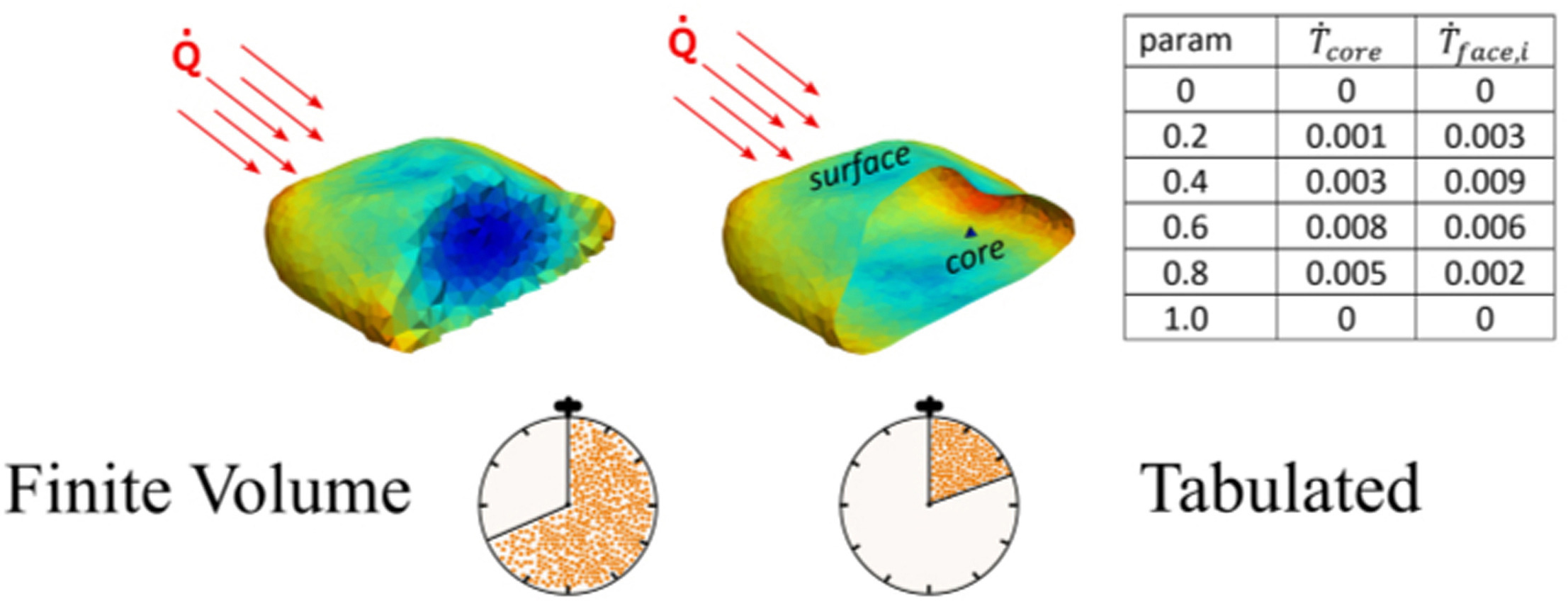
• Development of a tabulation-based method for intraparticle heat conduction in thermally thick polyhedral particles.
• Tabulation approach tested for different material properties; accuracy improves with higher particle thermal conductivity.
• Influence of particle shape is predicted by the model; no clear trend observed within the studied sphericity range.
• Achieved up to 5,900x faster calculation time for particle temperature prediction, with a maximum deviation of 1.2 %.
Abstract
Intraparticle models are crucial in the Discrete Element Method when particles are thermally thick. Accurately solving the intraparticle conservation equations using the finite volume method requires high spatial and temporal resolution, which significantly increases computational cost. This study presents a model that relies on tabulation to describe intraparticle heat conduction inside complex-shaped particles. This cost-effective method replaces the computationally expensive finite volume method without compromising the accuracy. The method has been applied to different particle shapes: a cylinder with two different aspect ratios, a cube, a square thin plate, a sphere and an irregular shape. Materials with very different thermal conductivities — glass, limestone, and wood — have also been examined. For wood particles, anisotropic heat conduction is considered as wood possesses directional thermal properties. The particles exchange heat with the surrounding gas by convection, where the gas-phase temperature varies over time between 350 K and 950 K as a superposition of four harmonic functions with different frequencies. The response of the particle surface temperature, core temperature, and internal temperature distributions is compared with results obtained from the finite volume method. The tabulated model accurately reproduced the temperatures of the finite volume method, with maximum root-mean-square deviations of 10 K. A speed-up factor of at least 100 was achieved using the tabulation method compared to the finite volume method, increasing further with higher mesh resolution.
Graphical abstract
Keywords
Polyhedra; Heat conduction; Heat transfer; Tabulation; Intraparticle; DEM
文章导读