
期刊文章
过刊浏览
- Volumes 108-119 (2025)
-
Volumes 96-107 (2025)
-
Volume 107
Pages 1-376 (December 2025)
-
Volume 106
Pages 1-336 (November 2025)
-
Volume 105
Pages 1-356 (October 2025)
-
Volume 104
Pages 1-332 (September 2025)
-
Volume 103
Pages 1-314 (August 2025)
-
Volume 102
Pages 1-276 (July 2025)
-
Volume 101
Pages 1-166 (June 2025)
-
Volume 100
Pages 1-256 (May 2025)
-
Volume 99
Pages 1-242 (April 2025)
-
Volume 98
Pages 1-288 (March 2025)
-
Volume 97
Pages 1-256 (February 2025)
-
Volume 96
Pages 1-340 (January 2025)
-
Volume 107
-
Volumes 84-95 (2024)
-
Volume 95
Pages 1-392 (December 2024)
-
Volume 94
Pages 1-400 (November 2024)
-
Volume 93
Pages 1-376 (October 2024)
-
Volume 92
Pages 1-316 (September 2024)
-
Volume 91
Pages 1-378 (August 2024)
-
Volume 90
Pages 1-580 (July 2024)
-
Volume 89
Pages 1-278 (June 2024)
-
Volume 88
Pages 1-350 (May 2024)
-
Volume 87
Pages 1-338 (April 2024)
-
Volume 86
Pages 1-312 (March 2024)
-
Volume 85
Pages 1-334 (February 2024)
-
Volume 84
Pages 1-308 (January 2024)
-
Volume 95
-
Volumes 72-83 (2023)
-
Volume 83
Pages 1-258 (December 2023)
-
Volume 82
Pages 1-204 (November 2023)
-
Volume 81
Pages 1-188 (October 2023)
-
Volume 80
Pages 1-202 (September 2023)
-
Volume 79
Pages 1-172 (August 2023)
-
Volume 78
Pages 1-146 (July 2023)
-
Volume 77
Pages 1-152 (June 2023)
-
Volume 76
Pages 1-176 (May 2023)
-
Volume 75
Pages 1-228 (April 2023)
-
Volume 74
Pages 1-200 (March 2023)
-
Volume 73
Pages 1-138 (February 2023)
-
Volume 72
Pages 1-144 (January 2023)
-
Volume 83
-
Volumes 60-71 (2022)
-
Volume 71
Pages 1-108 (December 2022)
-
Volume 70
Pages 1-106 (November 2022)
-
Volume 69
Pages 1-122 (October 2022)
-
Volume 68
Pages 1-124 (September 2022)
-
Volume 67
Pages 1-102 (August 2022)
-
Volume 66
Pages 1-112 (July 2022)
-
Volume 65
Pages 1-138 (June 2022)
-
Volume 64
Pages 1-186 (May 2022)
-
Volume 63
Pages 1-124 (April 2022)
-
Volume 62
Pages 1-104 (March 2022)
-
Volume 61
Pages 1-120 (February 2022)
-
Volume 60
Pages 1-124 (January 2022)
-
Volume 71
- Volumes 54-59 (2021)
- Volumes 48-53 (2020)
- Volumes 42-47 (2019)
- Volumes 36-41 (2018)
- Volumes 30-35 (2017)
- Volumes 24-29 (2016)
- Volumes 18-23 (2015)
- Volumes 12-17 (2014)
- Volume 11 (2013)
- Volume 10 (2012)
- Volume 9 (2011)
- Volume 8 (2010)
- Volume 7 (2009)
- Volume 6 (2008)
- Volume 5 (2007)
- Volume 4 (2006)
- Volume 3 (2005)
- Volume 2 (2004)
- Volume 1 (2003)
Volume 108
Adnan, M., Kampeewichean, C., Tanprasert, S., Korkerd, K., Piumsomboon, P., Tipratchadaporn, S., . . . Piemjaiswang, R. (2026). CFD modeling of particle deposition in human airways: Effect of inhalation rate, body temperature, and relative humidity. Particuology, 108, 99-112. https://doi.org/10.1016/j.partic.2025.11.001
CFD modeling of particle deposition in human airways: Effect of inhalation rate, body temperature, and relative humidity
Muhammad Adnan a b 1, Chanida Kampeewichean a 1, Sorathan Tanprasert a 1, Krittin Korkerd c, Pornpote Piumsomboon a, Sasipong Tipratchadaporn d, Benjapon Chalermsinsuwan a *, Ratchanon Piemjaiswang e *
a Fuels Research Center, Department of Chemical Technology, Faculty of Science, Chulalongkorn University, 254 Phayathai Road, Wangmai, Pathumwan, Bangkok, 10330, Thailand
b School of Chemical and Materials Engineering, National University of Sciences and Technology, Islamabad, 44000, Pakistan
c Department of Chemical Engineering, Faculty of Engineering, King Mongkut's University of Technology Thonburi, Bangkok, 10140, Thailand
d Faculty of Public Health, Chalermphrakiat Sakon Nakhon Province Campus, Kasetsart University, Chiang Khruea Sub-District, Mueang District, Sakon Nakhon, 47000, Thailand
e Sustainable Environment Research Institute, Chulalongkorn University, Institute Building 2, 254 Phayathai Road, Wangmai, Pathumwan, Bangkok, 10330, Thailand
10.1016/j.partic.2025.11.001
Volume 108,
January 2026,
Pages 99-112
Received 10 September 2025, Revised 19 October 2025, Accepted 2 November 2025, Available online 12 November 2025, Version of Record 3 December 2025.
E-mail:
benjapon.c@chula.ac.th; ratchanon.p@chula.ac.th
Highlights
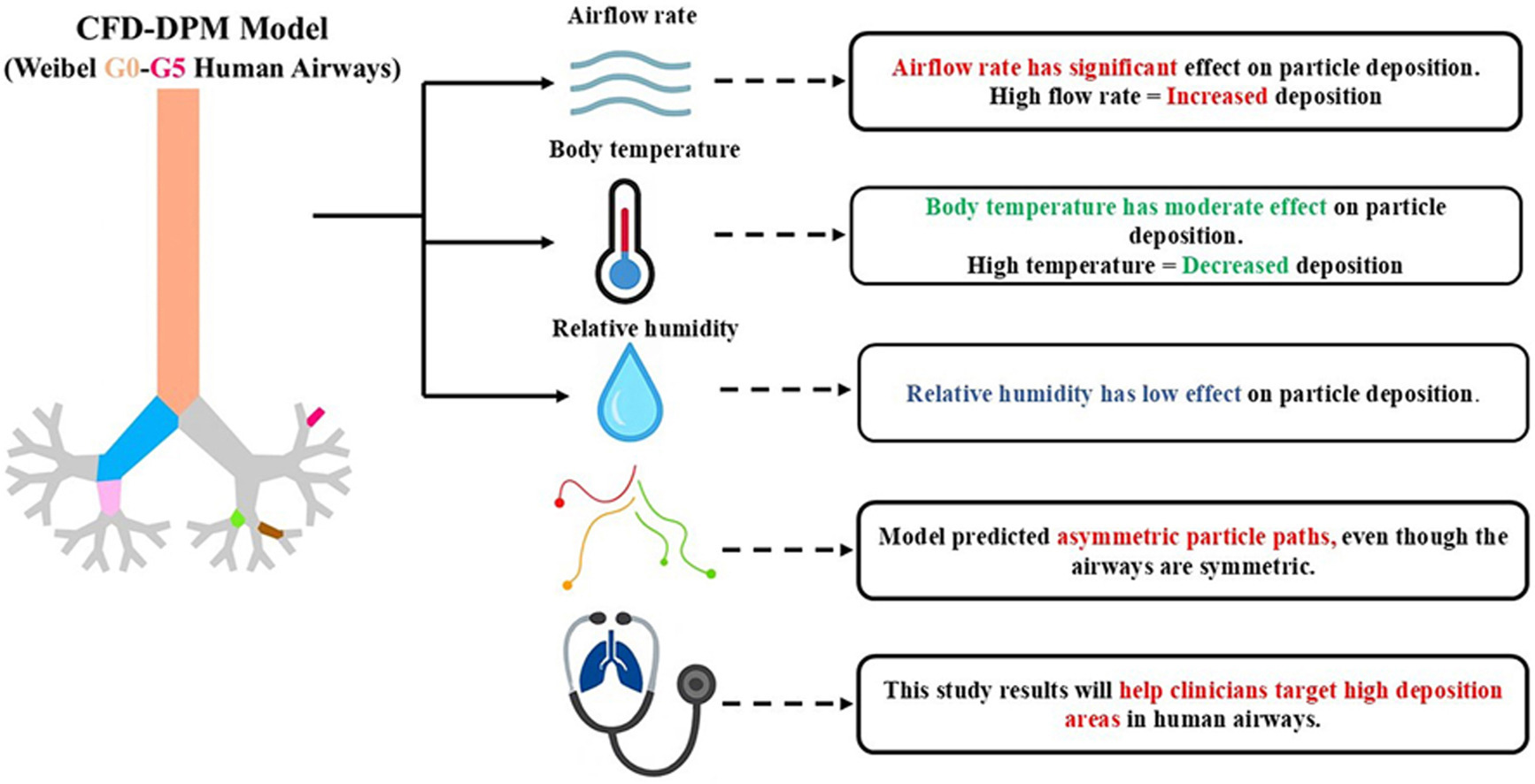
• CFD-DPM applied for studying particle deposition in Weibel’s (G0-G5) human airways.
• Airflow rate, temperature, and relative humidity effects on deposition were studied.
• Particle escape and deposition mainly governed by airflow rate and temperature.
• Higher airflow rate increased deposition, while higher temperature reduced it.
• Model predicted asymmetric paths, helping clinicians target high deposition areas.
Abstract
This study examines local particle deposition in an idealized Weibel tracheobronchial model up to six generations (G0–G6). The Discrete Phase Model (DPM) was employed to simulate airflow and particle motion. This study aimed to explore the combined effects of transient airflow patterns and environmental conditions (body temperature and relative humidity). These environmental factors can alter airflow properties, which in turn affect particle transport and deposition in human airways. Results of this study show that airflow rate and body temperature have a strong influence on deposition and particle escape, with airflow rate being the dominant factor. Deposition increases with airflow rate, while body temperature reduces it. Moreover, particle escape decreases as more particles attach to the fluid phase. The highest deposition is predicted in G1. Furthermore, at the outlet, velocity is observed to be considerably higher than at the inlet, and particle trajectories remain asymmetrical despite the airway’s symmetrical geometry. Although this work is based on an idealized Weibel model that cannot fully replicate the patient-specific airways, the findings of this study under realistic environmental conditions provide valuable insights for fundamental research on particle behavior and deposition in the human respiratory system.
Graphical abstract
Keywords
Air pollution; Inhalation; CFD; Particle deposition; Human airway
文章导读