
期刊文章
过刊浏览
- Volumes 108-119 (2025)
-
Volumes 96-107 (2025)
-
Volume 107
Pages 1-376 (December 2025)
-
Volume 106
Pages 1-336 (November 2025)
-
Volume 105
Pages 1-356 (October 2025)
-
Volume 104
Pages 1-332 (September 2025)
-
Volume 103
Pages 1-314 (August 2025)
-
Volume 102
Pages 1-276 (July 2025)
-
Volume 101
Pages 1-166 (June 2025)
-
Volume 100
Pages 1-256 (May 2025)
-
Volume 99
Pages 1-242 (April 2025)
-
Volume 98
Pages 1-288 (March 2025)
-
Volume 97
Pages 1-256 (February 2025)
-
Volume 96
Pages 1-340 (January 2025)
-
Volume 107
-
Volumes 84-95 (2024)
-
Volume 95
Pages 1-392 (December 2024)
-
Volume 94
Pages 1-400 (November 2024)
-
Volume 93
Pages 1-376 (October 2024)
-
Volume 92
Pages 1-316 (September 2024)
-
Volume 91
Pages 1-378 (August 2024)
-
Volume 90
Pages 1-580 (July 2024)
-
Volume 89
Pages 1-278 (June 2024)
-
Volume 88
Pages 1-350 (May 2024)
-
Volume 87
Pages 1-338 (April 2024)
-
Volume 86
Pages 1-312 (March 2024)
-
Volume 85
Pages 1-334 (February 2024)
-
Volume 84
Pages 1-308 (January 2024)
-
Volume 95
-
Volumes 72-83 (2023)
-
Volume 83
Pages 1-258 (December 2023)
-
Volume 82
Pages 1-204 (November 2023)
-
Volume 81
Pages 1-188 (October 2023)
-
Volume 80
Pages 1-202 (September 2023)
-
Volume 79
Pages 1-172 (August 2023)
-
Volume 78
Pages 1-146 (July 2023)
-
Volume 77
Pages 1-152 (June 2023)
-
Volume 76
Pages 1-176 (May 2023)
-
Volume 75
Pages 1-228 (April 2023)
-
Volume 74
Pages 1-200 (March 2023)
-
Volume 73
Pages 1-138 (February 2023)
-
Volume 72
Pages 1-144 (January 2023)
-
Volume 83
-
Volumes 60-71 (2022)
-
Volume 71
Pages 1-108 (December 2022)
-
Volume 70
Pages 1-106 (November 2022)
-
Volume 69
Pages 1-122 (October 2022)
-
Volume 68
Pages 1-124 (September 2022)
-
Volume 67
Pages 1-102 (August 2022)
-
Volume 66
Pages 1-112 (July 2022)
-
Volume 65
Pages 1-138 (June 2022)
-
Volume 64
Pages 1-186 (May 2022)
-
Volume 63
Pages 1-124 (April 2022)
-
Volume 62
Pages 1-104 (March 2022)
-
Volume 61
Pages 1-120 (February 2022)
-
Volume 60
Pages 1-124 (January 2022)
-
Volume 71
- Volumes 54-59 (2021)
- Volumes 48-53 (2020)
- Volumes 42-47 (2019)
- Volumes 36-41 (2018)
- Volumes 30-35 (2017)
- Volumes 24-29 (2016)
- Volumes 18-23 (2015)
- Volumes 12-17 (2014)
- Volume 11 (2013)
- Volume 10 (2012)
- Volume 9 (2011)
- Volume 8 (2010)
- Volume 7 (2009)
- Volume 6 (2008)
- Volume 5 (2007)
- Volume 4 (2006)
- Volume 3 (2005)
- Volume 2 (2004)
- Volume 1 (2003)
Volume 108
Jia, Z., Shen, X., Lan, X., & Wang, T. (2026). Hydrodynamics of pressurized cohesive fluidized beds: A CFD-DEM study. Particuology, 108, 113-124. https://doi.org/10.1016/j.partic.2025.11.007
Hydrodynamics of pressurized cohesive fluidized beds: A CFD-DEM study
Zhiyong Jia a, Xiankun Shen a, Xiaocheng Lan a b *, Tiefeng Wang a b c *
a Department of Chemical Engineering, Tsinghua University, Beijing 100084, China
b Ordos Lab, Ordos 017010, Inner Mongolia, China
c Institute for Carbon Neutrality, Tsinghua University, Beijing 100084, China
10.1016/j.partic.2025.11.007
Volume 108,
January 2026,
Pages 113-124
Received 29 September 2025, Revised 14 November 2025, Accepted 15 November 2025, Available online 21 November 2025, Version of Record 3 December 2025.
E-mail:
lanxc@tsinghua.edu.cn; wangtf@tsinghua.edu.cn
Highlights
• Impact of van der Waals force and operating pressure on fluidization is studied.
• Bubble dynamics, pressure drops, and particle-scale features are analyzed.
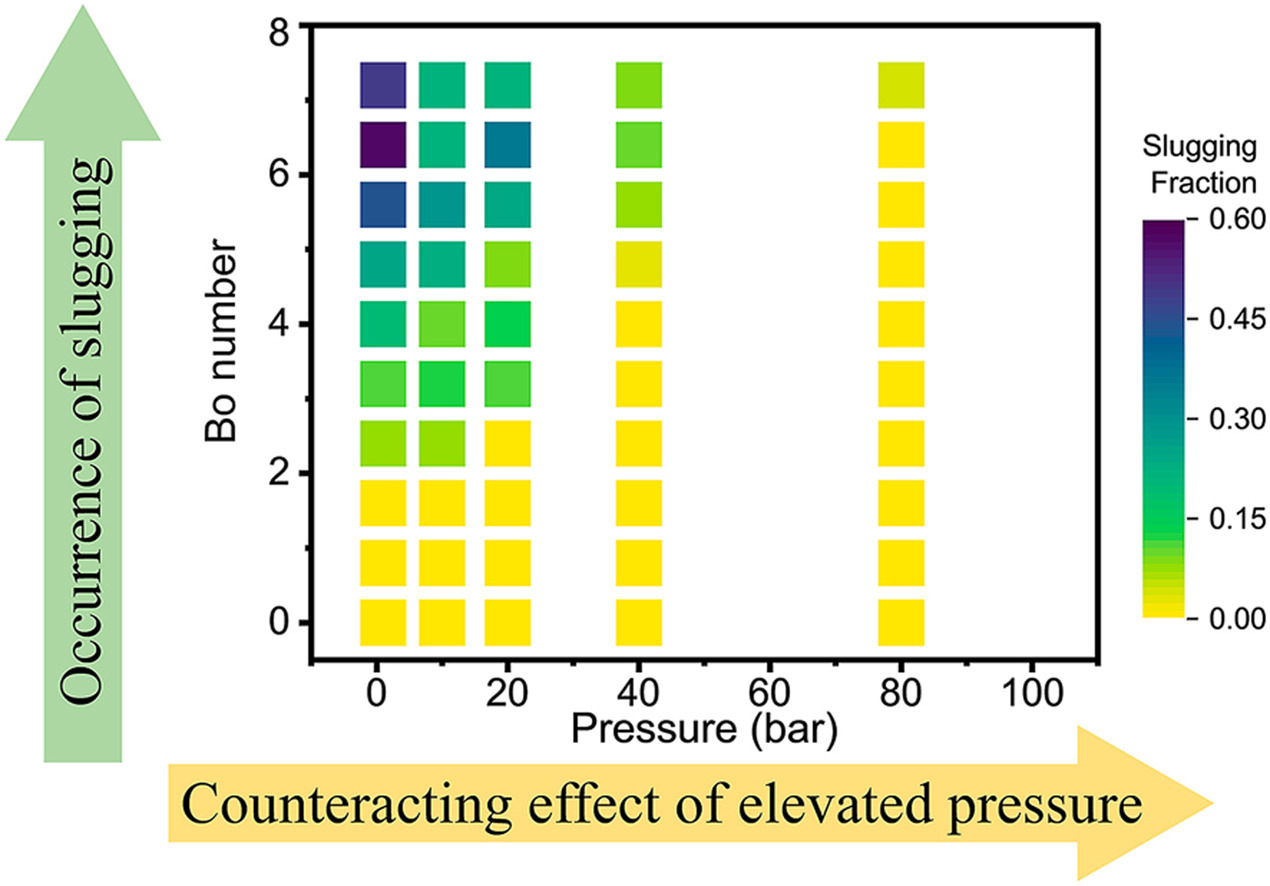
• Cohesion drives the transition from bubbling to slugging fluidization.
• Elevated pressure enhances the gas-holding capacity of the emulsion phase.
Abstract
The combined effects of operating pressure and interparticle cohesion on fluidization behavior remain a practical yet insufficiently explored topic. This study employs the CFD-DEM approach to investigate the impact of van der Waals force and operating pressure on fluidization hydrodynamics, focusing on bubble dynamics, pressure drop fluctuations, and particle-scale characteristics. It was observed that the fluidization regime transitions from stable bubbling to slugging when the Bond number (Bo) exceeds 2.4 under atmospheric pressure, whereas elevated pressures effectively mitigate the disruptive influence of cohesion and stabilize bubbling behavior. Moreover, while the bubble size decreases by about 20% as Bo increases from 0 to 5.6 under atmospheric pressure, it remains nearly unchanged with Bo at elevated pressures. The standard deviation of pressure drop fluctuations decreases, whereas the average frequency increases with rising cohesion under atmospheric pressure. Once again, increased pressures counteract these effects. Further analysis reveals that elevated pressure enhances the gas-holding capacity of the emulsion phase, leading to a 74% reduction in average cohesion force as pressure rises from 1 to 80 bar. The enhanced gas-solid interactions, evidenced by the increased drag coefficients, provides a physical perspective for understanding the counteracting effects of elevated pressures on cohesion.
Graphical abstract
Keywords
Pressurized fluidization; van der Waals force; Computational fluid dynamics (CFD); Discrete element method (DEM); Bubble dynamics
文章导读