
期刊文章
过刊浏览
- Volumes 108-119 (2025)
-
Volumes 96-107 (2025)
-
Volume 107
Pages 1-376 (December 2025)
-
Volume 106
Pages 1-336 (November 2025)
-
Volume 105
Pages 1-356 (October 2025)
-
Volume 104
Pages 1-332 (September 2025)
-
Volume 103
Pages 1-314 (August 2025)
-
Volume 102
Pages 1-276 (July 2025)
-
Volume 101
Pages 1-166 (June 2025)
-
Volume 100
Pages 1-256 (May 2025)
-
Volume 99
Pages 1-242 (April 2025)
-
Volume 98
Pages 1-288 (March 2025)
-
Volume 97
Pages 1-256 (February 2025)
-
Volume 96
Pages 1-340 (January 2025)
-
Volume 107
-
Volumes 84-95 (2024)
-
Volume 95
Pages 1-392 (December 2024)
-
Volume 94
Pages 1-400 (November 2024)
-
Volume 93
Pages 1-376 (October 2024)
-
Volume 92
Pages 1-316 (September 2024)
-
Volume 91
Pages 1-378 (August 2024)
-
Volume 90
Pages 1-580 (July 2024)
-
Volume 89
Pages 1-278 (June 2024)
-
Volume 88
Pages 1-350 (May 2024)
-
Volume 87
Pages 1-338 (April 2024)
-
Volume 86
Pages 1-312 (March 2024)
-
Volume 85
Pages 1-334 (February 2024)
-
Volume 84
Pages 1-308 (January 2024)
-
Volume 95
-
Volumes 72-83 (2023)
-
Volume 83
Pages 1-258 (December 2023)
-
Volume 82
Pages 1-204 (November 2023)
-
Volume 81
Pages 1-188 (October 2023)
-
Volume 80
Pages 1-202 (September 2023)
-
Volume 79
Pages 1-172 (August 2023)
-
Volume 78
Pages 1-146 (July 2023)
-
Volume 77
Pages 1-152 (June 2023)
-
Volume 76
Pages 1-176 (May 2023)
-
Volume 75
Pages 1-228 (April 2023)
-
Volume 74
Pages 1-200 (March 2023)
-
Volume 73
Pages 1-138 (February 2023)
-
Volume 72
Pages 1-144 (January 2023)
-
Volume 83
-
Volumes 60-71 (2022)
-
Volume 71
Pages 1-108 (December 2022)
-
Volume 70
Pages 1-106 (November 2022)
-
Volume 69
Pages 1-122 (October 2022)
-
Volume 68
Pages 1-124 (September 2022)
-
Volume 67
Pages 1-102 (August 2022)
-
Volume 66
Pages 1-112 (July 2022)
-
Volume 65
Pages 1-138 (June 2022)
-
Volume 64
Pages 1-186 (May 2022)
-
Volume 63
Pages 1-124 (April 2022)
-
Volume 62
Pages 1-104 (March 2022)
-
Volume 61
Pages 1-120 (February 2022)
-
Volume 60
Pages 1-124 (January 2022)
-
Volume 71
- Volumes 54-59 (2021)
- Volumes 48-53 (2020)
- Volumes 42-47 (2019)
- Volumes 36-41 (2018)
- Volumes 30-35 (2017)
- Volumes 24-29 (2016)
- Volumes 18-23 (2015)
- Volumes 12-17 (2014)
- Volume 11 (2013)
- Volume 10 (2012)
- Volume 9 (2011)
- Volume 8 (2010)
- Volume 7 (2009)
- Volume 6 (2008)
- Volume 5 (2007)
- Volume 4 (2006)
- Volume 3 (2005)
- Volume 2 (2004)
- Volume 1 (2003)
Volume 108
Kianimoqadam, A., & Lapp, J. (2026). Gaussian integral method for void fraction. Particuology, 108, 125-142. https://doi.org/10.1016/j.partic.2025.10.014
Gaussian integral method for void fraction
Alireza Kianimoqadam, Justin Lapp *
Department of Mechanical Engineering, University of Maine, Orono, ME, 04469, USA
10.1016/j.partic.2025.10.014
Volume 108,
January 2026,
Pages 125-142
Received 20 July 2025, Revised 16 October 2025, Accepted 20 October 2025, Available online 1 November 2025, Version of Record 3 December 2025.
E-mail:
Justin.Lapp@Maine.edu
Highlights
• Gaussian Integral Method is introduced for computing void fractions.
• The method applies to CFD-DEM simulations with a variety of CFD cell types.
• The method smooths void fraction gradients for more stable simulations.
• Accuracy in the fluid-particle interaction is retained by tuning coefficients.
Abstract
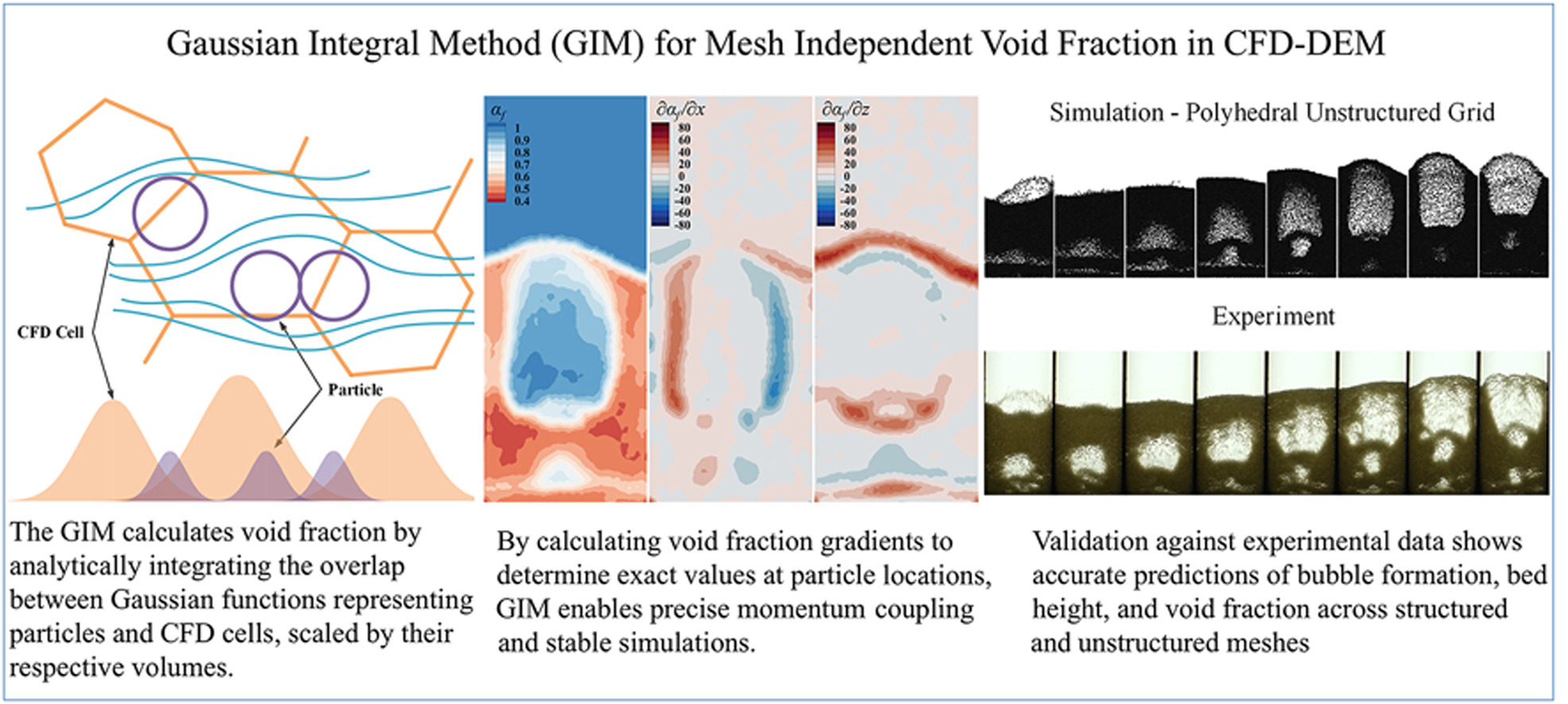
A novel method, the Gaussian Integral Method (GIM), is presented for calculating void fractions in Computational Fluid Dynamics–Discrete Element Method (CFD-DEM) simulations. GIM is versatile and applicable to various grid types, including structured and unstructured polyhedral meshes, without requiring special boundary treatments. An optimization technique is introduced to make GIM independent of grid resolution and type. The method is validated against experimental data from a fluidized bed, demonstrating that GIM produces realistic simulations closely resembling experimental observations. Additionally, unstructured polyhedral grids using GIM outperform structured grids of equivalent resolution, yielding results more aligned with experimental data. The gradient of the void fraction is computed in the CFD solver and utilized in the DEM solver for precise estimation at particle locations. Overall, GIM provides an effective solution for void fraction calculations in particulate media simulations with complex geometries, enhancing the accuracy and applicability of CFD-DEM simulations for industrial processes.
Graphical abstract
Keywords
Void fraction; Volume fraction; Discrete element method; CFD-DEM; Gaussian method
文章导读