
期刊文章
过刊浏览
- Volumes 108-119 (2025)
-
Volumes 96-107 (2025)
-
Volume 107
Pages 1-376 (December 2025)
-
Volume 106
Pages 1-336 (November 2025)
-
Volume 105
Pages 1-356 (October 2025)
-
Volume 104
Pages 1-332 (September 2025)
-
Volume 103
Pages 1-314 (August 2025)
-
Volume 102
Pages 1-276 (July 2025)
-
Volume 101
Pages 1-166 (June 2025)
-
Volume 100
Pages 1-256 (May 2025)
-
Volume 99
Pages 1-242 (April 2025)
-
Volume 98
Pages 1-288 (March 2025)
-
Volume 97
Pages 1-256 (February 2025)
-
Volume 96
Pages 1-340 (January 2025)
-
Volume 107
-
Volumes 84-95 (2024)
-
Volume 95
Pages 1-392 (December 2024)
-
Volume 94
Pages 1-400 (November 2024)
-
Volume 93
Pages 1-376 (October 2024)
-
Volume 92
Pages 1-316 (September 2024)
-
Volume 91
Pages 1-378 (August 2024)
-
Volume 90
Pages 1-580 (July 2024)
-
Volume 89
Pages 1-278 (June 2024)
-
Volume 88
Pages 1-350 (May 2024)
-
Volume 87
Pages 1-338 (April 2024)
-
Volume 86
Pages 1-312 (March 2024)
-
Volume 85
Pages 1-334 (February 2024)
-
Volume 84
Pages 1-308 (January 2024)
-
Volume 95
-
Volumes 72-83 (2023)
-
Volume 83
Pages 1-258 (December 2023)
-
Volume 82
Pages 1-204 (November 2023)
-
Volume 81
Pages 1-188 (October 2023)
-
Volume 80
Pages 1-202 (September 2023)
-
Volume 79
Pages 1-172 (August 2023)
-
Volume 78
Pages 1-146 (July 2023)
-
Volume 77
Pages 1-152 (June 2023)
-
Volume 76
Pages 1-176 (May 2023)
-
Volume 75
Pages 1-228 (April 2023)
-
Volume 74
Pages 1-200 (March 2023)
-
Volume 73
Pages 1-138 (February 2023)
-
Volume 72
Pages 1-144 (January 2023)
-
Volume 83
-
Volumes 60-71 (2022)
-
Volume 71
Pages 1-108 (December 2022)
-
Volume 70
Pages 1-106 (November 2022)
-
Volume 69
Pages 1-122 (October 2022)
-
Volume 68
Pages 1-124 (September 2022)
-
Volume 67
Pages 1-102 (August 2022)
-
Volume 66
Pages 1-112 (July 2022)
-
Volume 65
Pages 1-138 (June 2022)
-
Volume 64
Pages 1-186 (May 2022)
-
Volume 63
Pages 1-124 (April 2022)
-
Volume 62
Pages 1-104 (March 2022)
-
Volume 61
Pages 1-120 (February 2022)
-
Volume 60
Pages 1-124 (January 2022)
-
Volume 71
- Volumes 54-59 (2021)
- Volumes 48-53 (2020)
- Volumes 42-47 (2019)
- Volumes 36-41 (2018)
- Volumes 30-35 (2017)
- Volumes 24-29 (2016)
- Volumes 18-23 (2015)
- Volumes 12-17 (2014)
- Volume 11 (2013)
- Volume 10 (2012)
- Volume 9 (2011)
- Volume 8 (2010)
- Volume 7 (2009)
- Volume 6 (2008)
- Volume 5 (2007)
- Volume 4 (2006)
- Volume 3 (2005)
- Volume 2 (2004)
- Volume 1 (2003)
Volume 108
Asiedu-Boateng, P., Asiedu, N. Y., Patience, G. S., McDonough, J. R., & Zivkovic, V. (2026). High temperature micro fluidization of limestones. Particuology, 108, 156-167. https://doi.org/10.1016/j.partic.2025.10.020
High temperature micro fluidization of limestones
Peter Asiedu-Boateng a b *, Nana Yaw Asiedu a, Gregory S. Patience b, Jonathan R. McDonough c, Vladimir Zivkovic c
a Chemical Eng. Dept., College of Engineering, Kwame Nkrumah University of Science & Tech, Kumasi, Ghana
b Department of Chem. Eng, Polytechnique Montreal, C.P. 6079, Succ. CV, Montreal, H3C 3A7, Quebec, Canada
c School of Engineering, Merz Court, Newcastle University, Newcastle upon Tyne, NE1 7RU, UK
10.1016/j.partic.2025.10.020
Volume 108,
January 2026,
Pages 156-167
Received 25 July 2025, Revised 8 October 2025, Accepted 23 October 2025, Available online 5 November 2025, Version of Record 3 December 2025.
E-mail:
peter.asiedu-boateng@polymtl.ca
Highlights
• Dominant frequency reduces as the operating temperature increases.
• Particle-bed wall effect on fluidization behavior increases at elevated temperatures.
• Inter particle forces dominate wall effects with increasing temperature.
• Structural changes in particles with temperature significantly alter bubble dynamics.
• Slugging is bigger issue for high temperatures in micro fluidized bed reactors.
Abstract
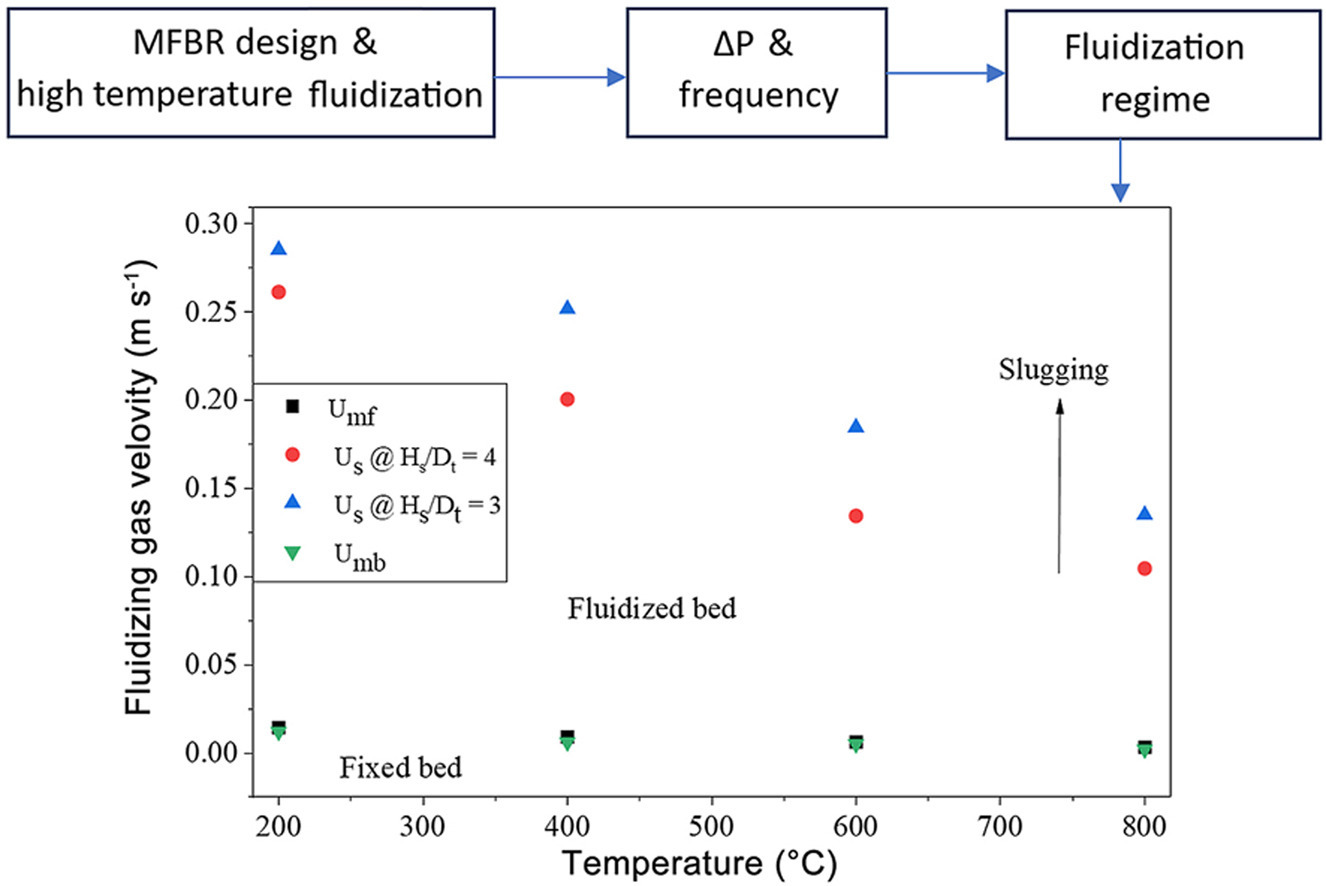
Micro fluidized bed reactors (MFBRs) operating at high temperatures hold great potential for finding suitable conditions for kinetic screening experiments for CO2 capture sorbents. Additionally, high temperature hydrodynamics study using MFBRs prior to kinetics analysis could enable the acquisition of realistic and intrinsic kinetic data in transport phenomena-induced processes but the existence of wall effects could negatively impact quality of fluidization and cause delayed fluidization even though it may aid reaction kinetics. High temperature hydrodynamic studies in MFBRs remains relatively unexplored despite its enormous potential. In this work, we designed a high temperature MFBR system to perform detailed hydrodynamic experiments using pressure drop characterization approach to analyze the effect of temperature and bed-wall friction on various fluidization regimes with Geldart B limestone sorbents by controlling temperature with portable induction heater. Results show that minimum fluidization velocity decreases with increasing temperature for both Nauli and Oterpkolu limestones due to increased Van der Waals forces and the cohesiveness between particles at elevated temperature; with the gradient of the decrease in minimum fluidization velocity being steeper between ambient temperature and 400 °C compared to the drop between 400 and 800 °C. At 600 °C, bubbles started appearing at air flow rate of (0.065 m/s) but bubbling started at 0.142 m/s and 400 °C. Frequency spectra revealed that the superficial gas velocity at which a dominant frequency is attained (when slugging fluidization begins) reduces as the operating temperature increases. Additionally, bed pressure drop overshoot per volume of particle bed increases with increasing operating temperature.
Graphical abstract
Keywords
Micro-fluidized bed; High temperature fluidization; Induction heating; Frequency analysis
文章导读