
期刊文章
过刊浏览
- Volumes 108-119 (2025)
-
Volumes 96-107 (2025)
-
Volume 107
Pages 1-376 (December 2025)
-
Volume 106
Pages 1-336 (November 2025)
-
Volume 105
Pages 1-356 (October 2025)
-
Volume 104
Pages 1-332 (September 2025)
-
Volume 103
Pages 1-314 (August 2025)
-
Volume 102
Pages 1-276 (July 2025)
-
Volume 101
Pages 1-166 (June 2025)
-
Volume 100
Pages 1-256 (May 2025)
-
Volume 99
Pages 1-242 (April 2025)
-
Volume 98
Pages 1-288 (March 2025)
-
Volume 97
Pages 1-256 (February 2025)
-
Volume 96
Pages 1-340 (January 2025)
-
Volume 107
-
Volumes 84-95 (2024)
-
Volume 95
Pages 1-392 (December 2024)
-
Volume 94
Pages 1-400 (November 2024)
-
Volume 93
Pages 1-376 (October 2024)
-
Volume 92
Pages 1-316 (September 2024)
-
Volume 91
Pages 1-378 (August 2024)
-
Volume 90
Pages 1-580 (July 2024)
-
Volume 89
Pages 1-278 (June 2024)
-
Volume 88
Pages 1-350 (May 2024)
-
Volume 87
Pages 1-338 (April 2024)
-
Volume 86
Pages 1-312 (March 2024)
-
Volume 85
Pages 1-334 (February 2024)
-
Volume 84
Pages 1-308 (January 2024)
-
Volume 95
-
Volumes 72-83 (2023)
-
Volume 83
Pages 1-258 (December 2023)
-
Volume 82
Pages 1-204 (November 2023)
-
Volume 81
Pages 1-188 (October 2023)
-
Volume 80
Pages 1-202 (September 2023)
-
Volume 79
Pages 1-172 (August 2023)
-
Volume 78
Pages 1-146 (July 2023)
-
Volume 77
Pages 1-152 (June 2023)
-
Volume 76
Pages 1-176 (May 2023)
-
Volume 75
Pages 1-228 (April 2023)
-
Volume 74
Pages 1-200 (March 2023)
-
Volume 73
Pages 1-138 (February 2023)
-
Volume 72
Pages 1-144 (January 2023)
-
Volume 83
-
Volumes 60-71 (2022)
-
Volume 71
Pages 1-108 (December 2022)
-
Volume 70
Pages 1-106 (November 2022)
-
Volume 69
Pages 1-122 (October 2022)
-
Volume 68
Pages 1-124 (September 2022)
-
Volume 67
Pages 1-102 (August 2022)
-
Volume 66
Pages 1-112 (July 2022)
-
Volume 65
Pages 1-138 (June 2022)
-
Volume 64
Pages 1-186 (May 2022)
-
Volume 63
Pages 1-124 (April 2022)
-
Volume 62
Pages 1-104 (March 2022)
-
Volume 61
Pages 1-120 (February 2022)
-
Volume 60
Pages 1-124 (January 2022)
-
Volume 71
- Volumes 54-59 (2021)
- Volumes 48-53 (2020)
- Volumes 42-47 (2019)
- Volumes 36-41 (2018)
- Volumes 30-35 (2017)
- Volumes 24-29 (2016)
- Volumes 18-23 (2015)
- Volumes 12-17 (2014)
- Volume 11 (2013)
- Volume 10 (2012)
- Volume 9 (2011)
- Volume 8 (2010)
- Volume 7 (2009)
- Volume 6 (2008)
- Volume 5 (2007)
- Volume 4 (2006)
- Volume 3 (2005)
- Volume 2 (2004)
- Volume 1 (2003)
Volume 108
Wang, B., Jin, H., Su, H., & Guo, L. (2026). Identification of scaling law for supercritical water fluidized bed reactors via CFD and data-driven approach. Particuology, 108, 168-182. https://doi.org/10.1016/j.partic.2025.11.010
Identification of scaling law for supercritical water fluidized bed reactors via CFD and data-driven approach
Bingcheng Wang, Hui Jin, Haozhe Su, Liejin Guo *
State Key Laboratory of Multiphase Flow in Power Engineering, Xi'an Jiaotong University, Xi'an, 710049, China
10.1016/j.partic.2025.11.010
Volume 108,
January 2026,
Pages 168-182
Received 26 September 2025, Revised 9 November 2025, Accepted 17 November 2025, Available online 25 November 2025, Version of Record 3 December 2025.
E-mail:
lj-guo@mail.xjtu.edu.cn
Highlights
• A data-driven method is proposed to develop a modified scaling law for SCWFBRs.
• The modified scaling law is validated against Glicksman's scaling sets.
• Pressure drop fluctuations, particle volume fraction and axial velocity are analyzed.
• The modified scaling law performs better in both tested Geldart A and B conditions.
Abstract
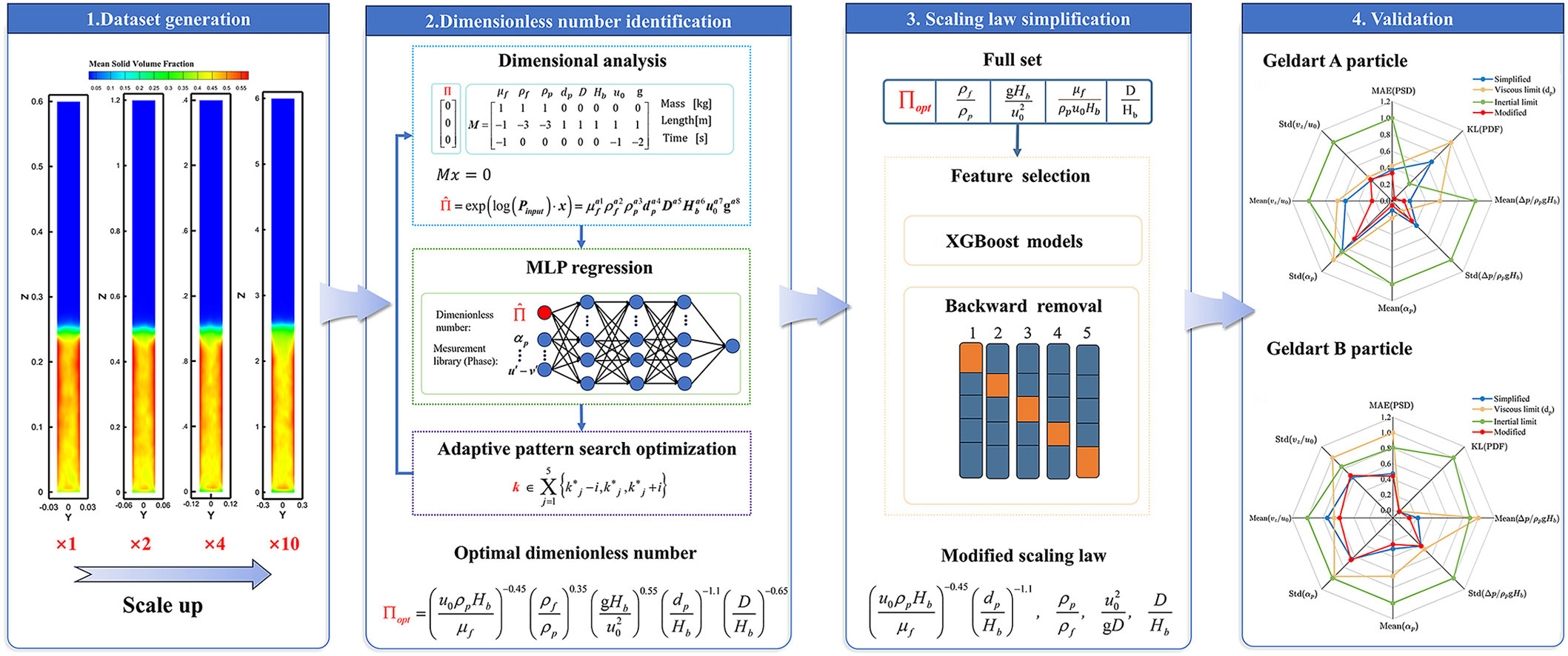
Supercritical water fluidized bed reactors (SCWFBRs) offer significant potential for large-scale hydrogen production, but their scale-up process remains challenging. Traditional scaling laws, such as Glicksman's sets, simplify or omit interphase and interparticle closure terms in conservation equations, limiting applicability under supercritical water conditions. To address this, a data-driven approach is proposed to develop a modified scaling law for SCWFBRs. A dataset was generated from two-fluid model (TFM) simulations across diverse operating conditions and reactor scales. Dimensional analysis, combined with a multi-layer perceptron (MLP) and a pattern search method, was then applied to identify a composite dimensionless number representing interaction closure terms in two-phase momentum equations. This number, together with dimensionless numbers derived from other momentum terms, was refined via XGBoost and backward stepwise feature selection to preserve essential design degrees of freedom, yielding the modified scaling law. Validation against key hydrodynamic indicators, including pressure drop fluctuations, particle volume fraction, and particle axial velocity, demonstrated that the modified law consistently outperforms Glicksman's criteria for both Geldart A and B particles, with the extent of improvement varying between particle types under a tenfold scale-up. These results highlight the importance of accounting for interphase and interparticle interactions in SCWFBRs and indicate that the data-driven approach is an effective tool for reactor design and scale-up.
Graphical abstract
Keywords
Scaling laws; Fluidized bed; Supercritical water; Data-driven
文章导读