
期刊文章
过刊浏览
- Volumes 108-119 (2025)
-
Volumes 96-107 (2025)
-
Volume 107
Pages 1-376 (December 2025)
-
Volume 106
Pages 1-336 (November 2025)
-
Volume 105
Pages 1-356 (October 2025)
-
Volume 104
Pages 1-332 (September 2025)
-
Volume 103
Pages 1-314 (August 2025)
-
Volume 102
Pages 1-276 (July 2025)
-
Volume 101
Pages 1-166 (June 2025)
-
Volume 100
Pages 1-256 (May 2025)
-
Volume 99
Pages 1-242 (April 2025)
-
Volume 98
Pages 1-288 (March 2025)
-
Volume 97
Pages 1-256 (February 2025)
-
Volume 96
Pages 1-340 (January 2025)
-
Volume 107
-
Volumes 84-95 (2024)
-
Volume 95
Pages 1-392 (December 2024)
-
Volume 94
Pages 1-400 (November 2024)
-
Volume 93
Pages 1-376 (October 2024)
-
Volume 92
Pages 1-316 (September 2024)
-
Volume 91
Pages 1-378 (August 2024)
-
Volume 90
Pages 1-580 (July 2024)
-
Volume 89
Pages 1-278 (June 2024)
-
Volume 88
Pages 1-350 (May 2024)
-
Volume 87
Pages 1-338 (April 2024)
-
Volume 86
Pages 1-312 (March 2024)
-
Volume 85
Pages 1-334 (February 2024)
-
Volume 84
Pages 1-308 (January 2024)
-
Volume 95
-
Volumes 72-83 (2023)
-
Volume 83
Pages 1-258 (December 2023)
-
Volume 82
Pages 1-204 (November 2023)
-
Volume 81
Pages 1-188 (October 2023)
-
Volume 80
Pages 1-202 (September 2023)
-
Volume 79
Pages 1-172 (August 2023)
-
Volume 78
Pages 1-146 (July 2023)
-
Volume 77
Pages 1-152 (June 2023)
-
Volume 76
Pages 1-176 (May 2023)
-
Volume 75
Pages 1-228 (April 2023)
-
Volume 74
Pages 1-200 (March 2023)
-
Volume 73
Pages 1-138 (February 2023)
-
Volume 72
Pages 1-144 (January 2023)
-
Volume 83
-
Volumes 60-71 (2022)
-
Volume 71
Pages 1-108 (December 2022)
-
Volume 70
Pages 1-106 (November 2022)
-
Volume 69
Pages 1-122 (October 2022)
-
Volume 68
Pages 1-124 (September 2022)
-
Volume 67
Pages 1-102 (August 2022)
-
Volume 66
Pages 1-112 (July 2022)
-
Volume 65
Pages 1-138 (June 2022)
-
Volume 64
Pages 1-186 (May 2022)
-
Volume 63
Pages 1-124 (April 2022)
-
Volume 62
Pages 1-104 (March 2022)
-
Volume 61
Pages 1-120 (February 2022)
-
Volume 60
Pages 1-124 (January 2022)
-
Volume 71
- Volumes 54-59 (2021)
- Volumes 48-53 (2020)
- Volumes 42-47 (2019)
- Volumes 36-41 (2018)
- Volumes 30-35 (2017)
- Volumes 24-29 (2016)
- Volumes 18-23 (2015)
- Volumes 12-17 (2014)
- Volume 11 (2013)
- Volume 10 (2012)
- Volume 9 (2011)
- Volume 8 (2010)
- Volume 7 (2009)
- Volume 6 (2008)
- Volume 5 (2007)
- Volume 4 (2006)
- Volume 3 (2005)
- Volume 2 (2004)
- Volume 1 (2003)
Volume 108
Wang, X., Shao, Y., Mao, Z., Wang, Y., Cui, B., & Bayly, A. (2026). Tailings flocculation and sedimentation in a lab-scale gravity thickener by CFD modelling. Particuology, 108, 183-195. https://doi.org/10.1016/j.partic.2025.10.023
Tailings flocculation and sedimentation in a lab-scale gravity thickener by CFD modelling
Xuetao Wang a *, Yuchen Shao a *, Zhiran Mao a, Yulian Wang a, Baoyu Cui b, Andrew Bayly c
a School of Materials Science and Engineering, Shenyang Ligong University, Shenyang, 110159, China
b School of Resources and Civil Engineering, Northeastern University, Shenyang, 110819, China
c School of Chemical and Processing Engineering, University of Leeds, Leeds, LS29JT, UK
10.1016/j.partic.2025.10.023
Volume 108,
January 2026,
Pages 183-195
Received 26 June 2025, Revised 29 July 2025, Accepted 28 October 2025, Available online 7 November 2025, Version of Record 3 December 2025.
E-mail:
wangxuetao@sylu.edu.cn; yuchenshao2025@126.com
Highlights
• A novel CFD-PBM-KTGF framework was proposed to simulate flocculation-sedimentation process by steps.
• A visualization analysis of particle behavior inside the thickener was conducted.
• Effects of turbulent characteristics on particle aggregation and floc breakage are systematically analyzed.
• Thickening efficiency was improved through the feeding parameters intensification.
Abstract
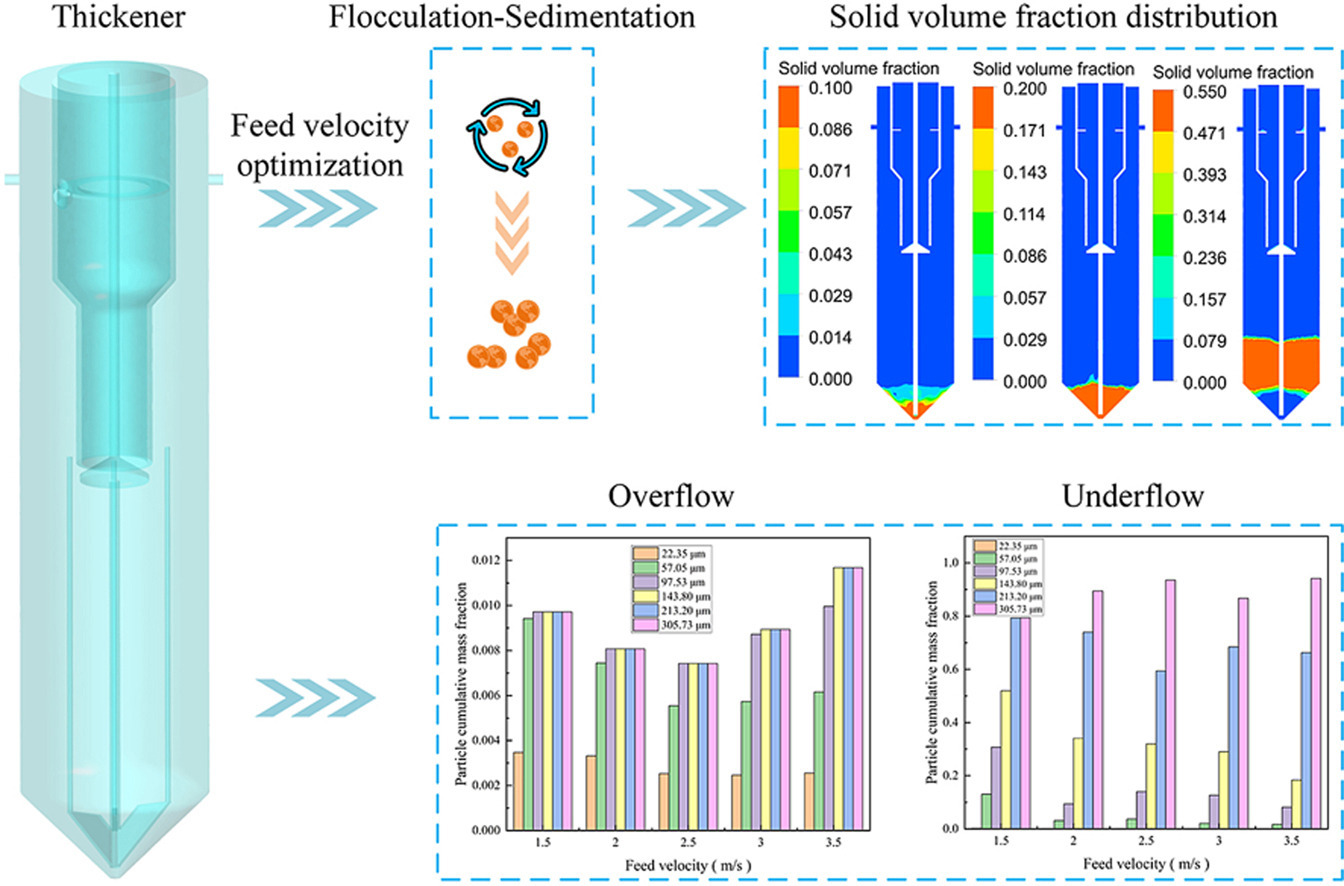
This study employed coupled the Computational Fluid Dynamics-Population Balance Model (CFD-PBM) framework and Kinetic Theory of Granular Flow (KTGF) to investigate the flocculation and sedimentation dynamics of polymodal tailings particles in a lab-scale gravity thickener. The Euler-Euler multiphase model and RNG k-ε turbulence model are integrated to simulate solid-liquid interactions and turbulent flow characteristics, while flocculation kinetics, including aggregation and breakage mechanisms, are incorporated to quantify particle size evolution. The influence of feed velocity on flow field characteristics and particle flocculation-sedimentation efficiency was analyzed through visualization. The results indicated that the turbulent energy distribution is highly sensitive to the feed velocity. The optimal velocity range (2.0–2.5 m/s) promotes a balanced aggregation-breakage dynamics of particles, stabilizing the formation of larger flocs and enhancing sedimentation. Excessively high feed velocities (>3.0 m/s) induce stronger turbulence, reducing floc size and impairing sedimentation efficiency. Spatial analysis reveals that fine particles (<50 μm) are widely dispersed, while large flocs (>100 μm) dominate the underflow solid concentration. The impact of floc size and density on sedimentation was also examined. This study identifies a critical threshold for feed velocity to optimize thickener performance, providing a theoretical basis for process intensification in industrial thickeners.
Graphical abstract
Keywords
Gravity thickener; Particle flocculation; Flocs sedimentation; Numerical simulation
文章导读