
期刊文章
过刊浏览
- Volumes 108-119 (2025)
-
Volumes 96-107 (2025)
-
Volume 107
Pages 1-376 (December 2025)
-
Volume 106
Pages 1-336 (November 2025)
-
Volume 105
Pages 1-356 (October 2025)
-
Volume 104
Pages 1-332 (September 2025)
-
Volume 103
Pages 1-314 (August 2025)
-
Volume 102
Pages 1-276 (July 2025)
-
Volume 101
Pages 1-166 (June 2025)
-
Volume 100
Pages 1-256 (May 2025)
-
Volume 99
Pages 1-242 (April 2025)
-
Volume 98
Pages 1-288 (March 2025)
-
Volume 97
Pages 1-256 (February 2025)
-
Volume 96
Pages 1-340 (January 2025)
-
Volume 107
-
Volumes 84-95 (2024)
-
Volume 95
Pages 1-392 (December 2024)
-
Volume 94
Pages 1-400 (November 2024)
-
Volume 93
Pages 1-376 (October 2024)
-
Volume 92
Pages 1-316 (September 2024)
-
Volume 91
Pages 1-378 (August 2024)
-
Volume 90
Pages 1-580 (July 2024)
-
Volume 89
Pages 1-278 (June 2024)
-
Volume 88
Pages 1-350 (May 2024)
-
Volume 87
Pages 1-338 (April 2024)
-
Volume 86
Pages 1-312 (March 2024)
-
Volume 85
Pages 1-334 (February 2024)
-
Volume 84
Pages 1-308 (January 2024)
-
Volume 95
-
Volumes 72-83 (2023)
-
Volume 83
Pages 1-258 (December 2023)
-
Volume 82
Pages 1-204 (November 2023)
-
Volume 81
Pages 1-188 (October 2023)
-
Volume 80
Pages 1-202 (September 2023)
-
Volume 79
Pages 1-172 (August 2023)
-
Volume 78
Pages 1-146 (July 2023)
-
Volume 77
Pages 1-152 (June 2023)
-
Volume 76
Pages 1-176 (May 2023)
-
Volume 75
Pages 1-228 (April 2023)
-
Volume 74
Pages 1-200 (March 2023)
-
Volume 73
Pages 1-138 (February 2023)
-
Volume 72
Pages 1-144 (January 2023)
-
Volume 83
-
Volumes 60-71 (2022)
-
Volume 71
Pages 1-108 (December 2022)
-
Volume 70
Pages 1-106 (November 2022)
-
Volume 69
Pages 1-122 (October 2022)
-
Volume 68
Pages 1-124 (September 2022)
-
Volume 67
Pages 1-102 (August 2022)
-
Volume 66
Pages 1-112 (July 2022)
-
Volume 65
Pages 1-138 (June 2022)
-
Volume 64
Pages 1-186 (May 2022)
-
Volume 63
Pages 1-124 (April 2022)
-
Volume 62
Pages 1-104 (March 2022)
-
Volume 61
Pages 1-120 (February 2022)
-
Volume 60
Pages 1-124 (January 2022)
-
Volume 71
- Volumes 54-59 (2021)
- Volumes 48-53 (2020)
- Volumes 42-47 (2019)
- Volumes 36-41 (2018)
- Volumes 30-35 (2017)
- Volumes 24-29 (2016)
- Volumes 18-23 (2015)
- Volumes 12-17 (2014)
- Volume 11 (2013)
- Volume 10 (2012)
- Volume 9 (2011)
- Volume 8 (2010)
- Volume 7 (2009)
- Volume 6 (2008)
- Volume 5 (2007)
- Volume 4 (2006)
- Volume 3 (2005)
- Volume 2 (2004)
- Volume 1 (2003)
Volume 108
Zhang, Q., Jiang, H., Sang, G., & Dang, Y. (2026). The shakedown behaviour of binary soil: A DEM study. Particuology, 108, 196-206. https://doi.org/10.1016/j.partic.2025.10.022
The shakedown behaviour of binary soil: A DEM study
Qi Zhang a, Haoran Jiang b, Guijie Sang c, Yike Dang d *
a Department of Civil and Environmental Engineering, University of Strathclyde, Glasgow, UK
b Civil Engineering Design Division, Kajima Corporation, Tokyo, Japan
c Department of Civil and Environmental Engineering, University of Liverpool, Liverpool, UK
d School of Human Settlements and Civil Engineering, Xi'an Jiaotong University, Xi'an, China
10.1016/j.partic.2025.10.022
Volume 108,
January 2026,
Pages 196-206
Received 31 August 2025, Revised 26 October 2025, Accepted 28 October 2025, Available online 5 November 2025, Version of Record 3 December 2025.
E-mail:
diryk0213@163.com; 4120122003@stu.xjtu.edu.cn
Highlights
• DEM simulations reveal cyclic shakedown behaviour of binary granular soils.
• Tangential contact anisotropy governs soil failure under cyclic loading.
• A simplified shakedown criterion is proposed for DEM-based soil analysis.
Abstract
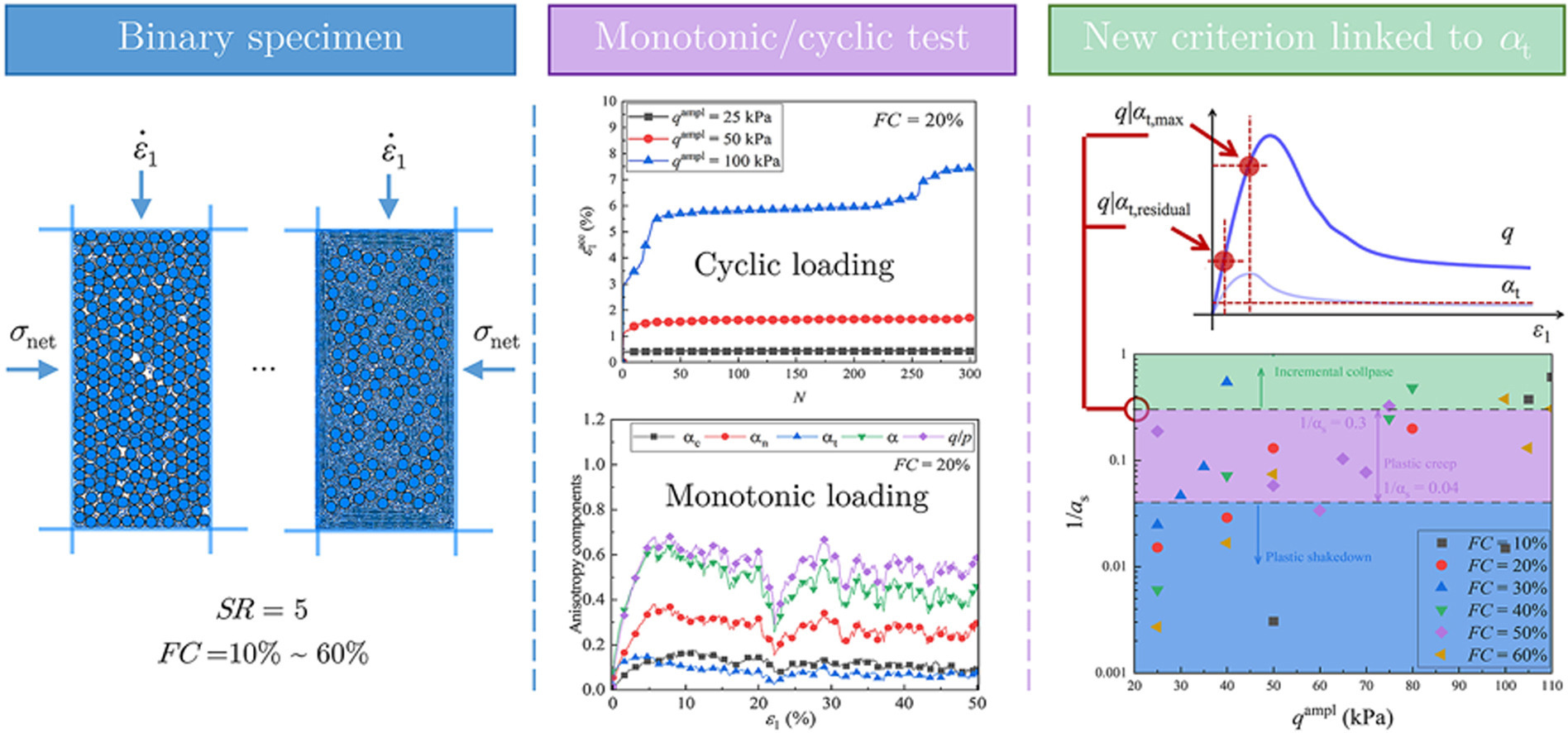
Binary soils are widespread in natural deposits and are frequently subjected to cyclic loading. While laboratory tests have provided valuable insights into their overall mechanical behaviour, the underlying structural evolution remains largely unexplored due to experimental constraints. In this study, the discrete element method (DEM) is employed to investigate the deformation behaviour of binary soils under drained cyclic loading. A series of monotonic and cyclic biaxial tests were performed on soils with varying fines content, covering the transition from coarse-particle-controlled to fine-particle-controlled structures. To enhance computational efficiency in cyclic loading simulations, a shakedown framework was adopted. The results indicate that increasing fines content reduces the strength and stiffness of coarse-particle-controlled structures but enhances those of fine-particle-controlled structures. Micromechanical analyses of the stress–force–fabric relationship reveal that shakedown behaviour is governed by the anisotropy of tangential contact force (at): in loose specimens, shakedown is controlled by the residual at, whereas in dense specimens it is controlled by the peak at. This work establishes a link between the micro-response in monotonic biaxial tests and the macro-response in cyclic biaxial tests. Furthermore, based on the simulation results, a criterion is proposed for characterising the shakedown ranges of granular materials in DEM analyses.
Graphical abstract
Keywords
Discrete element method; Cyclic loading; Binary soil; Shakedown theory; Fabric anisotropy
文章导读