
期刊文章
过刊浏览
- Volumes 108-119 (2025)
-
Volumes 96-107 (2025)
-
Volume 107
Pages 1-376 (December 2025)
-
Volume 106
Pages 1-336 (November 2025)
-
Volume 105
Pages 1-356 (October 2025)
-
Volume 104
Pages 1-332 (September 2025)
-
Volume 103
Pages 1-314 (August 2025)
-
Volume 102
Pages 1-276 (July 2025)
-
Volume 101
Pages 1-166 (June 2025)
-
Volume 100
Pages 1-256 (May 2025)
-
Volume 99
Pages 1-242 (April 2025)
-
Volume 98
Pages 1-288 (March 2025)
-
Volume 97
Pages 1-256 (February 2025)
-
Volume 96
Pages 1-340 (January 2025)
-
Volume 107
-
Volumes 84-95 (2024)
-
Volume 95
Pages 1-392 (December 2024)
-
Volume 94
Pages 1-400 (November 2024)
-
Volume 93
Pages 1-376 (October 2024)
-
Volume 92
Pages 1-316 (September 2024)
-
Volume 91
Pages 1-378 (August 2024)
-
Volume 90
Pages 1-580 (July 2024)
-
Volume 89
Pages 1-278 (June 2024)
-
Volume 88
Pages 1-350 (May 2024)
-
Volume 87
Pages 1-338 (April 2024)
-
Volume 86
Pages 1-312 (March 2024)
-
Volume 85
Pages 1-334 (February 2024)
-
Volume 84
Pages 1-308 (January 2024)
-
Volume 95
-
Volumes 72-83 (2023)
-
Volume 83
Pages 1-258 (December 2023)
-
Volume 82
Pages 1-204 (November 2023)
-
Volume 81
Pages 1-188 (October 2023)
-
Volume 80
Pages 1-202 (September 2023)
-
Volume 79
Pages 1-172 (August 2023)
-
Volume 78
Pages 1-146 (July 2023)
-
Volume 77
Pages 1-152 (June 2023)
-
Volume 76
Pages 1-176 (May 2023)
-
Volume 75
Pages 1-228 (April 2023)
-
Volume 74
Pages 1-200 (March 2023)
-
Volume 73
Pages 1-138 (February 2023)
-
Volume 72
Pages 1-144 (January 2023)
-
Volume 83
-
Volumes 60-71 (2022)
-
Volume 71
Pages 1-108 (December 2022)
-
Volume 70
Pages 1-106 (November 2022)
-
Volume 69
Pages 1-122 (October 2022)
-
Volume 68
Pages 1-124 (September 2022)
-
Volume 67
Pages 1-102 (August 2022)
-
Volume 66
Pages 1-112 (July 2022)
-
Volume 65
Pages 1-138 (June 2022)
-
Volume 64
Pages 1-186 (May 2022)
-
Volume 63
Pages 1-124 (April 2022)
-
Volume 62
Pages 1-104 (March 2022)
-
Volume 61
Pages 1-120 (February 2022)
-
Volume 60
Pages 1-124 (January 2022)
-
Volume 71
- Volumes 54-59 (2021)
- Volumes 48-53 (2020)
- Volumes 42-47 (2019)
- Volumes 36-41 (2018)
- Volumes 30-35 (2017)
- Volumes 24-29 (2016)
- Volumes 18-23 (2015)
- Volumes 12-17 (2014)
- Volume 11 (2013)
- Volume 10 (2012)
- Volume 9 (2011)
- Volume 8 (2010)
- Volume 7 (2009)
- Volume 6 (2008)
- Volume 5 (2007)
- Volume 4 (2006)
- Volume 3 (2005)
- Volume 2 (2004)
- Volume 1 (2003)
Volume 108
Qi, S., Lv, F., & Su, M. (2026). Regulation of polymer molecules on caffeine crystals of needle morphology and its flowability. Particuology, 108, 207-217. https://doi.org/10.1016/j.partic.2025.10.012
Regulation of polymer molecules on caffeine crystals of needle morphology and its flowability
Shuo Qi, Feng Lv, Min Su *
School of Chemical Engineering, Hebei University of Technology, Tianjin, 300072, China
10.1016/j.partic.2025.10.012
Volume 108,
January 2026,
Pages 207-217
Received 25 July 2025, Revised 12 October 2025, Accepted 13 October 2025, Available online 28 October 2025, Version of Record 3 December 2025.
E-mail:
sumin@hebut.edu.cn; sumin@tju.edu.cn
Highlights
• MD simulation revealed needle-like growth mechanism of caffeine crystals.
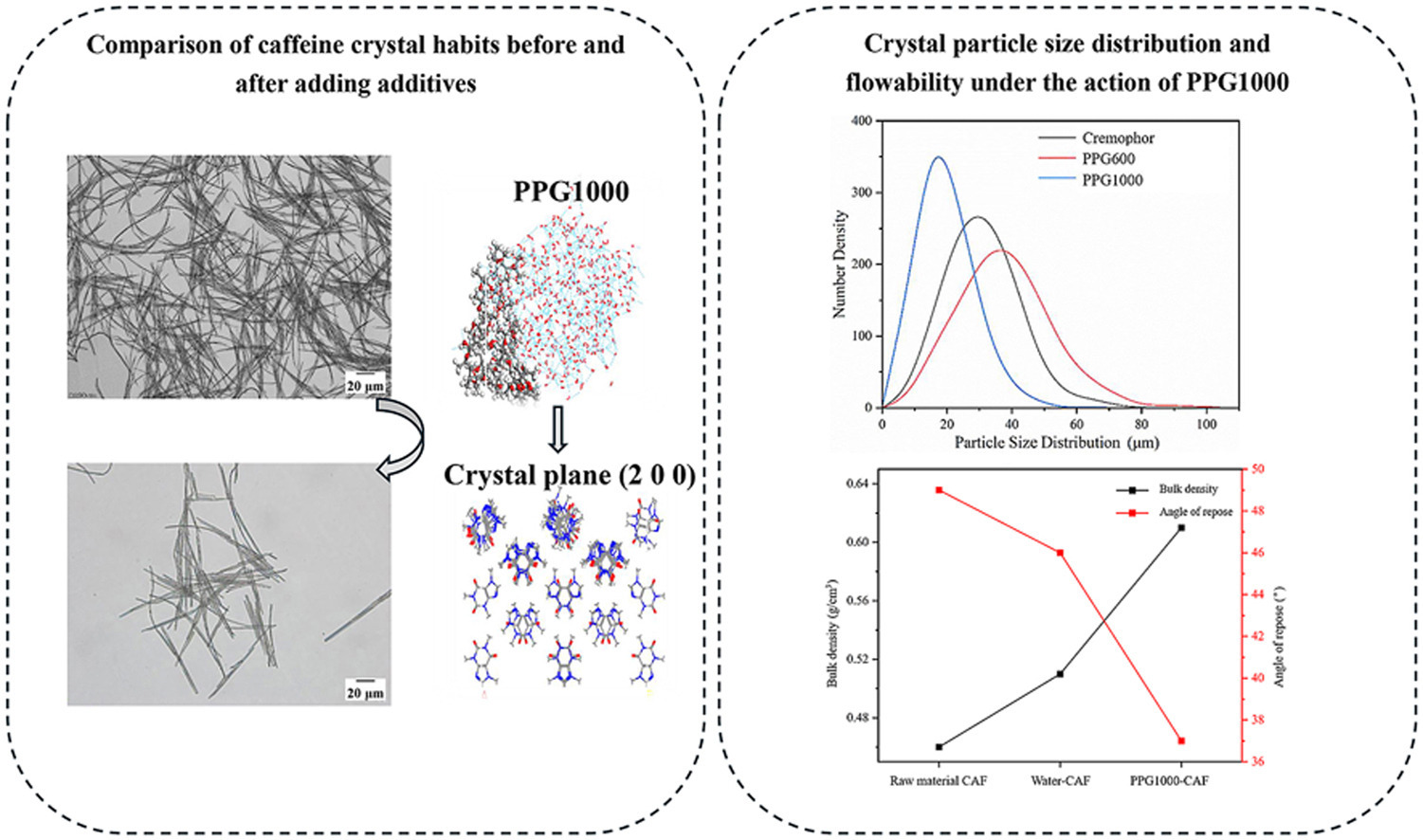
• PPG1000, identified via MD simulation, weakened (2 0 0) surface to reduce CAF aspect ratio.
• Experiments confirmed PPG1000 reduced CAF aspect ratio to approximately 16.
• Rod-like crystals with better flowability were formed at 0.82 % PPG1000.
• Additive changed morphology without altering crystal form or structure.
Abstract
Caffeine (CAF) crystals tend to form a high aspect ratio needle-like morphology, which seriously affects their performance in the post-processing process. To achieve precise control of crystal morphology, molecular dynamics simulation was adopted to reveal the formation mechanism of needle-like crystal patterns. Based on this, the regulatory effects of various polymer additives on CAF crystals were screened. Verification experiment shows that polypropylene glycol 1000 (PPG1000) with strong hydrophobic properties and significant steric hindrance can significantly reduce the aspect ratio of CAF crystals by reducing the interfacial interaction energy between the (2 0 0) crystal plane and the solvent. Rod-shaped CAF crystals with a lower aspect ratio of approximately 16 were successfully prepared using PPG1000 addition amount of 0.82 % (g/g solvent). Further, the tapped density and the Angle of repose of the rod crystals were also tested. The polymer additive has effectively regulated the morphology of the needle crystals of CAF and its flow characteristics, which has significant scientific and engineering value for improving the performance of CAF crystal products and the design of similar needle crystalline systems.
Graphical abstract
Keywords
Caffeine; Crystallization; Needle morphology; Polymer; Molecular simulation
文章导读