
期刊文章
过刊浏览
- Volumes 108-119 (2025)
-
Volumes 96-107 (2025)
-
Volume 107
Pages 1-376 (December 2025)
-
Volume 106
Pages 1-336 (November 2025)
-
Volume 105
Pages 1-356 (October 2025)
-
Volume 104
Pages 1-332 (September 2025)
-
Volume 103
Pages 1-314 (August 2025)
-
Volume 102
Pages 1-276 (July 2025)
-
Volume 101
Pages 1-166 (June 2025)
-
Volume 100
Pages 1-256 (May 2025)
-
Volume 99
Pages 1-242 (April 2025)
-
Volume 98
Pages 1-288 (March 2025)
-
Volume 97
Pages 1-256 (February 2025)
-
Volume 96
Pages 1-340 (January 2025)
-
Volume 107
-
Volumes 84-95 (2024)
-
Volume 95
Pages 1-392 (December 2024)
-
Volume 94
Pages 1-400 (November 2024)
-
Volume 93
Pages 1-376 (October 2024)
-
Volume 92
Pages 1-316 (September 2024)
-
Volume 91
Pages 1-378 (August 2024)
-
Volume 90
Pages 1-580 (July 2024)
-
Volume 89
Pages 1-278 (June 2024)
-
Volume 88
Pages 1-350 (May 2024)
-
Volume 87
Pages 1-338 (April 2024)
-
Volume 86
Pages 1-312 (March 2024)
-
Volume 85
Pages 1-334 (February 2024)
-
Volume 84
Pages 1-308 (January 2024)
-
Volume 95
-
Volumes 72-83 (2023)
-
Volume 83
Pages 1-258 (December 2023)
-
Volume 82
Pages 1-204 (November 2023)
-
Volume 81
Pages 1-188 (October 2023)
-
Volume 80
Pages 1-202 (September 2023)
-
Volume 79
Pages 1-172 (August 2023)
-
Volume 78
Pages 1-146 (July 2023)
-
Volume 77
Pages 1-152 (June 2023)
-
Volume 76
Pages 1-176 (May 2023)
-
Volume 75
Pages 1-228 (April 2023)
-
Volume 74
Pages 1-200 (March 2023)
-
Volume 73
Pages 1-138 (February 2023)
-
Volume 72
Pages 1-144 (January 2023)
-
Volume 83
-
Volumes 60-71 (2022)
-
Volume 71
Pages 1-108 (December 2022)
-
Volume 70
Pages 1-106 (November 2022)
-
Volume 69
Pages 1-122 (October 2022)
-
Volume 68
Pages 1-124 (September 2022)
-
Volume 67
Pages 1-102 (August 2022)
-
Volume 66
Pages 1-112 (July 2022)
-
Volume 65
Pages 1-138 (June 2022)
-
Volume 64
Pages 1-186 (May 2022)
-
Volume 63
Pages 1-124 (April 2022)
-
Volume 62
Pages 1-104 (March 2022)
-
Volume 61
Pages 1-120 (February 2022)
-
Volume 60
Pages 1-124 (January 2022)
-
Volume 71
- Volumes 54-59 (2021)
- Volumes 48-53 (2020)
- Volumes 42-47 (2019)
- Volumes 36-41 (2018)
- Volumes 30-35 (2017)
- Volumes 24-29 (2016)
- Volumes 18-23 (2015)
- Volumes 12-17 (2014)
- Volume 11 (2013)
- Volume 10 (2012)
- Volume 9 (2011)
- Volume 8 (2010)
- Volume 7 (2009)
- Volume 6 (2008)
- Volume 5 (2007)
- Volume 4 (2006)
- Volume 3 (2005)
- Volume 2 (2004)
- Volume 1 (2003)
Volume 108
Wang, T., Wang, Y., Zeng, J., Li, B., Feng, H., Shen, Y., . . . Zhou, Y. (2026). Porous Ni-rich cathode material constructed by K+ and F− co-doping. Particuology, 108, 218-229. https://doi.org/10.1016/j.partic.2025.10.024
Porous Ni-rich cathode material constructed by K+ and F− co-doping
Tongtong Wang a b c d, Yumin Wang a b c d, Jinbo Zeng a b c d *, Bo Li a b c d *, Haitao Feng a b c d, Yue Shen a b c d, Chunxi Hai e, Kaisheng Xia f, Yuan Zhou e *
a Key Laboratory of Green and High-end Utilization of Salt Lake Resources, Qinghai Institute of Salt Lakes, Chinese Academy of Sciences, Xining, 810008, China
b Qinghai Engineering and Technology Research Center of Comprehensive Utilization of Salt Lake Resources, Xining, 810008, China
c Qinghai Provincial Key Laboratory of Resources and Chemistry of Salt Lakes, Xining, 810008, China
d University of Chinese Academy of Sciences, Beijing, 100049, China
e College of Materials and Chemistry & Chemical Engineering, Chengdu University of Technology, Chengdu, 610059, China
f Faculty of Materials Science and Chemistry, China University of Geosciences, Wuhan, 430074, China
10.1016/j.partic.2025.10.024
Volume 108,
January 2026,
Pages 218-229
Received 17 September 2025, Revised 24 October 2025, Accepted 28 October 2025, Available online 10 November 2025, Version of Record 3 December 2025.
E-mail:
jinbozeng@isl.ac.cn; libo@isl.ac.cn; yzhou712@sina.com
Highlights
• Larger angular polyhedron primary particles were found.
• Porous Ni-rich cathode material was constructed.
• The K+ and F− co-doping leads to a porous and more stable structure.
• The facile low-cost co-doping is ideal for industrial applications.
Abstract
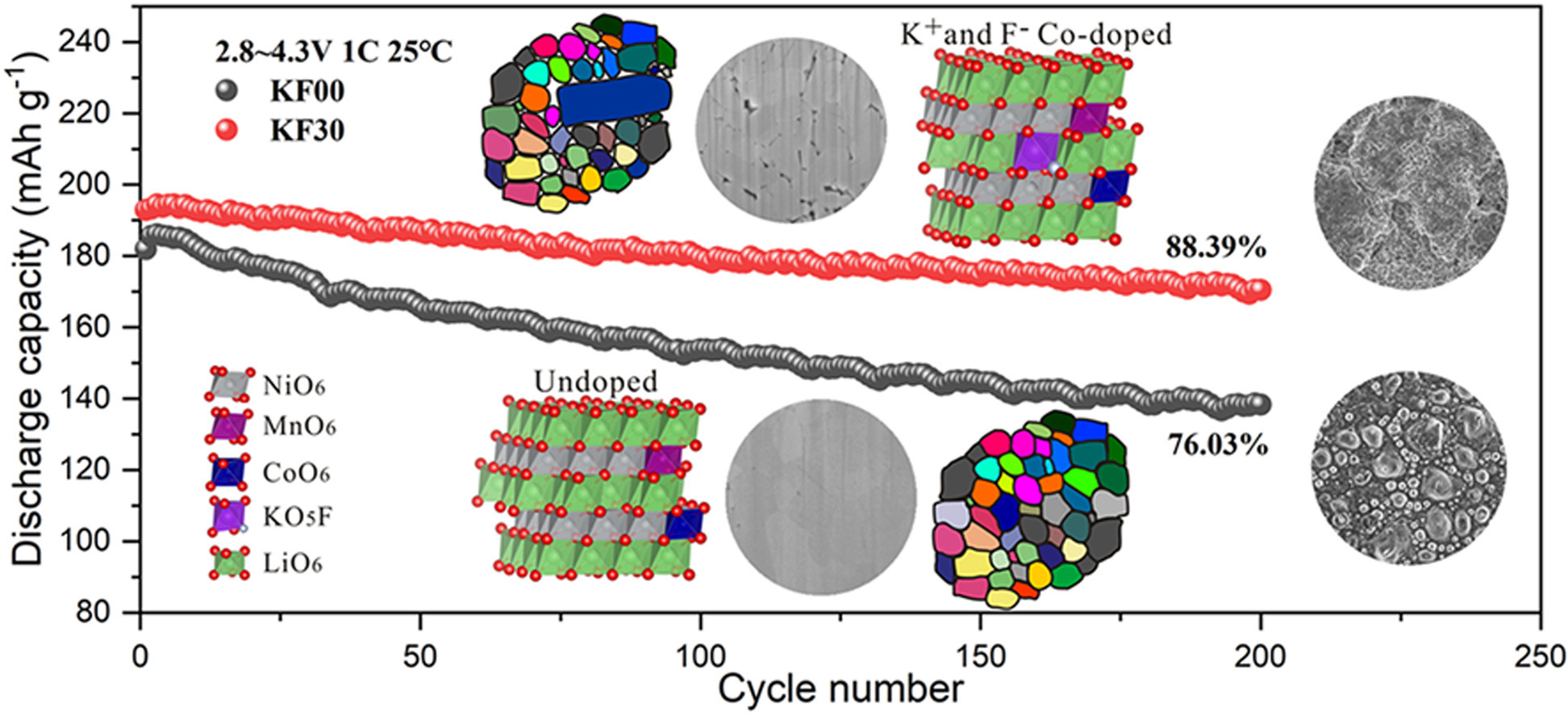
Ni-rich cathode materials for lithium-ion batteries have attracted much attention due to their high capacity and low cost; however, they are structurally and thermodynamically unstable, and their cycling performance also needs to be further improved to meet the needs of large-scale commercial applications. Herein, a synergistic K+ and F− co-doping strategy is used to enhance performance of Ni-rich LiNi0.8Co0.1Mn0.1O2 cathode material. Trace surface K+ doping forms large polyhedral primary particles with sharp edges, hindering dense aggregation and promoting uniform internal porosity within secondary particles. Bulk F− doping stabilizes the structure. This co-doping, combined with the porous architecture, significantly improves electrolyte infiltration, shortens Li+ pathways, reduces Li+/Ni2+ disordering, and lowers Li+ migration barriers, facilitates a stable cathode electrolyte interface (CEI), mitigates polarization and suppresses lattice oxygen loss. The optimized KF30 sample delivers 173.0 mAh g−1 at 8 C (111 % of undoped KF00 capacity). After 200 cycles at 1 C, it retains 170.5 mAh g−1 (88.39 % retention), outperforming KF00 by 12.36 %. This strategy provides a cost-effective approach to boost Ni-rich cathode stability and electrochemical properties for lithium-ion batteries.
Graphical abstract
Keywords
Porous material; K+ and F− co-doping; Ni-rich cathode material; Electrochemical performance; Lithium-ion batteries
文章导读