
期刊文章
过刊浏览
- Volumes 108-119 (2025)
-
Volumes 96-107 (2025)
-
Volume 107
Pages 1-376 (December 2025)
-
Volume 106
Pages 1-336 (November 2025)
-
Volume 105
Pages 1-356 (October 2025)
-
Volume 104
Pages 1-332 (September 2025)
-
Volume 103
Pages 1-314 (August 2025)
-
Volume 102
Pages 1-276 (July 2025)
-
Volume 101
Pages 1-166 (June 2025)
-
Volume 100
Pages 1-256 (May 2025)
-
Volume 99
Pages 1-242 (April 2025)
-
Volume 98
Pages 1-288 (March 2025)
-
Volume 97
Pages 1-256 (February 2025)
-
Volume 96
Pages 1-340 (January 2025)
-
Volume 107
-
Volumes 84-95 (2024)
-
Volume 95
Pages 1-392 (December 2024)
-
Volume 94
Pages 1-400 (November 2024)
-
Volume 93
Pages 1-376 (October 2024)
-
Volume 92
Pages 1-316 (September 2024)
-
Volume 91
Pages 1-378 (August 2024)
-
Volume 90
Pages 1-580 (July 2024)
-
Volume 89
Pages 1-278 (June 2024)
-
Volume 88
Pages 1-350 (May 2024)
-
Volume 87
Pages 1-338 (April 2024)
-
Volume 86
Pages 1-312 (March 2024)
-
Volume 85
Pages 1-334 (February 2024)
-
Volume 84
Pages 1-308 (January 2024)
-
Volume 95
-
Volumes 72-83 (2023)
-
Volume 83
Pages 1-258 (December 2023)
-
Volume 82
Pages 1-204 (November 2023)
-
Volume 81
Pages 1-188 (October 2023)
-
Volume 80
Pages 1-202 (September 2023)
-
Volume 79
Pages 1-172 (August 2023)
-
Volume 78
Pages 1-146 (July 2023)
-
Volume 77
Pages 1-152 (June 2023)
-
Volume 76
Pages 1-176 (May 2023)
-
Volume 75
Pages 1-228 (April 2023)
-
Volume 74
Pages 1-200 (March 2023)
-
Volume 73
Pages 1-138 (February 2023)
-
Volume 72
Pages 1-144 (January 2023)
-
Volume 83
-
Volumes 60-71 (2022)
-
Volume 71
Pages 1-108 (December 2022)
-
Volume 70
Pages 1-106 (November 2022)
-
Volume 69
Pages 1-122 (October 2022)
-
Volume 68
Pages 1-124 (September 2022)
-
Volume 67
Pages 1-102 (August 2022)
-
Volume 66
Pages 1-112 (July 2022)
-
Volume 65
Pages 1-138 (June 2022)
-
Volume 64
Pages 1-186 (May 2022)
-
Volume 63
Pages 1-124 (April 2022)
-
Volume 62
Pages 1-104 (March 2022)
-
Volume 61
Pages 1-120 (February 2022)
-
Volume 60
Pages 1-124 (January 2022)
-
Volume 71
- Volumes 54-59 (2021)
- Volumes 48-53 (2020)
- Volumes 42-47 (2019)
- Volumes 36-41 (2018)
- Volumes 30-35 (2017)
- Volumes 24-29 (2016)
- Volumes 18-23 (2015)
- Volumes 12-17 (2014)
- Volume 11 (2013)
- Volume 10 (2012)
- Volume 9 (2011)
- Volume 8 (2010)
- Volume 7 (2009)
- Volume 6 (2008)
- Volume 5 (2007)
- Volume 4 (2006)
- Volume 3 (2005)
- Volume 2 (2004)
- Volume 1 (2003)
Volume 108
Luo, D., Tian, R., Xie, S., Xue, Y., You, Y., & Lv, X. (2026). Interparticle forces and their regulation mechanisms in iron ore granulation: A review. Particuology, 108, 252-271. https://doi.org/10.1016/j.partic.2025.11.014
Interparticle forces and their regulation mechanisms in iron ore granulation: A review
Dongcai Luo, Renhao Tian, Shaoxian Xie, Yuxiao Xue, Yang You *, Xuewei Lv *
College of Materials Science and Engineering, Chongqing University, Chongqing, 400044, China
10.1016/j.partic.2025.11.014
Volume 108,
January 2026,
Pages 252-271
Received 6 March 2025, Revised 13 November 2025, Accepted 18 November 2025, Available online 28 November 2025, Version of Record 4 December 2025.
E-mail:
youyang@cqu.edu.cn; lvxuewei@cqu.edu.cn
Highlights
• Interparticle forces are critical to particle aggregation and growth.
• Summarize the types of interparticle force and their governing factors.
• Establish a connection between the interparticle force and operating conditions.
• Summarize the research progress of new granulation processes.
Abstract
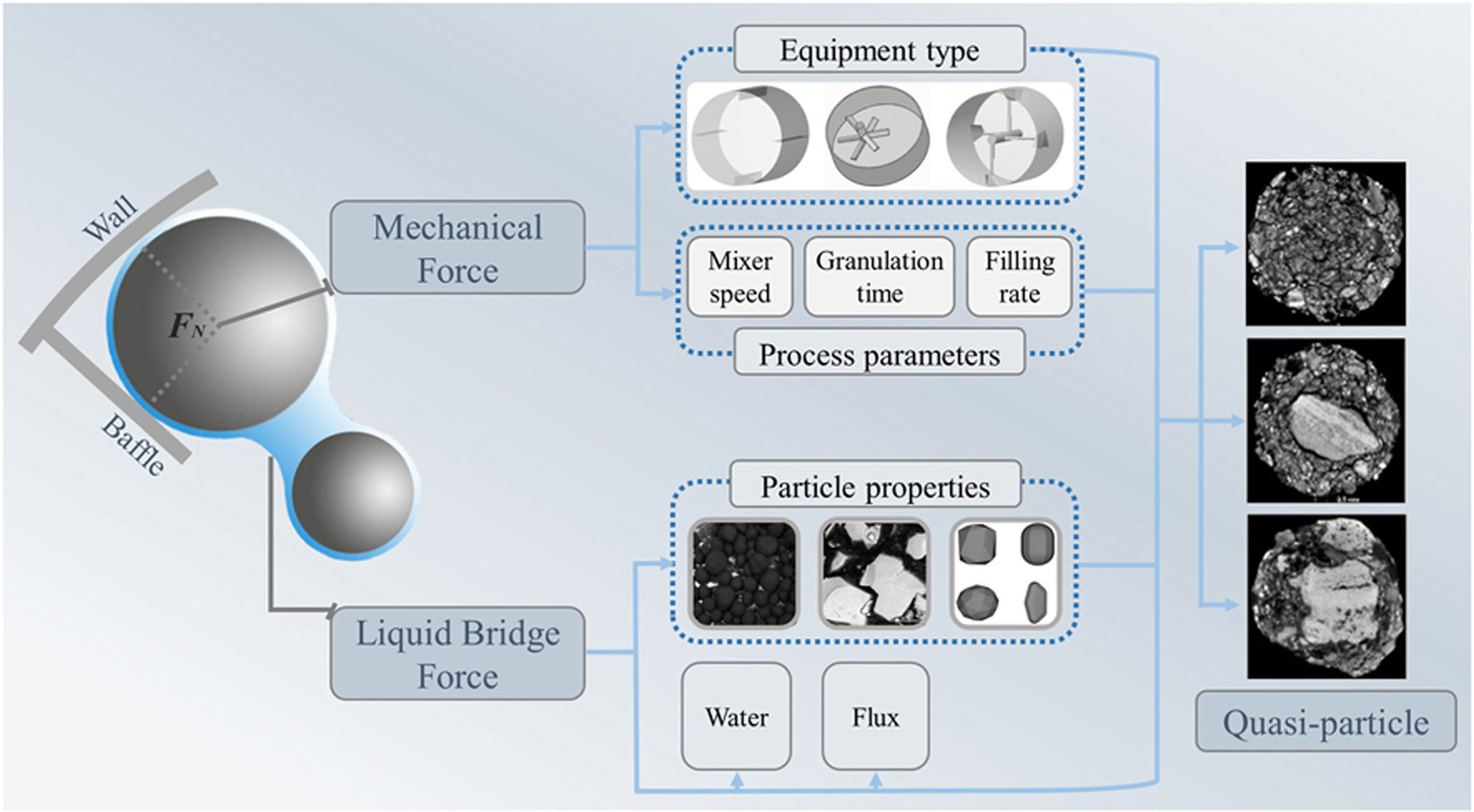
Iron ore granulation is a critical role in the production of sinter, with the resulting granule size distribution and strength directly influencing the permeability of the subsequent sinter bed and the quality of the sinter. Granulation involves the process of particle coalescence and growth under the influence of forces such as collision, compression, and friction, resulting in larger granules with a narrower size distribution. The inter-particle forces are governed by the properties of the iron ore, granulation equipment, and process parameters. Therefore, the appropriate granulation process and optimized configuration of iron ore plays a significant role in improving the technical and economic indicators of sintering. This paper reviews the mechanisms of particle growth during the granulation process, focusing on the microscopic interparticle forces that drive particle coalescence. A central theme of this review is to establish the critical link between these microscopic forces and the macroscopic process parameters. Therefore, it subsequently analyzes how raw material properties, equipment design, and operating conditions exert their influence precisely by regulating these interparticle forces. Finally, the paper summarizes the current challenges and future research directions in iron ore granulation. The results provide a theoretical basis for comprehensive understanding of iron ore granulation and efficient production of high-quality granules.
Graphical abstract
Keywords
Iron ore; Granulation; Inter-particle forces; Agglomeration; Granulation efficiency
文章导读