
期刊文章
过刊浏览
- Volumes 108-119 (2025)
-
Volumes 96-107 (2025)
-
Volume 107
Pages 1-376 (December 2025)
-
Volume 106
Pages 1-336 (November 2025)
-
Volume 105
Pages 1-356 (October 2025)
-
Volume 104
Pages 1-332 (September 2025)
-
Volume 103
Pages 1-314 (August 2025)
-
Volume 102
Pages 1-276 (July 2025)
-
Volume 101
Pages 1-166 (June 2025)
-
Volume 100
Pages 1-256 (May 2025)
-
Volume 99
Pages 1-242 (April 2025)
-
Volume 98
Pages 1-288 (March 2025)
-
Volume 97
Pages 1-256 (February 2025)
-
Volume 96
Pages 1-340 (January 2025)
-
Volume 107
-
Volumes 84-95 (2024)
-
Volume 95
Pages 1-392 (December 2024)
-
Volume 94
Pages 1-400 (November 2024)
-
Volume 93
Pages 1-376 (October 2024)
-
Volume 92
Pages 1-316 (September 2024)
-
Volume 91
Pages 1-378 (August 2024)
-
Volume 90
Pages 1-580 (July 2024)
-
Volume 89
Pages 1-278 (June 2024)
-
Volume 88
Pages 1-350 (May 2024)
-
Volume 87
Pages 1-338 (April 2024)
-
Volume 86
Pages 1-312 (March 2024)
-
Volume 85
Pages 1-334 (February 2024)
-
Volume 84
Pages 1-308 (January 2024)
-
Volume 95
-
Volumes 72-83 (2023)
-
Volume 83
Pages 1-258 (December 2023)
-
Volume 82
Pages 1-204 (November 2023)
-
Volume 81
Pages 1-188 (October 2023)
-
Volume 80
Pages 1-202 (September 2023)
-
Volume 79
Pages 1-172 (August 2023)
-
Volume 78
Pages 1-146 (July 2023)
-
Volume 77
Pages 1-152 (June 2023)
-
Volume 76
Pages 1-176 (May 2023)
-
Volume 75
Pages 1-228 (April 2023)
-
Volume 74
Pages 1-200 (March 2023)
-
Volume 73
Pages 1-138 (February 2023)
-
Volume 72
Pages 1-144 (January 2023)
-
Volume 83
-
Volumes 60-71 (2022)
-
Volume 71
Pages 1-108 (December 2022)
-
Volume 70
Pages 1-106 (November 2022)
-
Volume 69
Pages 1-122 (October 2022)
-
Volume 68
Pages 1-124 (September 2022)
-
Volume 67
Pages 1-102 (August 2022)
-
Volume 66
Pages 1-112 (July 2022)
-
Volume 65
Pages 1-138 (June 2022)
-
Volume 64
Pages 1-186 (May 2022)
-
Volume 63
Pages 1-124 (April 2022)
-
Volume 62
Pages 1-104 (March 2022)
-
Volume 61
Pages 1-120 (February 2022)
-
Volume 60
Pages 1-124 (January 2022)
-
Volume 71
- Volumes 54-59 (2021)
- Volumes 48-53 (2020)
- Volumes 42-47 (2019)
- Volumes 36-41 (2018)
- Volumes 30-35 (2017)
- Volumes 24-29 (2016)
- Volumes 18-23 (2015)
- Volumes 12-17 (2014)
- Volume 11 (2013)
- Volume 10 (2012)
- Volume 9 (2011)
- Volume 8 (2010)
- Volume 7 (2009)
- Volume 6 (2008)
- Volume 5 (2007)
- Volume 4 (2006)
- Volume 3 (2005)
- Volume 2 (2004)
- Volume 1 (2003)
Volume 108
Wang, Z., Gao, L., Zhang, Y., Zhang, X., & Zhang, B. (2026). Morphology controlled synthesis of ZSM-5 and enhanced catalytic activity in polypropylene hydrocracking. Particuology, 108, 272-279. https://doi.org/10.1016/j.partic.2025.11.016
Morphology controlled synthesis of ZSM-5 and enhanced catalytic activity in polypropylene hydrocracking
Ziru Wang a b, Li Gao a c, Ying Zhang a d, Xia Zhang b *, Bingsen Zhang a c *
a Shenyang National Laboratory for Materials Science, Institute of Metal Research, Chinese Academy of Sciences, Shenyang, 110016, China
b Department of Chemistry, College of Science, Northeastern University, Shenyang, 110819, China
c School of Materials Science and Engineering, University of Science and Technology of China, Shenyang, 110016, China
d School of Petrochemical Engineering, Liaoning Petrochemical University, Fushun, 113001, China
10.1016/j.partic.2025.11.016
Volume 108,
January 2026,
Pages 272-279
Received 23 October 2025, Revised 19 November 2025, Accepted 20 November 2025, Available online 28 November 2025, Version of Record 5 December 2025.
E-mail:
xzhang@mail.neu.edu.cn; bszhang@imr.ac.cn
Highlights
• Adjusting structure guide agent ratio precisely regulates ZSM-5 zeolite nucleation and crystal morphology.
• Two distinct ZSM-5 zeolites (n-ZSM-5 and s-ZSM-5) were synthesized with enhanced surface acid site density.
• n-ZSM-5 optimizes mass transfer, achieving 57.3 % liquid yield in plastic hydrocracking with controllable properties.
Abstract
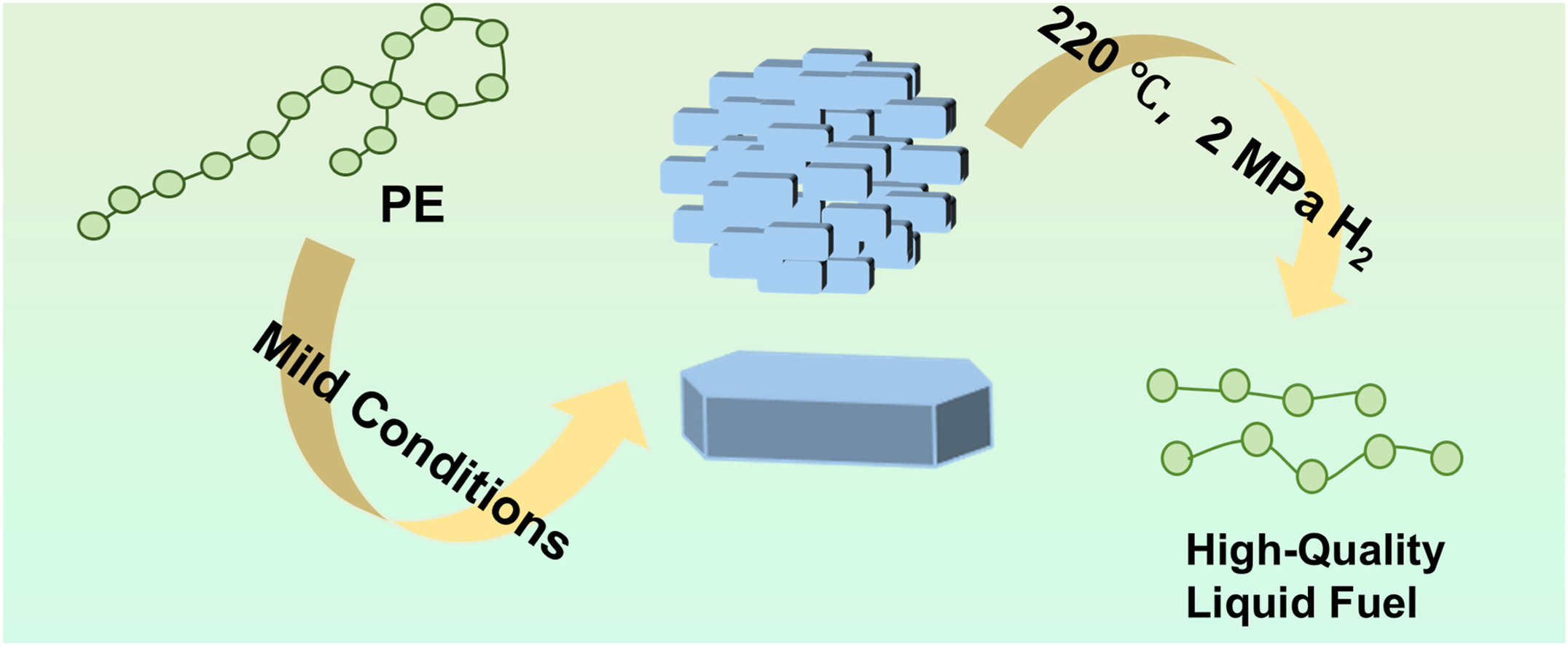
ZSM-5 zeolite has emerged as an outstanding catalyst in converting waste plastics into high-value chemicals. Constructing hierarchical micro-mesoporous ZSM-5 can significantly enhance diffusion characteristics and consequently improve catalytic cracking performance. The morphology of ZSM-5 plays a crucial role in altering its catalytic hydrocracking efficiency in plastic degradation, but the reasons behind this is not clear. Herein, by precisely adjusting the structure-directing agent (SDA) ratio to control nucleation dynamics, we have developed a morphology-controlled synthesis strategy for ZSM-5 zeolites. Two distinct hierarchical ZSM-5 catalysts were successfully fabricated: plate-shaped n-ZSM-5 and quasi-spherical s-ZSM-5. And, increasing the SDA content was worked in promoting nucleation kinetics, facilitating the incorporation of active components into the zeolite framework, and increasing surface acid site density. The plate-shaped n-ZSM-5 exhibited exceptional catalytic performance in polypropylene hydrocracking with a liquid yield of 57.3 %, and proved to maintain effective activity for the actual conversion of plastic waste. The catalytic mechanism reveals that the morphology engineering can effectively regulate mass transport within catalyst pores, provide a novel approach for tailoring zeolite catalyst properties. This work offers fundamental insights into structure-performance relationships for advanced plastic upcycling catalysts.
Graphical abstract
Keywords
Plastic upcycling; Catalytic hydrocracking; Polypropylene; Liquid fuel; Zeolites
文章导读