
期刊文章
过刊浏览
- Volumes 108-119 (2025)
-
Volumes 96-107 (2025)
-
Volume 107
Pages 1-376 (December 2025)
-
Volume 106
Pages 1-336 (November 2025)
-
Volume 105
Pages 1-356 (October 2025)
-
Volume 104
Pages 1-332 (September 2025)
-
Volume 103
Pages 1-314 (August 2025)
-
Volume 102
Pages 1-276 (July 2025)
-
Volume 101
Pages 1-166 (June 2025)
-
Volume 100
Pages 1-256 (May 2025)
-
Volume 99
Pages 1-242 (April 2025)
-
Volume 98
Pages 1-288 (March 2025)
-
Volume 97
Pages 1-256 (February 2025)
-
Volume 96
Pages 1-340 (January 2025)
-
Volume 107
-
Volumes 84-95 (2024)
-
Volume 95
Pages 1-392 (December 2024)
-
Volume 94
Pages 1-400 (November 2024)
-
Volume 93
Pages 1-376 (October 2024)
-
Volume 92
Pages 1-316 (September 2024)
-
Volume 91
Pages 1-378 (August 2024)
-
Volume 90
Pages 1-580 (July 2024)
-
Volume 89
Pages 1-278 (June 2024)
-
Volume 88
Pages 1-350 (May 2024)
-
Volume 87
Pages 1-338 (April 2024)
-
Volume 86
Pages 1-312 (March 2024)
-
Volume 85
Pages 1-334 (February 2024)
-
Volume 84
Pages 1-308 (January 2024)
-
Volume 95
-
Volumes 72-83 (2023)
-
Volume 83
Pages 1-258 (December 2023)
-
Volume 82
Pages 1-204 (November 2023)
-
Volume 81
Pages 1-188 (October 2023)
-
Volume 80
Pages 1-202 (September 2023)
-
Volume 79
Pages 1-172 (August 2023)
-
Volume 78
Pages 1-146 (July 2023)
-
Volume 77
Pages 1-152 (June 2023)
-
Volume 76
Pages 1-176 (May 2023)
-
Volume 75
Pages 1-228 (April 2023)
-
Volume 74
Pages 1-200 (March 2023)
-
Volume 73
Pages 1-138 (February 2023)
-
Volume 72
Pages 1-144 (January 2023)
-
Volume 83
-
Volumes 60-71 (2022)
-
Volume 71
Pages 1-108 (December 2022)
-
Volume 70
Pages 1-106 (November 2022)
-
Volume 69
Pages 1-122 (October 2022)
-
Volume 68
Pages 1-124 (September 2022)
-
Volume 67
Pages 1-102 (August 2022)
-
Volume 66
Pages 1-112 (July 2022)
-
Volume 65
Pages 1-138 (June 2022)
-
Volume 64
Pages 1-186 (May 2022)
-
Volume 63
Pages 1-124 (April 2022)
-
Volume 62
Pages 1-104 (March 2022)
-
Volume 61
Pages 1-120 (February 2022)
-
Volume 60
Pages 1-124 (January 2022)
-
Volume 71
- Volumes 54-59 (2021)
- Volumes 48-53 (2020)
- Volumes 42-47 (2019)
- Volumes 36-41 (2018)
- Volumes 30-35 (2017)
- Volumes 24-29 (2016)
- Volumes 18-23 (2015)
- Volumes 12-17 (2014)
- Volume 11 (2013)
- Volume 10 (2012)
- Volume 9 (2011)
- Volume 8 (2010)
- Volume 7 (2009)
- Volume 6 (2008)
- Volume 5 (2007)
- Volume 4 (2006)
- Volume 3 (2005)
- Volume 2 (2004)
- Volume 1 (2003)
Volume 108
Influence of fluidization dynamics and liquid evaporation on particle growth in a top-spray fluidized bed
Han Pu, Jiliang Ma *, Jialiang Cai, Yi Wang, Xiaoping Chen, Cai Liang, Daoyin Liu, Meng Liu
Southeast University, Key Laboratory of Energy Thermal Conversion and Control of Ministry of Education, School of Energy and Environment, Nanjing, 211102, China
10.1016/j.partic.2025.11.013
Volume 108,
January 2026,
Pages 280-292
Received 19 May 2025, Revised 12 November 2025, Accepted 17 November 2025, Available online 29 November 2025, Version of Record 5 December 2025.
E-mail:
jlma@seu.edu.cn
Highlights
• Relationship between particle growth, fluidization, and evaporation is studied.
• Agglomeration closely relates to liquid viscosity, temperature and spraying rate.
• Liquid evaporation significantly correlates with dynamics of bubbles in the bed.
• Particle growth mode is categorized into nucleation growth and shell growth.
• A regime map is constructed to distinguish agglomeration and fluidization failure.
Abstract
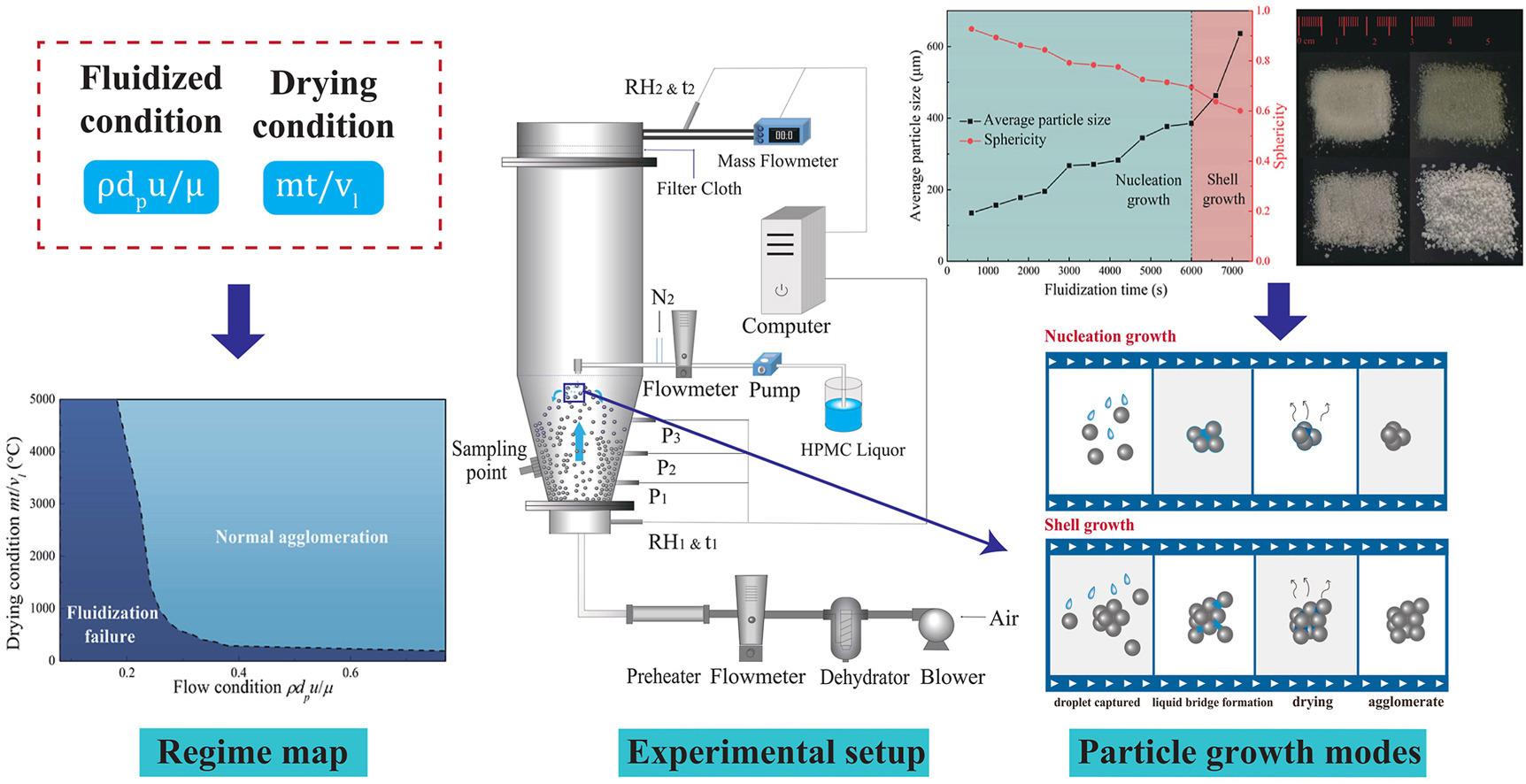
The phenomenon of particle agglomeration in a liquid-containing fluidized bed is closely associated with the interactions between gas and solid phases, as well as the evaporation of the liquid component. This study performs an experimental investigation to examine the interactions among particle growth, fluidization behavior, and droplet evaporation within a continuous top-spray fluidized bed system. The research indicates that increased drying air temperatures generate severe drying conditions that promote the conversion of liquid bridges to solid bridges between particles. This conversion significantly decreases the nucleation time and encourages a more consistent distribution of agglomerate sizes. Additionally, a rise in the spraying rate and binder viscosity, strengthen the cohesive forces among particles, resulting in the development of larger agglomerates. The evaporation of the liquid binder exhibits a substantial correlation with the behavior of bubbles within the bed, which in turn affects particle growth and the chaotic dynamics of the fluidized bed system. The process of particle growth is delineated into two separate phases: nucleation growth and shell growth. Notably, the duration of nucleation growth phase exceeds that of the shell growth phase. Ultimately, a regime map has been developed to evaluate the feasibility of the spray granulation process concerning fluidization and drying parameters. The findings suggest that excessively low fluidization numbers, coupled with inadequate drying conditions, could lead to the failure of the liquid-containing fluidization process.
Graphical abstract
Keywords
Top-spray fluidized bed; Liqiud bridge force; Particle agglomeration; Drying; Pressure fluctuation
文章导读