
期刊文章
过刊浏览
- Volumes 108-119 (2025)
-
Volumes 96-107 (2025)
-
Volume 107
Pages 1-376 (December 2025)
-
Volume 106
Pages 1-336 (November 2025)
-
Volume 105
Pages 1-356 (October 2025)
-
Volume 104
Pages 1-332 (September 2025)
-
Volume 103
Pages 1-314 (August 2025)
-
Volume 102
Pages 1-276 (July 2025)
-
Volume 101
Pages 1-166 (June 2025)
-
Volume 100
Pages 1-256 (May 2025)
-
Volume 99
Pages 1-242 (April 2025)
-
Volume 98
Pages 1-288 (March 2025)
-
Volume 97
Pages 1-256 (February 2025)
-
Volume 96
Pages 1-340 (January 2025)
-
Volume 107
-
Volumes 84-95 (2024)
-
Volume 95
Pages 1-392 (December 2024)
-
Volume 94
Pages 1-400 (November 2024)
-
Volume 93
Pages 1-376 (October 2024)
-
Volume 92
Pages 1-316 (September 2024)
-
Volume 91
Pages 1-378 (August 2024)
-
Volume 90
Pages 1-580 (July 2024)
-
Volume 89
Pages 1-278 (June 2024)
-
Volume 88
Pages 1-350 (May 2024)
-
Volume 87
Pages 1-338 (April 2024)
-
Volume 86
Pages 1-312 (March 2024)
-
Volume 85
Pages 1-334 (February 2024)
-
Volume 84
Pages 1-308 (January 2024)
-
Volume 95
-
Volumes 72-83 (2023)
-
Volume 83
Pages 1-258 (December 2023)
-
Volume 82
Pages 1-204 (November 2023)
-
Volume 81
Pages 1-188 (October 2023)
-
Volume 80
Pages 1-202 (September 2023)
-
Volume 79
Pages 1-172 (August 2023)
-
Volume 78
Pages 1-146 (July 2023)
-
Volume 77
Pages 1-152 (June 2023)
-
Volume 76
Pages 1-176 (May 2023)
-
Volume 75
Pages 1-228 (April 2023)
-
Volume 74
Pages 1-200 (March 2023)
-
Volume 73
Pages 1-138 (February 2023)
-
Volume 72
Pages 1-144 (January 2023)
-
Volume 83
-
Volumes 60-71 (2022)
-
Volume 71
Pages 1-108 (December 2022)
-
Volume 70
Pages 1-106 (November 2022)
-
Volume 69
Pages 1-122 (October 2022)
-
Volume 68
Pages 1-124 (September 2022)
-
Volume 67
Pages 1-102 (August 2022)
-
Volume 66
Pages 1-112 (July 2022)
-
Volume 65
Pages 1-138 (June 2022)
-
Volume 64
Pages 1-186 (May 2022)
-
Volume 63
Pages 1-124 (April 2022)
-
Volume 62
Pages 1-104 (March 2022)
-
Volume 61
Pages 1-120 (February 2022)
-
Volume 60
Pages 1-124 (January 2022)
-
Volume 71
- Volumes 54-59 (2021)
- Volumes 48-53 (2020)
- Volumes 42-47 (2019)
- Volumes 36-41 (2018)
- Volumes 30-35 (2017)
- Volumes 24-29 (2016)
- Volumes 18-23 (2015)
- Volumes 12-17 (2014)
- Volume 11 (2013)
- Volume 10 (2012)
- Volume 9 (2011)
- Volume 8 (2010)
- Volume 7 (2009)
- Volume 6 (2008)
- Volume 5 (2007)
- Volume 4 (2006)
- Volume 3 (2005)
- Volume 2 (2004)
- Volume 1 (2003)
Volume 108
Numerical investigation on reactive crystallization of Li-ion batteries precursor Ni(OH)2 in a stirred tank: Effect of structural factors on particle size and distribution
Junhai Deng a b, Jiuhua Chen a, Shuyao Feng a, Yunyun Tian a, Yingqi Liao a, Bi Luo a, Luchang Han a, Yefeng Zhou a *
a National & Local United Engineering Research Centre for Chemical Process Simulation and Intensification, Chemical Process Simulation and Optimization Engineering Research Center of Ministry of Education, Xiangtan University, Xiangtan, 411105, China
b Institute of Advanced Equipment, Zhejiang University, Hangzhou, 310027, China
10.1016/j.partic.2025.12.001
Volume 108,
January 2026,
Pages 307-319
Received 14 October 2025, Revised 27 November 2025, Accepted 2 December 2025, Available online 5 December 2025, Version of Record 11 December 2025.
E-mail:
zhouyf@xtu.edu.cn
Highlights
• CFD-PBM coupled model is utilized to simulate the reactive crystallization of Li-ion batteries precursor.
• Simulations incorporate fluid dynamics and crystallization kinetics in different structure and option.
• Effects of turbulent parameters on particle size and distribution are investigated and analyzed.
Abstract
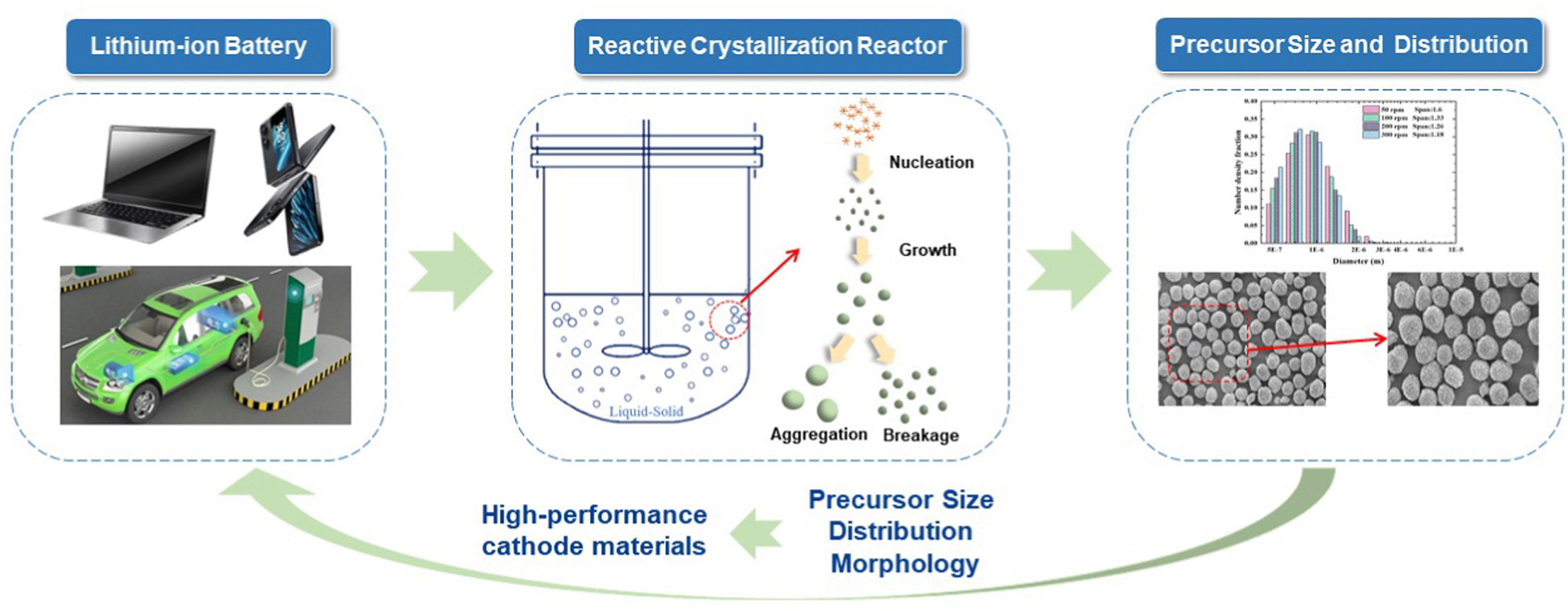
The stirred tank reactor is widely used for preparing Li-ion batteries precursors, and the high-performance materials are utilized in various fields such as electronic devices. However, controlling the particle characteristics remains a significant challenge due to the complex interaction between fluid dynamics and crystallization kinetics. Therefore, this work proposes the computational fluid dynamics-population balance model coupled model to simulate Ni(OH)2 reactive crystallization. By altering the structure and operation, this work analyzes effects of turbulence parameters on particle characteristics. Results show that increasing the height, baffle number and rotational speed enhances turbulence parameters, which reduces the Sauter mean diameter about 1.08–2.14 times and decreases the span from 1.6 to 1.17. Axial-flow impellers generate lower turbulent dissipation and shear force compared to radial-flow impellers, causing less particle breakage and better suitability for reactive crystallization. The wave bottom enhances turbulent dissipation about 1.19–1.38 times compared to flat and round bottom, improving flow circulation and reducing dead zones. Moreover, experiment and simulation demonstrate consistent trend in particle size and distribution under different baffle numbers, with morphology becoming better. This work provides important theoretical support for optimizing reactor design and enhancing reactive crystallization, facilitating the production of high-performance materials.
Graphical abstract
Keywords
CFD-PBM; Reactive crystallization; Li-ion batteries precursor; Stirred tank reactor
文章导读