
期刊文章
过刊浏览
- Volumes 108-119 (2025)
-
Volumes 96-107 (2025)
-
Volume 107
Pages 1-376 (December 2025)
-
Volume 106
Pages 1-336 (November 2025)
-
Volume 105
Pages 1-356 (October 2025)
-
Volume 104
Pages 1-332 (September 2025)
-
Volume 103
Pages 1-314 (August 2025)
-
Volume 102
Pages 1-276 (July 2025)
-
Volume 101
Pages 1-166 (June 2025)
-
Volume 100
Pages 1-256 (May 2025)
-
Volume 99
Pages 1-242 (April 2025)
-
Volume 98
Pages 1-288 (March 2025)
-
Volume 97
Pages 1-256 (February 2025)
-
Volume 96
Pages 1-340 (January 2025)
-
Volume 107
-
Volumes 84-95 (2024)
-
Volume 95
Pages 1-392 (December 2024)
-
Volume 94
Pages 1-400 (November 2024)
-
Volume 93
Pages 1-376 (October 2024)
-
Volume 92
Pages 1-316 (September 2024)
-
Volume 91
Pages 1-378 (August 2024)
-
Volume 90
Pages 1-580 (July 2024)
-
Volume 89
Pages 1-278 (June 2024)
-
Volume 88
Pages 1-350 (May 2024)
-
Volume 87
Pages 1-338 (April 2024)
-
Volume 86
Pages 1-312 (March 2024)
-
Volume 85
Pages 1-334 (February 2024)
-
Volume 84
Pages 1-308 (January 2024)
-
Volume 95
-
Volumes 72-83 (2023)
-
Volume 83
Pages 1-258 (December 2023)
-
Volume 82
Pages 1-204 (November 2023)
-
Volume 81
Pages 1-188 (October 2023)
-
Volume 80
Pages 1-202 (September 2023)
-
Volume 79
Pages 1-172 (August 2023)
-
Volume 78
Pages 1-146 (July 2023)
-
Volume 77
Pages 1-152 (June 2023)
-
Volume 76
Pages 1-176 (May 2023)
-
Volume 75
Pages 1-228 (April 2023)
-
Volume 74
Pages 1-200 (March 2023)
-
Volume 73
Pages 1-138 (February 2023)
-
Volume 72
Pages 1-144 (January 2023)
-
Volume 83
-
Volumes 60-71 (2022)
-
Volume 71
Pages 1-108 (December 2022)
-
Volume 70
Pages 1-106 (November 2022)
-
Volume 69
Pages 1-122 (October 2022)
-
Volume 68
Pages 1-124 (September 2022)
-
Volume 67
Pages 1-102 (August 2022)
-
Volume 66
Pages 1-112 (July 2022)
-
Volume 65
Pages 1-138 (June 2022)
-
Volume 64
Pages 1-186 (May 2022)
-
Volume 63
Pages 1-124 (April 2022)
-
Volume 62
Pages 1-104 (March 2022)
-
Volume 61
Pages 1-120 (February 2022)
-
Volume 60
Pages 1-124 (January 2022)
-
Volume 71
- Volumes 54-59 (2021)
- Volumes 48-53 (2020)
- Volumes 42-47 (2019)
- Volumes 36-41 (2018)
- Volumes 30-35 (2017)
- Volumes 24-29 (2016)
- Volumes 18-23 (2015)
- Volumes 12-17 (2014)
- Volume 11 (2013)
- Volume 10 (2012)
- Volume 9 (2011)
- Volume 8 (2010)
- Volume 7 (2009)
- Volume 6 (2008)
- Volume 5 (2007)
- Volume 4 (2006)
- Volume 3 (2005)
- Volume 2 (2004)
- Volume 1 (2003)
Volume 108
Separation dynamic model of air dense medium fluidized bed for coal beneficiation and control
Gansu Zhang a b, Tianxin Li e, Hongyang Li c, Zhiqiang Li a b, Shuxian Su a b, Xuan Xu a b, Wei Dai d, Liang Dong a b d *
a International Joint Laboratory of Minerals Efficient Processing and Utilization, Ministry of Education, Xuzhou, 221116, China
b School of Chemical Engineering & Technology, China University of Mining & Technology, Xuzhou, 221116, China
c State Key Laboratory of Multimodal Artificial Intelligence Systems, Institute of Automation, Chinese Academy of Sciences, Beijing, 100190, China
d Artificial Intelligence Research Institute, China University of Mining & Technology, Xuzhou, 221116, China
e Ningxia Baofeng Energy Coal Preparation and Blending Technology Co., Ltd, Yinchuan, 751400, China
10.1016/j.partic.2025.11.019
Volume 108,
January 2026,
Pages 320-335
Received 8 October 2025, Revised 29 November 2025, Accepted 30 November 2025, Available online 6 December 2025, Version of Record 17 December 2025.
E-mail:
dongl@cumt.edu.cn
Highlights
• The separation dynamics of ADMFB was modeled, containing dynamic and static information.
• A decoupling density model with self-balancing property was developed for control purposes.
• An ash consistency assumption for ash correction was proposed, with relative error around 5%.
• Model predictive control was implemented on ADMFB model, reducing control time by 46%.
Abstract
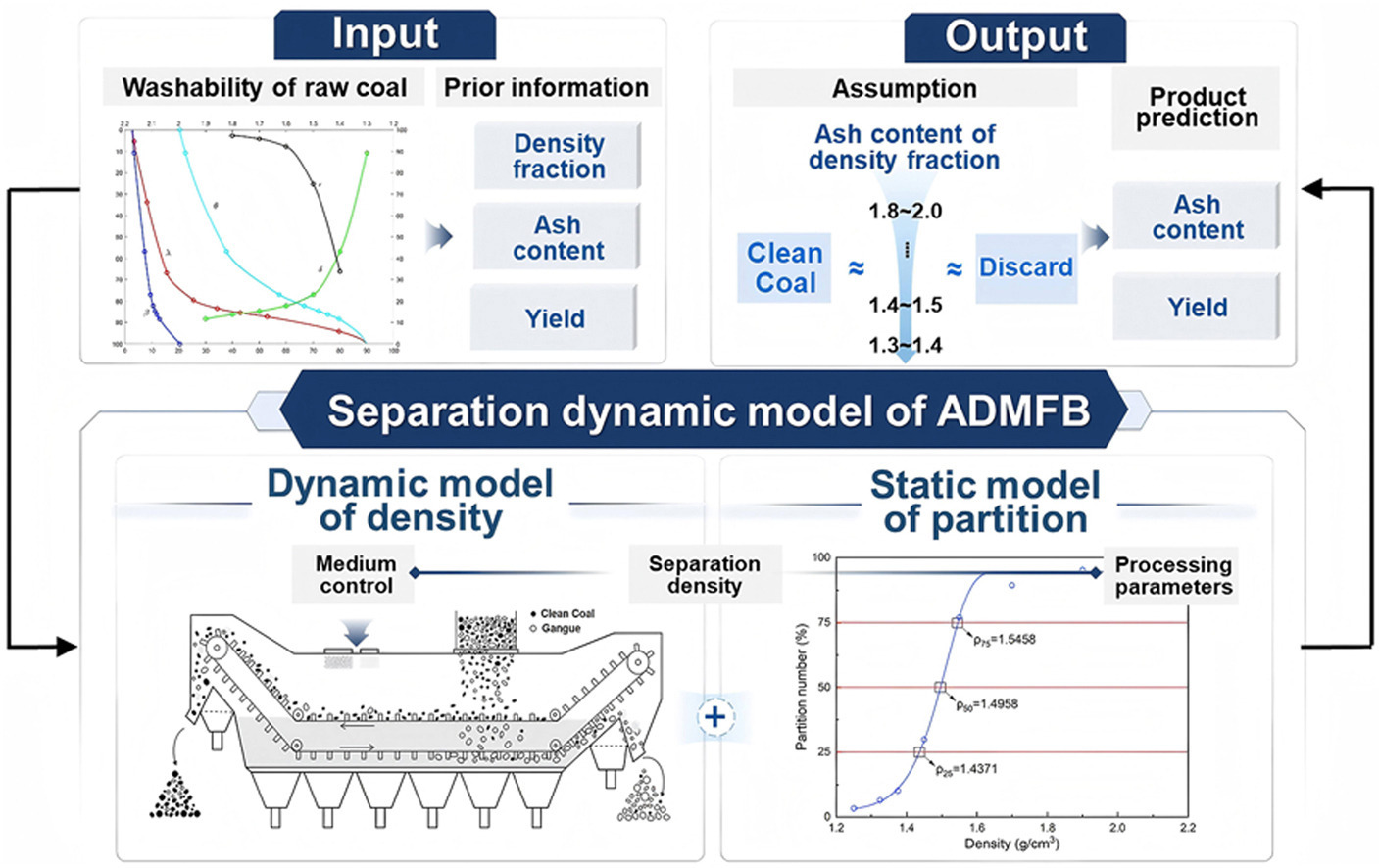
This study presents a comprehensive framework for the separation dynamic model of Air Dense Medium Fluidized Bed (ADMFB) to promote the intelligentization of coal preparation. The framework is a double-layer composite structure. In the outer layer, the static model of partition was extended from Dense Medium Cyclones to ADMFB. In the inner layer, the dynamic model of bed density was developed from the coupling model to the decoupling model with self-balancing characteristics. The model predicts product yield and ash content, which is validated against industrial separation data. The baseline performance is good but unstable, with maximum relative error 38.43 % and minimum relative error 4.48 % for coal ash content. To address this, an ash correction algorithm was innovatively put forward by introducing organic efficiency θ. The performance improvement is significant that coal ash content has maximum relative error 5.97 % and minimum relative error 0.48 %. Finally, Model Predictive Control (MPC) was implemented following the global linearization of the nonlinear bed density model, whose convergence speed to reach the tracking value is 46 % faster than constant control. Overall, this work provides a pathway for coal preparation plants to achieve more stable and intelligent production.
Graphical abstract
Keywords
Dry coal preparation; Separation dynamic model; Partition curve; Bed density regulation; Model predictive control
文章导读