
期刊文章
过刊浏览
- Volumes 108-119 (2025)
-
Volumes 96-107 (2025)
-
Volume 107
Pages 1-376 (December 2025)
-
Volume 106
Pages 1-336 (November 2025)
-
Volume 105
Pages 1-356 (October 2025)
-
Volume 104
Pages 1-332 (September 2025)
-
Volume 103
Pages 1-314 (August 2025)
-
Volume 102
Pages 1-276 (July 2025)
-
Volume 101
Pages 1-166 (June 2025)
-
Volume 100
Pages 1-256 (May 2025)
-
Volume 99
Pages 1-242 (April 2025)
-
Volume 98
Pages 1-288 (March 2025)
-
Volume 97
Pages 1-256 (February 2025)
-
Volume 96
Pages 1-340 (January 2025)
-
Volume 107
-
Volumes 84-95 (2024)
-
Volume 95
Pages 1-392 (December 2024)
-
Volume 94
Pages 1-400 (November 2024)
-
Volume 93
Pages 1-376 (October 2024)
-
Volume 92
Pages 1-316 (September 2024)
-
Volume 91
Pages 1-378 (August 2024)
-
Volume 90
Pages 1-580 (July 2024)
-
Volume 89
Pages 1-278 (June 2024)
-
Volume 88
Pages 1-350 (May 2024)
-
Volume 87
Pages 1-338 (April 2024)
-
Volume 86
Pages 1-312 (March 2024)
-
Volume 85
Pages 1-334 (February 2024)
-
Volume 84
Pages 1-308 (January 2024)
-
Volume 95
-
Volumes 72-83 (2023)
-
Volume 83
Pages 1-258 (December 2023)
-
Volume 82
Pages 1-204 (November 2023)
-
Volume 81
Pages 1-188 (October 2023)
-
Volume 80
Pages 1-202 (September 2023)
-
Volume 79
Pages 1-172 (August 2023)
-
Volume 78
Pages 1-146 (July 2023)
-
Volume 77
Pages 1-152 (June 2023)
-
Volume 76
Pages 1-176 (May 2023)
-
Volume 75
Pages 1-228 (April 2023)
-
Volume 74
Pages 1-200 (March 2023)
-
Volume 73
Pages 1-138 (February 2023)
-
Volume 72
Pages 1-144 (January 2023)
-
Volume 83
-
Volumes 60-71 (2022)
-
Volume 71
Pages 1-108 (December 2022)
-
Volume 70
Pages 1-106 (November 2022)
-
Volume 69
Pages 1-122 (October 2022)
-
Volume 68
Pages 1-124 (September 2022)
-
Volume 67
Pages 1-102 (August 2022)
-
Volume 66
Pages 1-112 (July 2022)
-
Volume 65
Pages 1-138 (June 2022)
-
Volume 64
Pages 1-186 (May 2022)
-
Volume 63
Pages 1-124 (April 2022)
-
Volume 62
Pages 1-104 (March 2022)
-
Volume 61
Pages 1-120 (February 2022)
-
Volume 60
Pages 1-124 (January 2022)
-
Volume 71
- Volumes 54-59 (2021)
- Volumes 48-53 (2020)
- Volumes 42-47 (2019)
- Volumes 36-41 (2018)
- Volumes 30-35 (2017)
- Volumes 24-29 (2016)
- Volumes 18-23 (2015)
- Volumes 12-17 (2014)
- Volume 11 (2013)
- Volume 10 (2012)
- Volume 9 (2011)
- Volume 8 (2010)
- Volume 7 (2009)
- Volume 6 (2008)
- Volume 5 (2007)
- Volume 4 (2006)
- Volume 3 (2005)
- Volume 2 (2004)
- Volume 1 (2003)
Volume 109
Yang, S., Zhang, J., Wang, B., Gu, W., & Zhou, W. (2026). Numerical simulation and experimental study on PM2.5 capture performance of multiple electric field ESP under different magnetic field introduction positions. Particuology, 109, 117-126. https://doi.org/10.1016/j.partic.2025.12.009
Numerical simulation and experimental study on PM2.5 capture performance of multiple electric field ESP under different magnetic field introduction positions
Shengxin Yang a 1, Jianping Zhang b 1 *, Boren Wang c, Wen Gu c, Weiguo Zhou c
a School of Mechanical Engineering, University of Shanghai for Science and Technology, Shanghai, 200093, China
b School of Information Science and Technology, Sanda University, Shanghai, 201209, China
c Shanghai Donghai Wind Power Generation Co., Ltd., Shanghai, 200090, China
10.1016/j.partic.2025.12.009
Volume 109,
February 2026,
Pages 117-126
Received 29 July 2025, Revised 30 November 2025, Accepted 11 December 2025, Available online 2 January 2026, Version of Record 7 January 2026.
E-mail:
zjpusst@163.com
Highlights
• Dust-removal mechanism in multiple electric field ESP is investigated.
• Magnetic confinement effect can significantly promote the trapping of fine particles.
• Particle motion under different operating conditions is analyzed by PIV experiments.
• Magnetic field location affects particle trajectory and collection performance.
• Low flue gas flow rate and voltage enhance magnetic confinement.
Abstract
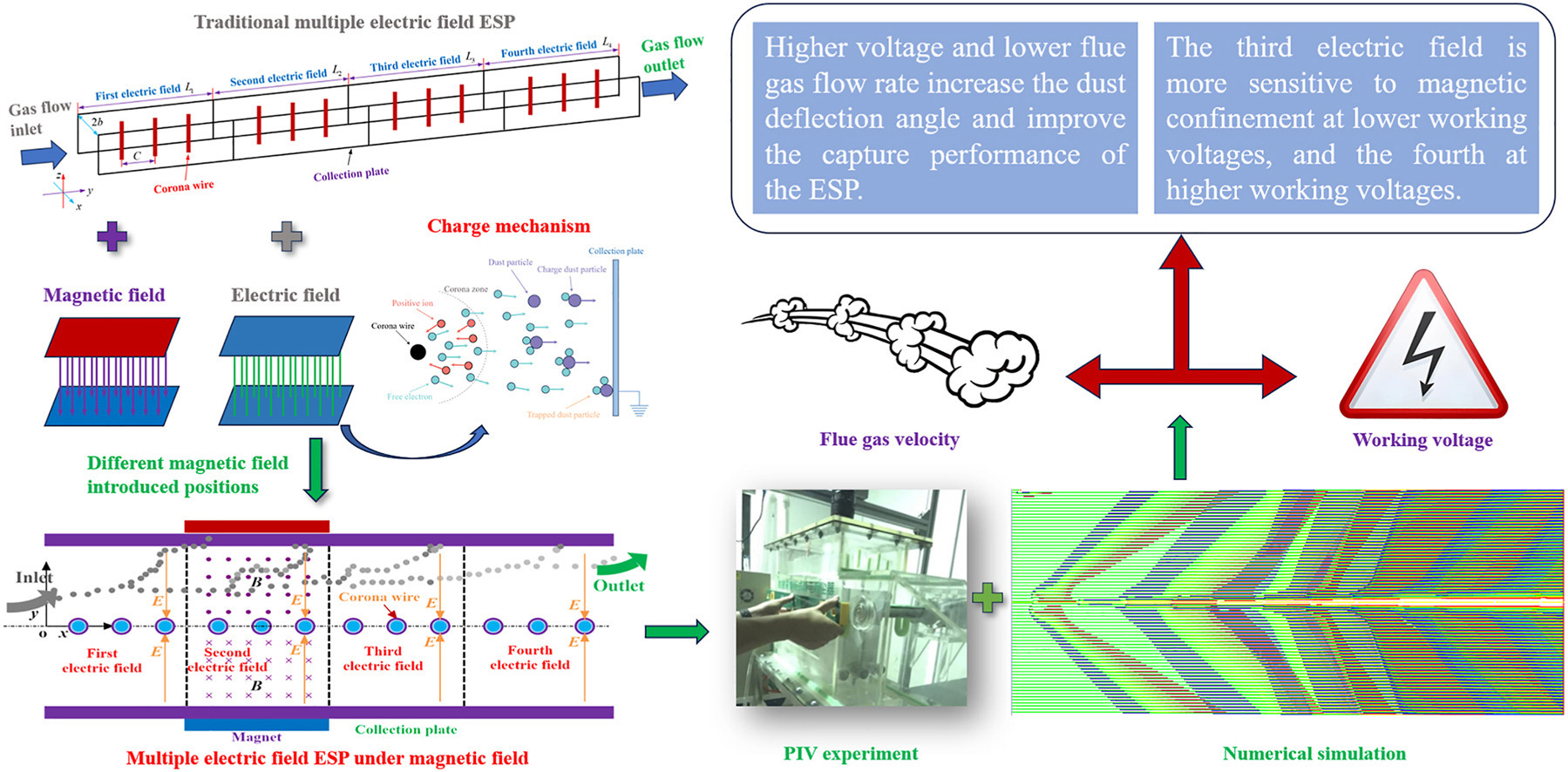
Aiming at enhancing the capture performance of electrostatic precipitator (ESP) for PM2.5 particles, this paper introduces a multi-field coupling model and carries out the analysis of the electromagnetic dedusting mechanism of four electric field ESP under the magnetic-field-induced trajectory modification, and investigates the capture performance of multiple electric field ESP for PM2.5 particles at different magnetic field introduction positions through numerical simulations and PIV (Particle Image Velocimetry) experiments. The PIV measurements showed flow-field patterns that were consistent with established ESP findings, where higher applied voltage and lower flue-gas velocity lead to stronger particle deflection toward the collection plate. These observed trends serve as a validation of the reliability of the present PIV setup and simulation model. Introducing a magnetic field into a specific zone resulted in particles to follow a spiral path leading to the collection plate. This motion not only altered the paths of particles in the targeted region but also influenced adjacent zones. Magnetic confinement was found to be more effective under low flue gas velocity and low operating voltage conditions. Furthermore, at lower voltages, the third electric field was more sensitive to magnetic confinement, whereas at higher voltages, the fourth electric field exhibited greater sensitivity. The findings can offer new design ideas for performance enhancement of traditional ESPs.
Graphical abstract
Keywords
Multiple electric field ESP; Magnetic field introduction position; PIV experiment; Magnetic confinement; Capture performance
文章导读