
期刊文章
过刊浏览
- Volumes 108-119 (2025)
-
Volumes 96-107 (2025)
-
Volume 107
Pages 1-376 (December 2025)
-
Volume 106
Pages 1-336 (November 2025)
-
Volume 105
Pages 1-356 (October 2025)
-
Volume 104
Pages 1-332 (September 2025)
-
Volume 103
Pages 1-314 (August 2025)
-
Volume 102
Pages 1-276 (July 2025)
-
Volume 101
Pages 1-166 (June 2025)
-
Volume 100
Pages 1-256 (May 2025)
-
Volume 99
Pages 1-242 (April 2025)
-
Volume 98
Pages 1-288 (March 2025)
-
Volume 97
Pages 1-256 (February 2025)
-
Volume 96
Pages 1-340 (January 2025)
-
Volume 107
-
Volumes 84-95 (2024)
-
Volume 95
Pages 1-392 (December 2024)
-
Volume 94
Pages 1-400 (November 2024)
-
Volume 93
Pages 1-376 (October 2024)
-
Volume 92
Pages 1-316 (September 2024)
-
Volume 91
Pages 1-378 (August 2024)
-
Volume 90
Pages 1-580 (July 2024)
-
Volume 89
Pages 1-278 (June 2024)
-
Volume 88
Pages 1-350 (May 2024)
-
Volume 87
Pages 1-338 (April 2024)
-
Volume 86
Pages 1-312 (March 2024)
-
Volume 85
Pages 1-334 (February 2024)
-
Volume 84
Pages 1-308 (January 2024)
-
Volume 95
-
Volumes 72-83 (2023)
-
Volume 83
Pages 1-258 (December 2023)
-
Volume 82
Pages 1-204 (November 2023)
-
Volume 81
Pages 1-188 (October 2023)
-
Volume 80
Pages 1-202 (September 2023)
-
Volume 79
Pages 1-172 (August 2023)
-
Volume 78
Pages 1-146 (July 2023)
-
Volume 77
Pages 1-152 (June 2023)
-
Volume 76
Pages 1-176 (May 2023)
-
Volume 75
Pages 1-228 (April 2023)
-
Volume 74
Pages 1-200 (March 2023)
-
Volume 73
Pages 1-138 (February 2023)
-
Volume 72
Pages 1-144 (January 2023)
-
Volume 83
-
Volumes 60-71 (2022)
-
Volume 71
Pages 1-108 (December 2022)
-
Volume 70
Pages 1-106 (November 2022)
-
Volume 69
Pages 1-122 (October 2022)
-
Volume 68
Pages 1-124 (September 2022)
-
Volume 67
Pages 1-102 (August 2022)
-
Volume 66
Pages 1-112 (July 2022)
-
Volume 65
Pages 1-138 (June 2022)
-
Volume 64
Pages 1-186 (May 2022)
-
Volume 63
Pages 1-124 (April 2022)
-
Volume 62
Pages 1-104 (March 2022)
-
Volume 61
Pages 1-120 (February 2022)
-
Volume 60
Pages 1-124 (January 2022)
-
Volume 71
- Volumes 54-59 (2021)
- Volumes 48-53 (2020)
- Volumes 42-47 (2019)
- Volumes 36-41 (2018)
- Volumes 30-35 (2017)
- Volumes 24-29 (2016)
- Volumes 18-23 (2015)
- Volumes 12-17 (2014)
- Volume 11 (2013)
- Volume 10 (2012)
- Volume 9 (2011)
- Volume 8 (2010)
- Volume 7 (2009)
- Volume 6 (2008)
- Volume 5 (2007)
- Volume 4 (2006)
- Volume 3 (2005)
- Volume 2 (2004)
- Volume 1 (2003)
Volume 109
Kodicherla, S. P. K., Zhu, M., Fernandes, K., Nandyala, D. K., & Revanna, N. (2026). Experimental investigation into the role of particle morphology in the strength and dilatancy behaviour of aeolian dune sand. Particuology, 109, 165-179. https://doi.org/10.1016/j.partic.2025.12.012
Experimental investigation into the role of particle morphology in the strength and dilatancy behaviour of aeolian dune sand
Shiva Prashanth Kumar Kodicherla a *, Minyi Zhu b, Kamoca Fernandes a, Darga Kumar Nandyala c, Naveen Revanna d
a Department of Civil, Mining and Process Engineering, Namibia University of Science and Technology, Windhoek, Namibia
b Department of Geotechnical Engineering, College of Civil Engineering, Tongji University, Shanghai, China
c Department of Civil Engineering, JNT University Hyderabad, Kukatpally, Hyderabad, Telangana State, India
d Department of Civil Engineering, Dr Ambedkar Institute of Technology, Bengaluru, India
10.1016/j.partic.2025.12.012
Volume 109,
February 2026,
Pages 165-179
Received 30 October 2025, Revised 11 December 2025, Accepted 17 December 2025, Available online 2 January 2026, Version of Record 8 January 2026.
E-mail:
prashanthetc1024@gmail.com; skodicherla@nust.na
Highlights
• Normalised shear stress is stable across densities; strains depend on packing.
• Peak and critical friction angles rise with density; dilation underpredicted.
• Results confirm morphology controls strength and dilatancy characteristics via microstructure.
Abstract
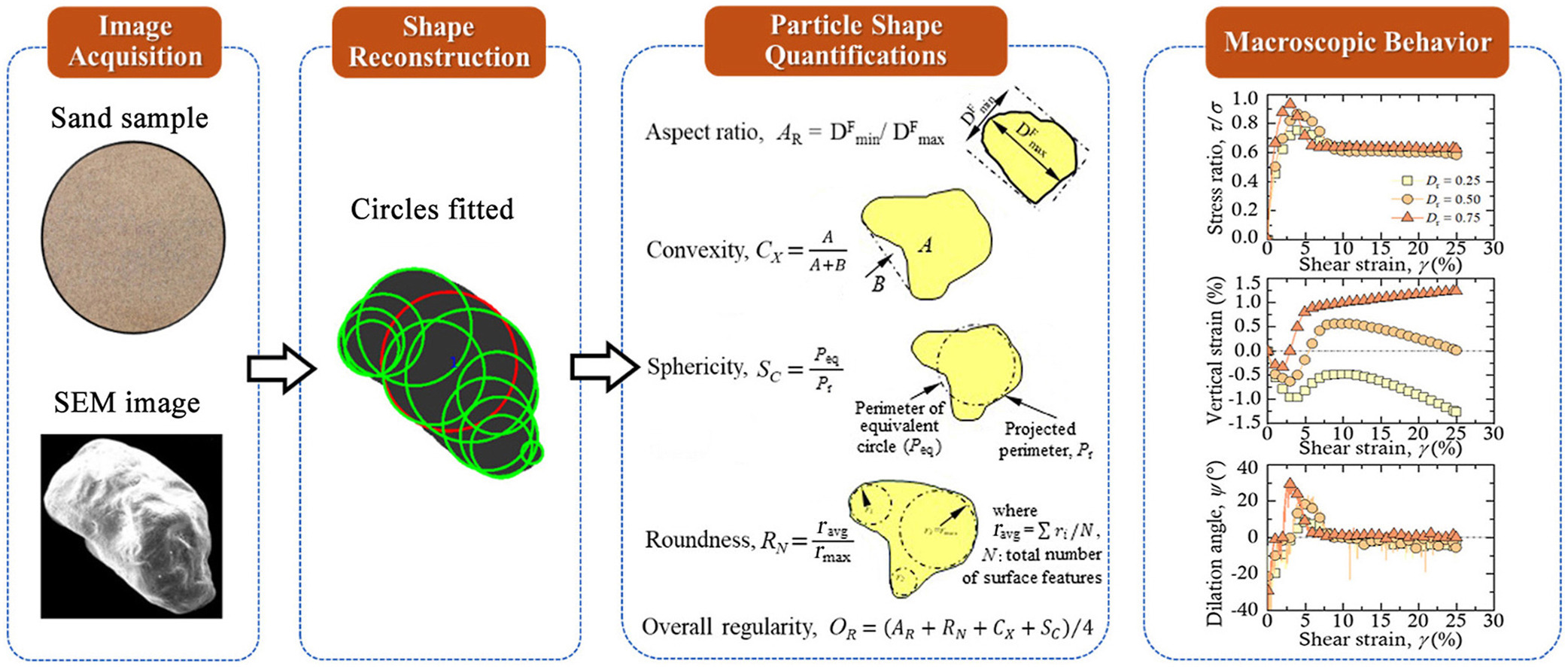
This study investigates the role of particle morphology in the strength and dilatancy behaviour of Namibian dune sand under direct shear test (DST) conditions. For this purpose, a series of DSTs were performed under three normal stresses (50, 100, and 200 kPa) and three relative densities (0.25, 0.5, and 0.75). To understand the role of particle morphology, the particle shape descriptors, including aspect ratio, roundness, convexity, sphericity, and overall regularity, were quantified from two-dimensional binary images derived from scanning electron microscopy using a computational geometry approach considering the major plane of orientation. Results indicate that the stress ratio exhibits strain-hardening followed by softening in dense assemblies, while loose assemblies display continuous hardening. The vertical strain and dilatancy angle decrease with increasing normal stress, whereas peak friction angles rise with relative density due to enhanced particle interlocking; critical state friction angles remain largely insensitive to density, reflecting stabilisation at ultimate shearing. Bolton's empirical model underestimates dilatancy angles, which are highly sensitive to normal stress (empirical constant, Q ≈ 10.47 at 200 kPa). The critical state parameters in the void's ratio – logarithm of normal stress normalised by atmospheric pressure plane vary systematically with density and particle regularity, aligning with literature and confirming the robustness of the proposed framework. These findings validate constitutive predictions and underscore the pivotal role of particle morphology in controlling sand strength and dilatancy, offering insights for physically grounded constitutive modelling of granular materials.
Graphical abstract
Keywords
Namibian dune sand; Particle morphology; Shear strength; Stress-dilatancy; Critical state
文章导读