
期刊文章
过刊浏览
- Volumes 108-119 (2025)
-
Volumes 96-107 (2025)
-
Volume 107
Pages 1-376 (December 2025)
-
Volume 106
Pages 1-336 (November 2025)
-
Volume 105
Pages 1-356 (October 2025)
-
Volume 104
Pages 1-332 (September 2025)
-
Volume 103
Pages 1-314 (August 2025)
-
Volume 102
Pages 1-276 (July 2025)
-
Volume 101
Pages 1-166 (June 2025)
-
Volume 100
Pages 1-256 (May 2025)
-
Volume 99
Pages 1-242 (April 2025)
-
Volume 98
Pages 1-288 (March 2025)
-
Volume 97
Pages 1-256 (February 2025)
-
Volume 96
Pages 1-340 (January 2025)
-
Volume 107
-
Volumes 84-95 (2024)
-
Volume 95
Pages 1-392 (December 2024)
-
Volume 94
Pages 1-400 (November 2024)
-
Volume 93
Pages 1-376 (October 2024)
-
Volume 92
Pages 1-316 (September 2024)
-
Volume 91
Pages 1-378 (August 2024)
-
Volume 90
Pages 1-580 (July 2024)
-
Volume 89
Pages 1-278 (June 2024)
-
Volume 88
Pages 1-350 (May 2024)
-
Volume 87
Pages 1-338 (April 2024)
-
Volume 86
Pages 1-312 (March 2024)
-
Volume 85
Pages 1-334 (February 2024)
-
Volume 84
Pages 1-308 (January 2024)
-
Volume 95
-
Volumes 72-83 (2023)
-
Volume 83
Pages 1-258 (December 2023)
-
Volume 82
Pages 1-204 (November 2023)
-
Volume 81
Pages 1-188 (October 2023)
-
Volume 80
Pages 1-202 (September 2023)
-
Volume 79
Pages 1-172 (August 2023)
-
Volume 78
Pages 1-146 (July 2023)
-
Volume 77
Pages 1-152 (June 2023)
-
Volume 76
Pages 1-176 (May 2023)
-
Volume 75
Pages 1-228 (April 2023)
-
Volume 74
Pages 1-200 (March 2023)
-
Volume 73
Pages 1-138 (February 2023)
-
Volume 72
Pages 1-144 (January 2023)
-
Volume 83
-
Volumes 60-71 (2022)
-
Volume 71
Pages 1-108 (December 2022)
-
Volume 70
Pages 1-106 (November 2022)
-
Volume 69
Pages 1-122 (October 2022)
-
Volume 68
Pages 1-124 (September 2022)
-
Volume 67
Pages 1-102 (August 2022)
-
Volume 66
Pages 1-112 (July 2022)
-
Volume 65
Pages 1-138 (June 2022)
-
Volume 64
Pages 1-186 (May 2022)
-
Volume 63
Pages 1-124 (April 2022)
-
Volume 62
Pages 1-104 (March 2022)
-
Volume 61
Pages 1-120 (February 2022)
-
Volume 60
Pages 1-124 (January 2022)
-
Volume 71
- Volumes 54-59 (2021)
- Volumes 48-53 (2020)
- Volumes 42-47 (2019)
- Volumes 36-41 (2018)
- Volumes 30-35 (2017)
- Volumes 24-29 (2016)
- Volumes 18-23 (2015)
- Volumes 12-17 (2014)
- Volume 11 (2013)
- Volume 10 (2012)
- Volume 9 (2011)
- Volume 8 (2010)
- Volume 7 (2009)
- Volume 6 (2008)
- Volume 5 (2007)
- Volume 4 (2006)
- Volume 3 (2005)
- Volume 2 (2004)
- Volume 1 (2003)
Volume 109
Liu, Z., Wu, F., Lv, X., & Dai, X. (2026). A key antagonistic effect in alkaline pretreatment of clay-type lithium ores and its targeted control for enhanced lithium enrichment. Particuology, 109, 180-191. https://doi.org/10.1016/j.partic.2025.12.013
A key antagonistic effect in alkaline pretreatment of clay-type lithium ores and its targeted control for enhanced lithium enrichment
Ziliang Liu, Fuzhong Wu *, Xiaodong Lv, Xinyi Dai
Guizhou High-level Institution Key Laboratory of High-Performance Battery Materials, Guizhou University, Guiyang, 550025, China
10.1016/j.partic.2025.12.013
Volume 109,
February 2026,
Pages 180-191
Received 22 September 2025, Revised 29 November 2025, Accepted 9 December 2025, Available online 2 January 2026, Version of Record 8 January 2026.
E-mail:
gutwfz@163.com
Highlights
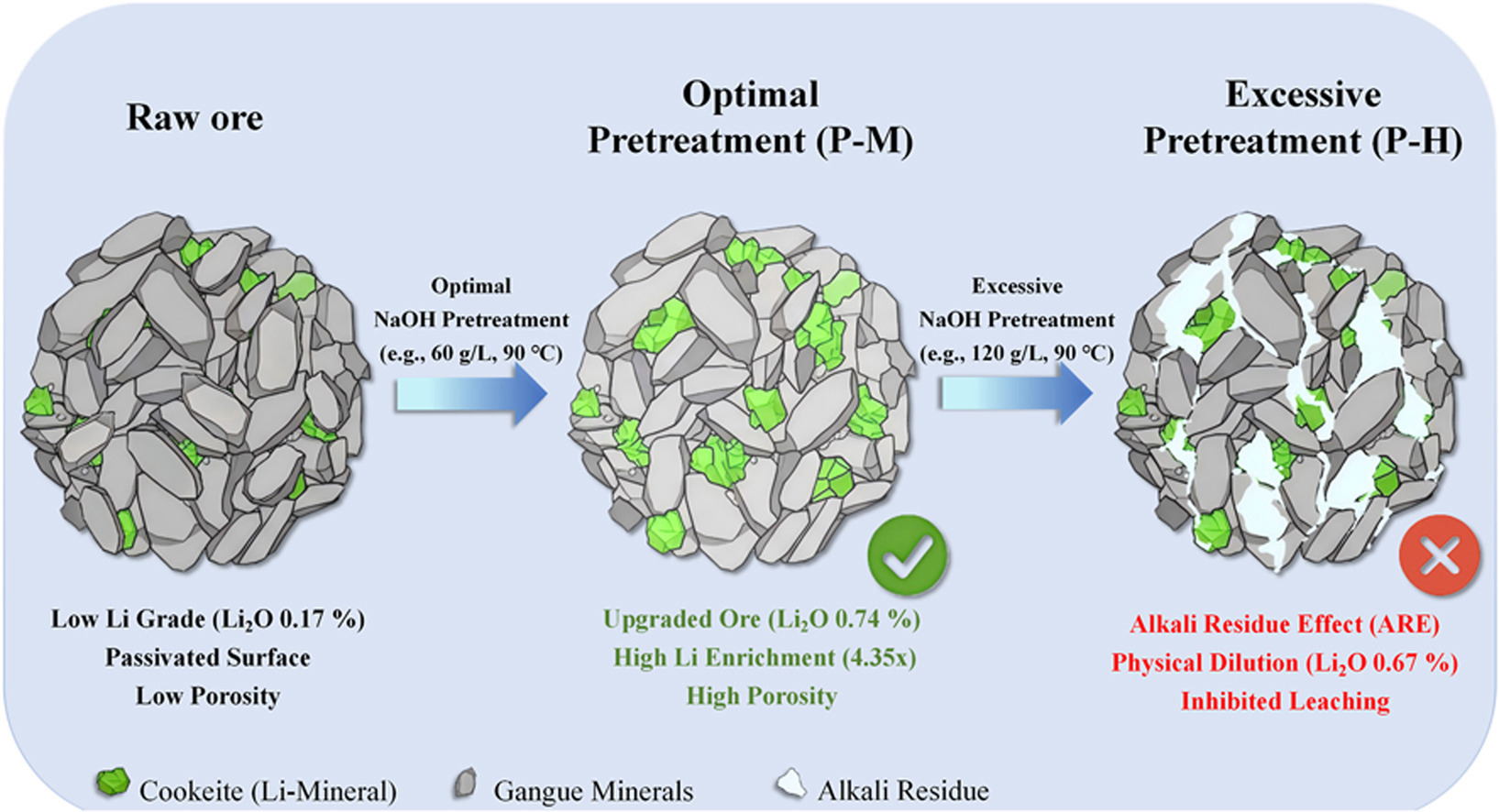
• Novel Alkali Residue Effect (ARE) governs pre-treatment efficacy trade-offs.
• Optimized process yields 4.35-fold lithium enrichment at a low temperature (90 °C).
• Selective etching of amorphous gangue enhances Li-bearing mineral reactivity.
• Techno-economic analysis projects a low operating cost of ∼US$81 per ton of ore.
Abstract
Clay-type lithium ores represent a vast, underexploited resource critical for future lithium supply, but their complex mineralogy hinders efficient processing. While alkaline pretreatment is a promising enrichment strategy, its optimization is hampered by elusive regulatory mechanisms. Here, we report a critical non-monotonic response where excessive pretreatment intensity paradoxically suppresses lithium recovery. We identify and verify that this response is governed by a key antagonistic mechanism, termed the Alkali Residue Effect (ARE), where residual alkaline species cause both physical dilution and chemical neutralization. Through response surface methodology (RSM) targeting the mitigation of ARE, we established an optimized processing window that achieves a 4.35-fold lithium enrichment (Li2O from 0.17 to 0.74 wt%). Microscopic analyses (SEM-EDS, XRD, XPS) confirm the optimized process selectively etches amorphous gangue, enhancing the reactivity of the Li-bearing mineral (cookeite). A techno-economic analysis projects a favorable operating cost of ∼US$81/ton. This study provides a new theoretical framework (ARE) for optimizing complex hydrometallurgical processes by balancing targeted reactions against unintended side effects.
Graphical abstract
Keywords
Clay-type lithium ore; Alkaline pretreatment; Lithium enrichment; Alkali Residue Effect (ARE); Selective leaching; Response Surface Methodology (RSM)
文章导读