
期刊文章
过刊浏览
- Volumes 108-119 (2025)
-
Volumes 96-107 (2025)
-
Volume 107
Pages 1-376 (December 2025)
-
Volume 106
Pages 1-336 (November 2025)
-
Volume 105
Pages 1-356 (October 2025)
-
Volume 104
Pages 1-332 (September 2025)
-
Volume 103
Pages 1-314 (August 2025)
-
Volume 102
Pages 1-276 (July 2025)
-
Volume 101
Pages 1-166 (June 2025)
-
Volume 100
Pages 1-256 (May 2025)
-
Volume 99
Pages 1-242 (April 2025)
-
Volume 98
Pages 1-288 (March 2025)
-
Volume 97
Pages 1-256 (February 2025)
-
Volume 96
Pages 1-340 (January 2025)
-
Volume 107
-
Volumes 84-95 (2024)
-
Volume 95
Pages 1-392 (December 2024)
-
Volume 94
Pages 1-400 (November 2024)
-
Volume 93
Pages 1-376 (October 2024)
-
Volume 92
Pages 1-316 (September 2024)
-
Volume 91
Pages 1-378 (August 2024)
-
Volume 90
Pages 1-580 (July 2024)
-
Volume 89
Pages 1-278 (June 2024)
-
Volume 88
Pages 1-350 (May 2024)
-
Volume 87
Pages 1-338 (April 2024)
-
Volume 86
Pages 1-312 (March 2024)
-
Volume 85
Pages 1-334 (February 2024)
-
Volume 84
Pages 1-308 (January 2024)
-
Volume 95
-
Volumes 72-83 (2023)
-
Volume 83
Pages 1-258 (December 2023)
-
Volume 82
Pages 1-204 (November 2023)
-
Volume 81
Pages 1-188 (October 2023)
-
Volume 80
Pages 1-202 (September 2023)
-
Volume 79
Pages 1-172 (August 2023)
-
Volume 78
Pages 1-146 (July 2023)
-
Volume 77
Pages 1-152 (June 2023)
-
Volume 76
Pages 1-176 (May 2023)
-
Volume 75
Pages 1-228 (April 2023)
-
Volume 74
Pages 1-200 (March 2023)
-
Volume 73
Pages 1-138 (February 2023)
-
Volume 72
Pages 1-144 (January 2023)
-
Volume 83
-
Volumes 60-71 (2022)
-
Volume 71
Pages 1-108 (December 2022)
-
Volume 70
Pages 1-106 (November 2022)
-
Volume 69
Pages 1-122 (October 2022)
-
Volume 68
Pages 1-124 (September 2022)
-
Volume 67
Pages 1-102 (August 2022)
-
Volume 66
Pages 1-112 (July 2022)
-
Volume 65
Pages 1-138 (June 2022)
-
Volume 64
Pages 1-186 (May 2022)
-
Volume 63
Pages 1-124 (April 2022)
-
Volume 62
Pages 1-104 (March 2022)
-
Volume 61
Pages 1-120 (February 2022)
-
Volume 60
Pages 1-124 (January 2022)
-
Volume 71
- Volumes 54-59 (2021)
- Volumes 48-53 (2020)
- Volumes 42-47 (2019)
- Volumes 36-41 (2018)
- Volumes 30-35 (2017)
- Volumes 24-29 (2016)
- Volumes 18-23 (2015)
- Volumes 12-17 (2014)
- Volume 11 (2013)
- Volume 10 (2012)
- Volume 9 (2011)
- Volume 8 (2010)
- Volume 7 (2009)
- Volume 6 (2008)
- Volume 5 (2007)
- Volume 4 (2006)
- Volume 3 (2005)
- Volume 2 (2004)
- Volume 1 (2003)
Volume 109
Ghazoui, M., Boudouch, O., Sylla, A. S., Moulakhnif, K., Dabali, S., & Elkacmi, R. (2026). Engineering particulate architectures for hybrid energy storage: Bridging the gap between intercalation capacity and adsorption kinetics. Particuology, 109, 192-210. https://doi.org/10.1016/j.partic.2025.12.019
Engineering particulate architectures for hybrid energy storage: Bridging the gap between intercalation capacity and adsorption kinetics
Mohssine Ghazoui a, Otmane Boudouch b, Aboubacar Sidigh Sylla c, Kaoutar Moulakhnif d, Siham Dabali a, Reda Elkacmi a *
a Laboratory of Environmental, Ecological and Agro-Industrial Engineering, Faculty of Science and Technology, Sultan Moulay Slimane University, BP 592, Beni-Mellal, Morocco
b Laboratory of Sciences and Technologies Team, Higher Education and Training School, Chouaib Doukkali University, El Jadida, Morocco
c Laboratory of Molecular Chemistry, Materials, and Catalysis, Faculty of Sciences and Technics, Sultan Moulay Slimane University, Beni Mellal, Morocco
d Laboratory of Physical Chemistry, Materials and Catalysis, Faculty of Sciences Ben M'Sick, Hassan II University of Casablanca, Morocco
10.1016/j.partic.2025.12.019
Volume 109,
February 2026,
Pages 192-210
Received 4 November 2025, Revised 17 December 2025, Accepted 19 December 2025, Available online 2 January 2026, Version of Record 8 January 2026.
E-mail:
r.elkacmi@usms.ma
Highlights
• From intercalation to adsorption, a paradigm shift is proposed for ultra-fast storage.
• Defines absorption as a capacity provider and adsorption as a speed enabler in one continuum.
• Demonstrates how hybridization bridges the energy and power gap in electrochemical devices.
• Reviews advanced materials strategies: nanostructuring, doping, functionalization, and hybrids.
• Projects the impact of this paradigm on EVs, smart grids, and next-generation electronics.
Abstract
Electrochemical energy storage faces a persistent trade-off: batteries deliver high energy densities via ion intercalation but remain kinetically limited, whereas supercapacitors provide ultrafast power and outstanding durability through interfacial adsorption but suffer from low energy densities. This dichotomy has become a bottleneck for electric mobility, renewable grid stabilization, and portable electronics.
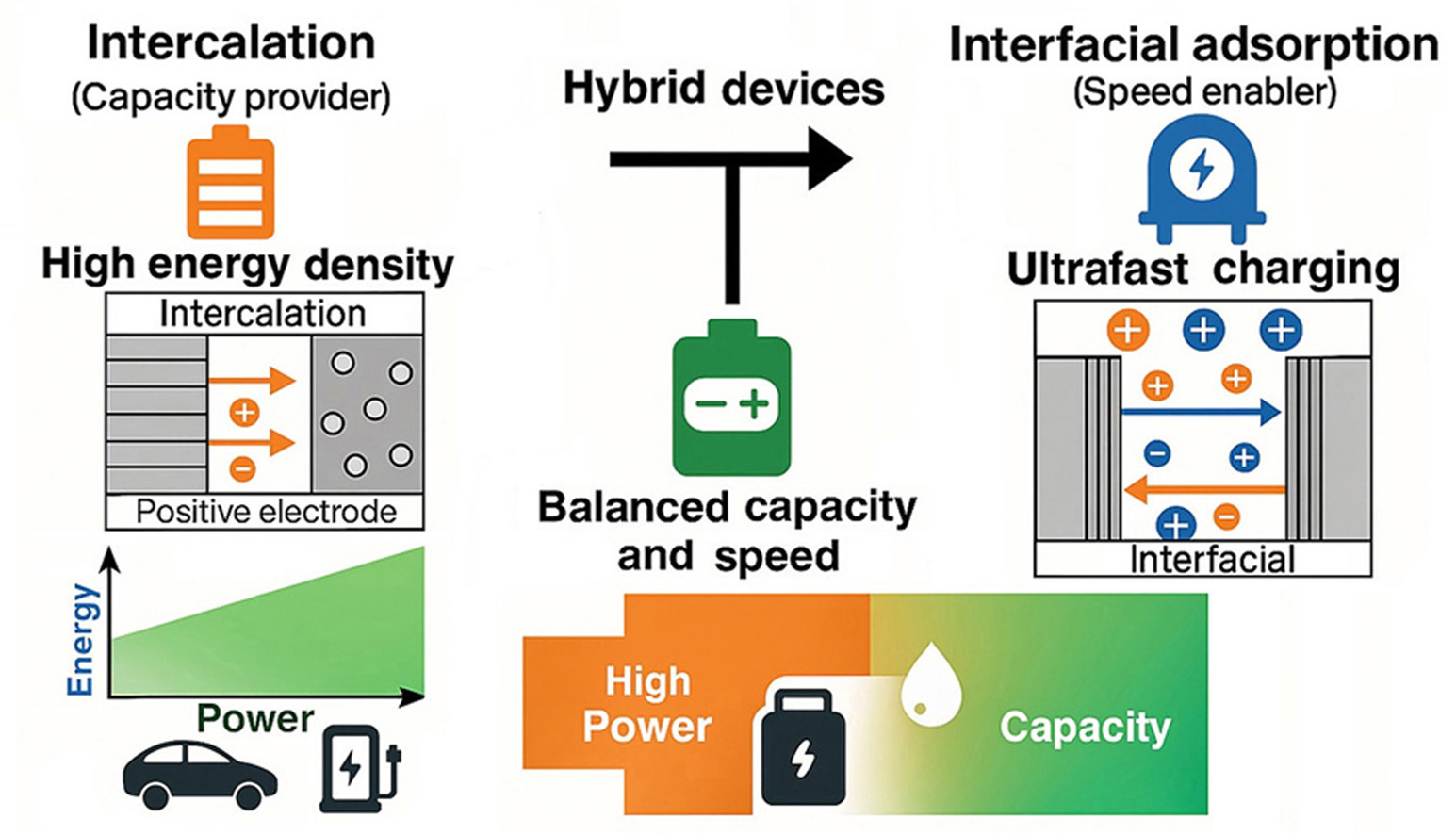
This review introduces a unifying paradigm in which absorption acts as a capacity provider and adsorption as a speed enabler. We critically examine the fundamentals of both mechanisms and survey state-of-the-art materials, from graphite, transition-metal oxides, and phosphates to bio-derived carbons, graphene, MOFs, COFs, and emerging sodium-ion and solid-state systems. Particular emphasis is placed on hybrid devices such as lithium-ion capacitors and hybrid supercapacitors, which already achieve 30–70 Wh kg−1 with multi-kW kg−1 power output and lifetimes exceeding 20,000 cycles.
Looking ahead, disruptive directions include solid-state architectures, bio-inspired electrodes, ultra-fast charging infrastructures (>500 kW), and circular-economy strategies. By reconciling autonomy and speed, the absorption–adsorption paradigm charts a roadmap for next-generation storage systems, capable of supporting the 2030–2040 transition to a resilient, electrified, low-carbon society.
Graphical abstract
Keywords
Electrochemical energy storage; Ion intercalation; Interfacial adsorption; Hybrid devices; Ultra-fast charging; Circular economy
文章导读