
期刊文章
过刊浏览
- Volumes 108-119 (2025)
-
Volumes 96-107 (2025)
-
Volume 107
Pages 1-376 (December 2025)
-
Volume 106
Pages 1-336 (November 2025)
-
Volume 105
Pages 1-356 (October 2025)
-
Volume 104
Pages 1-332 (September 2025)
-
Volume 103
Pages 1-314 (August 2025)
-
Volume 102
Pages 1-276 (July 2025)
-
Volume 101
Pages 1-166 (June 2025)
-
Volume 100
Pages 1-256 (May 2025)
-
Volume 99
Pages 1-242 (April 2025)
-
Volume 98
Pages 1-288 (March 2025)
-
Volume 97
Pages 1-256 (February 2025)
-
Volume 96
Pages 1-340 (January 2025)
-
Volume 107
-
Volumes 84-95 (2024)
-
Volume 95
Pages 1-392 (December 2024)
-
Volume 94
Pages 1-400 (November 2024)
-
Volume 93
Pages 1-376 (October 2024)
-
Volume 92
Pages 1-316 (September 2024)
-
Volume 91
Pages 1-378 (August 2024)
-
Volume 90
Pages 1-580 (July 2024)
-
Volume 89
Pages 1-278 (June 2024)
-
Volume 88
Pages 1-350 (May 2024)
-
Volume 87
Pages 1-338 (April 2024)
-
Volume 86
Pages 1-312 (March 2024)
-
Volume 85
Pages 1-334 (February 2024)
-
Volume 84
Pages 1-308 (January 2024)
-
Volume 95
-
Volumes 72-83 (2023)
-
Volume 83
Pages 1-258 (December 2023)
-
Volume 82
Pages 1-204 (November 2023)
-
Volume 81
Pages 1-188 (October 2023)
-
Volume 80
Pages 1-202 (September 2023)
-
Volume 79
Pages 1-172 (August 2023)
-
Volume 78
Pages 1-146 (July 2023)
-
Volume 77
Pages 1-152 (June 2023)
-
Volume 76
Pages 1-176 (May 2023)
-
Volume 75
Pages 1-228 (April 2023)
-
Volume 74
Pages 1-200 (March 2023)
-
Volume 73
Pages 1-138 (February 2023)
-
Volume 72
Pages 1-144 (January 2023)
-
Volume 83
-
Volumes 60-71 (2022)
-
Volume 71
Pages 1-108 (December 2022)
-
Volume 70
Pages 1-106 (November 2022)
-
Volume 69
Pages 1-122 (October 2022)
-
Volume 68
Pages 1-124 (September 2022)
-
Volume 67
Pages 1-102 (August 2022)
-
Volume 66
Pages 1-112 (July 2022)
-
Volume 65
Pages 1-138 (June 2022)
-
Volume 64
Pages 1-186 (May 2022)
-
Volume 63
Pages 1-124 (April 2022)
-
Volume 62
Pages 1-104 (March 2022)
-
Volume 61
Pages 1-120 (February 2022)
-
Volume 60
Pages 1-124 (January 2022)
-
Volume 71
- Volumes 54-59 (2021)
- Volumes 48-53 (2020)
- Volumes 42-47 (2019)
- Volumes 36-41 (2018)
- Volumes 30-35 (2017)
- Volumes 24-29 (2016)
- Volumes 18-23 (2015)
- Volumes 12-17 (2014)
- Volume 11 (2013)
- Volume 10 (2012)
- Volume 9 (2011)
- Volume 8 (2010)
- Volume 7 (2009)
- Volume 6 (2008)
- Volume 5 (2007)
- Volume 4 (2006)
- Volume 3 (2005)
- Volume 2 (2004)
- Volume 1 (2003)
Volume 109
Zhong, P.-W., Yang, H.-X., Xu, W., Yu, Z., Li, B., Wang, H., . . . Wang, H.-F. (2026). MXene-assisted NiFe sulfides with interfacial modulation for oxygen evolution electrocatalysis. Particuology, 109, 211-218. https://doi.org/10.1016/j.partic.2025.12.020
MXene-assisted NiFe sulfides with interfacial modulation for oxygen evolution electrocatalysis
Pei-Wei Zhong 1, Hong-Xiao Yang 1, Wenkang Xu, Zhiyang Yu, Bei Li, Hongjuan Wang, Yonghai Cao, Hao Yu, Hao-Fan Wang *
School of Chemistry and Chemical Engineering, South China University of Technology, Guangzhou, 510641, Guangdong, China
10.1016/j.partic.2025.12.020
Volume 109,
February 2026,
Pages 211-218
Received 21 November 2025, Revised 19 December 2025, Accepted 20 December 2025, Available online 2 January 2026, Version of Record 8 January 2026.
E-mail:
whf@scut.edu.cn
Highlights
• A core–shell S-NiFc MOF@Mo2CTx MXene hybrid was synthesized via a facile two-step hydrothermal strategy.
• Strong interfacial coupling between sulfides and MXene promotes efficient electron redistribution and charge transfer.
• Composite catalyst achieves an ultralow overpotential of 223 mV at 10 mA cm−2 and a Tafel slope of 41.3 mV dec−1.
• This study expands application scope of MXenes and provides new insights into optimizing OER electrocatalysts.
Abstract
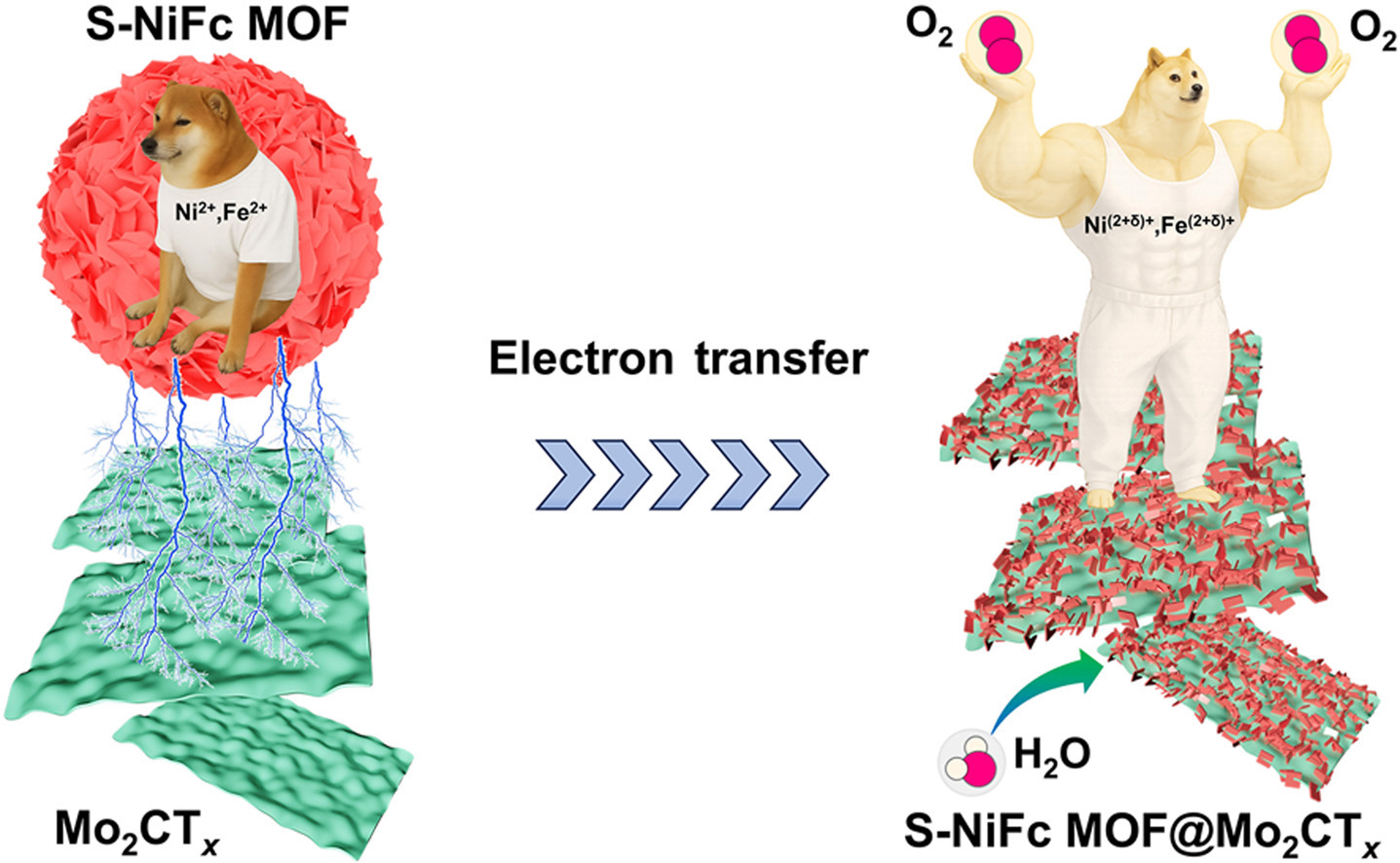
Oxygen evolution reaction (OER) plays a vital role in various pivotal electrochemical applications. To improve the energy efficiency and economic viability of these technologies, it is critical to develop cost-effective and highly active OER electrocatalysts based on earth-abundant elements. Among various candidates, transition-metal-based compounds have demonstrated notable potential for OER electrocatalysis, attributable to their adjustable electronic configurations. Nevertheless, their practical application remains constrained by limited intrinsic activity, poor electrical conductivity, and particle aggregation, which compromise their overall OER efficiency. In this study, an efficient OER electrocatalyst, S-NiFc MOF@Mo2CTx, is constructed by the sulfidation of NiFe-based metal–organic framework (MOF) precursors anchored on conductive Mo2CTx MXene. The MOF-derived NiFe sulfides offer abundant accessible active sites, and the strong interfacial coupling between NiFe sulfides and Mo2CTx enhances the catalyst's intrinsic activity. The conductive Mo2CTx matrix also guarantees efficient electron transport and homogeneous dispersion of the active phase. As a result, S-NiFc MOF@ Mo2CTx exhibits excellent OER activity, reaching 10 mA cm−2 at an overpotential of 223 mV, along with stable operation for 68 h in 1.0 M KOH solution. This study broadens the scope of MXene-based materials in electrocatalytic applications and offers valuable insights into optimizing NiFe-derived OER catalysts.
Graphical abstract
Keywords
Oxygen evolution reaction; Electrocatalyst; Transition-metal-based materials; NiFe sulfides; Mo2CTx MXene
文章导读