
期刊文章
过刊浏览
- Volumes 108-119 (2025)
-
Volumes 96-107 (2025)
-
Volume 107
Pages 1-376 (December 2025)
-
Volume 106
Pages 1-336 (November 2025)
-
Volume 105
Pages 1-356 (October 2025)
-
Volume 104
Pages 1-332 (September 2025)
-
Volume 103
Pages 1-314 (August 2025)
-
Volume 102
Pages 1-276 (July 2025)
-
Volume 101
Pages 1-166 (June 2025)
-
Volume 100
Pages 1-256 (May 2025)
-
Volume 99
Pages 1-242 (April 2025)
-
Volume 98
Pages 1-288 (March 2025)
-
Volume 97
Pages 1-256 (February 2025)
-
Volume 96
Pages 1-340 (January 2025)
-
Volume 107
-
Volumes 84-95 (2024)
-
Volume 95
Pages 1-392 (December 2024)
-
Volume 94
Pages 1-400 (November 2024)
-
Volume 93
Pages 1-376 (October 2024)
-
Volume 92
Pages 1-316 (September 2024)
-
Volume 91
Pages 1-378 (August 2024)
-
Volume 90
Pages 1-580 (July 2024)
-
Volume 89
Pages 1-278 (June 2024)
-
Volume 88
Pages 1-350 (May 2024)
-
Volume 87
Pages 1-338 (April 2024)
-
Volume 86
Pages 1-312 (March 2024)
-
Volume 85
Pages 1-334 (February 2024)
-
Volume 84
Pages 1-308 (January 2024)
-
Volume 95
-
Volumes 72-83 (2023)
-
Volume 83
Pages 1-258 (December 2023)
-
Volume 82
Pages 1-204 (November 2023)
-
Volume 81
Pages 1-188 (October 2023)
-
Volume 80
Pages 1-202 (September 2023)
-
Volume 79
Pages 1-172 (August 2023)
-
Volume 78
Pages 1-146 (July 2023)
-
Volume 77
Pages 1-152 (June 2023)
-
Volume 76
Pages 1-176 (May 2023)
-
Volume 75
Pages 1-228 (April 2023)
-
Volume 74
Pages 1-200 (March 2023)
-
Volume 73
Pages 1-138 (February 2023)
-
Volume 72
Pages 1-144 (January 2023)
-
Volume 83
-
Volumes 60-71 (2022)
-
Volume 71
Pages 1-108 (December 2022)
-
Volume 70
Pages 1-106 (November 2022)
-
Volume 69
Pages 1-122 (October 2022)
-
Volume 68
Pages 1-124 (September 2022)
-
Volume 67
Pages 1-102 (August 2022)
-
Volume 66
Pages 1-112 (July 2022)
-
Volume 65
Pages 1-138 (June 2022)
-
Volume 64
Pages 1-186 (May 2022)
-
Volume 63
Pages 1-124 (April 2022)
-
Volume 62
Pages 1-104 (March 2022)
-
Volume 61
Pages 1-120 (February 2022)
-
Volume 60
Pages 1-124 (January 2022)
-
Volume 71
- Volumes 54-59 (2021)
- Volumes 48-53 (2020)
- Volumes 42-47 (2019)
- Volumes 36-41 (2018)
- Volumes 30-35 (2017)
- Volumes 24-29 (2016)
- Volumes 18-23 (2015)
- Volumes 12-17 (2014)
- Volume 11 (2013)
- Volume 10 (2012)
- Volume 9 (2011)
- Volume 8 (2010)
- Volume 7 (2009)
- Volume 6 (2008)
- Volume 5 (2007)
- Volume 4 (2006)
- Volume 3 (2005)
- Volume 2 (2004)
- Volume 1 (2003)
Volume 109
Li, Z., Jiao, X., Li, Y., Ma, X., Wang, C., Lan, X., & Gao, J. (2026). Stable flow characteristics of Geldart C desulfurization ash particles in a novel loop-coupled riser under swirling-flow enhancement. Particuology, 109, 219-230. https://doi.org/10.1016/j.partic.2026.01.001
Stable flow characteristics of Geldart C desulfurization ash particles in a novel loop-coupled riser under swirling-flow enhancement
Zhihui Li, Xueyan Jiao, Yumei Li, Xiao Ma, Chengxiu Wang *, Xingying Lan, Jinsen Gao
State Key Laboratory of Heavy Oil Processing, China University of Petroleum, Beijing, 102249, China
10.1016/j.partic.2026.01.001
Volume 109,
February 2026,
Pages 219-230
Received 25 October 2025, Revised 15 December 2025, Accepted 5 January 2026, Available online 8 January 2026, Version of Record 14 January 2026.
E-mail:
cwang1277@cup.edu.cn
Highlights
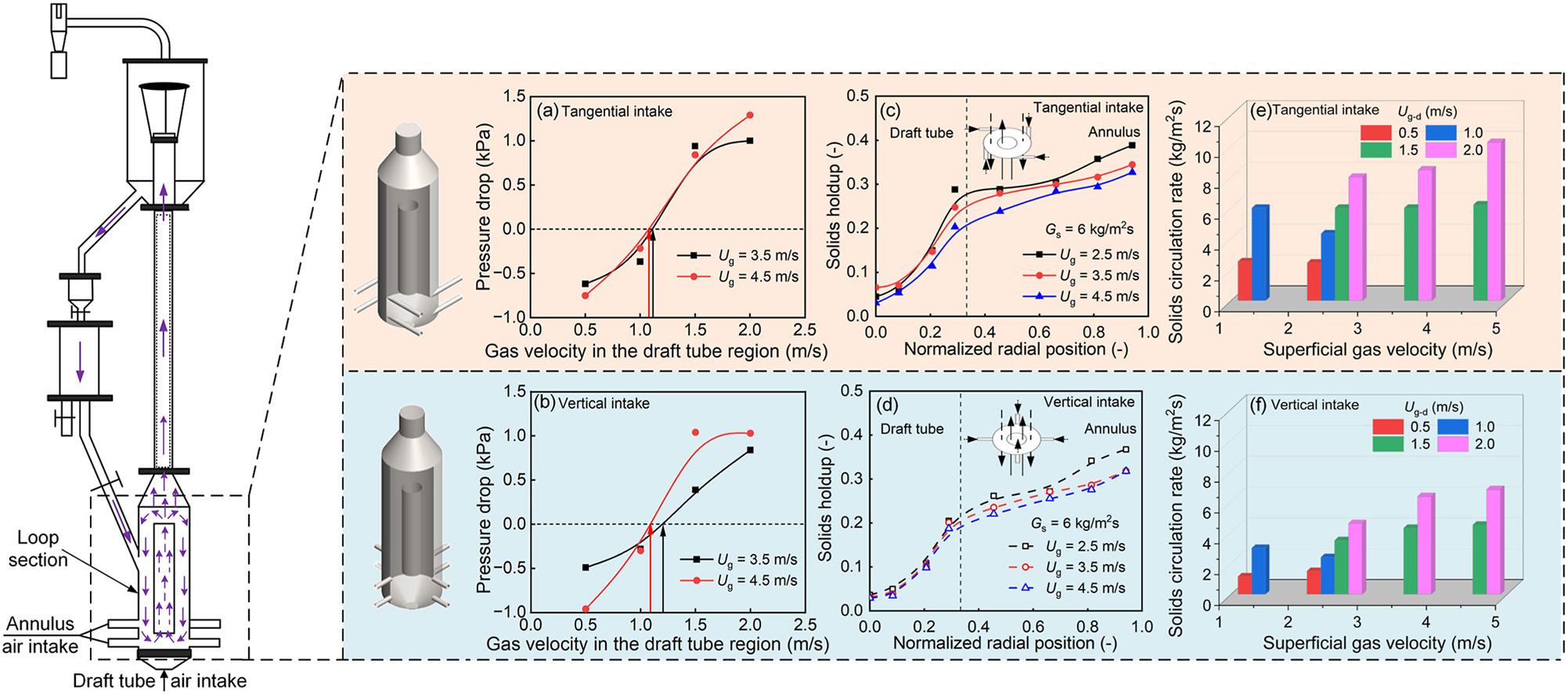
• Effects of three intakes on fine particles are compared at high superficial gas velocity 3.5–4.5 m/s.
• Draft tube-lift loop forms most readily with tangential intake.
• Enhanced turbulence intensity and fluidization are obtained with tangential intake.
• Greater solids holdup is achieved by tangential intake, compared to vertical intake.
• Solids circulation rate is enhanced by 42.9 % with tangential intake's swirling-flow.
Abstract
During the flue gas desulfurization process with the circulating fluidized bed (CFB) reactor, Geldart C desulfurization ash particles are prone to aggregation and accumulation in the inlet region, which significantly impairs gas-solid contact. To address this challenge, the present study proposes a novel design that couples a loop reactor to the bottom of the riser and employs a tangential intake structure. This combination generates a swirling flow to enhance the fluidization performance of Geldart C particles in the inlet region of the CFB reactor, thereby improving gas-solids contact efficiency. Under a superficial gas velocity of 1.5–4.5 m/s, the tangential intake configuration facilitates the formation of draft tube-lift loop flow when the draft tube gas velocity exceeds 1.10 m/s. In comparison, the vertical intake requires a gas velocity in the draft tube region greater than 1.20 m/s, while the coiled intake demands 1.25 m/s. Furthermore, the swirling-flow from tangential intake effectively entrains more Geldart C particles into the internal loop flow and external circulation, increasing the solids circulation rate from 7.0 to 10.0 kg/(m2 s), an increase of 42.9 %. These findings offer a valuable insight for the industrial application of Geldart C particles in CFB systems.
Graphical abstract
Keywords
Geldart C particles; Circulating fluidized bed; Loop flow; Intake structure; Solids holdup; Solids circulation rate
文章导读