
期刊文章
过刊浏览
- Volumes 108-119 (2025)
-
Volumes 96-107 (2025)
-
Volume 107
Pages 1-376 (December 2025)
-
Volume 106
Pages 1-336 (November 2025)
-
Volume 105
Pages 1-356 (October 2025)
-
Volume 104
Pages 1-332 (September 2025)
-
Volume 103
Pages 1-314 (August 2025)
-
Volume 102
Pages 1-276 (July 2025)
-
Volume 101
Pages 1-166 (June 2025)
-
Volume 100
Pages 1-256 (May 2025)
-
Volume 99
Pages 1-242 (April 2025)
-
Volume 98
Pages 1-288 (March 2025)
-
Volume 97
Pages 1-256 (February 2025)
-
Volume 96
Pages 1-340 (January 2025)
-
Volume 107
-
Volumes 84-95 (2024)
-
Volume 95
Pages 1-392 (December 2024)
-
Volume 94
Pages 1-400 (November 2024)
-
Volume 93
Pages 1-376 (October 2024)
-
Volume 92
Pages 1-316 (September 2024)
-
Volume 91
Pages 1-378 (August 2024)
-
Volume 90
Pages 1-580 (July 2024)
-
Volume 89
Pages 1-278 (June 2024)
-
Volume 88
Pages 1-350 (May 2024)
-
Volume 87
Pages 1-338 (April 2024)
-
Volume 86
Pages 1-312 (March 2024)
-
Volume 85
Pages 1-334 (February 2024)
-
Volume 84
Pages 1-308 (January 2024)
-
Volume 95
-
Volumes 72-83 (2023)
-
Volume 83
Pages 1-258 (December 2023)
-
Volume 82
Pages 1-204 (November 2023)
-
Volume 81
Pages 1-188 (October 2023)
-
Volume 80
Pages 1-202 (September 2023)
-
Volume 79
Pages 1-172 (August 2023)
-
Volume 78
Pages 1-146 (July 2023)
-
Volume 77
Pages 1-152 (June 2023)
-
Volume 76
Pages 1-176 (May 2023)
-
Volume 75
Pages 1-228 (April 2023)
-
Volume 74
Pages 1-200 (March 2023)
-
Volume 73
Pages 1-138 (February 2023)
-
Volume 72
Pages 1-144 (January 2023)
-
Volume 83
-
Volumes 60-71 (2022)
-
Volume 71
Pages 1-108 (December 2022)
-
Volume 70
Pages 1-106 (November 2022)
-
Volume 69
Pages 1-122 (October 2022)
-
Volume 68
Pages 1-124 (September 2022)
-
Volume 67
Pages 1-102 (August 2022)
-
Volume 66
Pages 1-112 (July 2022)
-
Volume 65
Pages 1-138 (June 2022)
-
Volume 64
Pages 1-186 (May 2022)
-
Volume 63
Pages 1-124 (April 2022)
-
Volume 62
Pages 1-104 (March 2022)
-
Volume 61
Pages 1-120 (February 2022)
-
Volume 60
Pages 1-124 (January 2022)
-
Volume 71
- Volumes 54-59 (2021)
- Volumes 48-53 (2020)
- Volumes 42-47 (2019)
- Volumes 36-41 (2018)
- Volumes 30-35 (2017)
- Volumes 24-29 (2016)
- Volumes 18-23 (2015)
- Volumes 12-17 (2014)
- Volume 11 (2013)
- Volume 10 (2012)
- Volume 9 (2011)
- Volume 8 (2010)
- Volume 7 (2009)
- Volume 6 (2008)
- Volume 5 (2007)
- Volume 4 (2006)
- Volume 3 (2005)
- Volume 2 (2004)
- Volume 1 (2003)
Volume 109
Cheng, Z., Dong, X., & Liu, C. (2026). Toughening modification of bismaleimide resin with a cyano-containing thermoplastic PPENK particles. Particuology, 109, 231-237.
https://doi.org/10.1016/j.partic.2025.12.014
Toughening modification of bismaleimide resin with a cyano-containing thermoplastic PPENK particles
Zhiyuan Cheng a b, Xinbo Dong a b, Cheng Liu a b c d *
a State Key Laboratory of Fine Chemicals, Frontier Science Center for Smart Materials, School of Chemical Engineering, Dalian University of Technology, Dalian, 116024, China
b Department of Polymer Science & Engineering, School of Chemical Engineering, Dalian University of Technology, Dalian, 116024, China
c Liaoning Province Technology Innovation Center of High Performance Resin Materials, Dalian, 116012, China
d Dalian Engineering Research Center of High Performance Resin, Processing and Application, Dalian, 116012, China
10.1016/j.partic.2025.12.014
Volume 109,
February 2026,
Pages 231-237
Received 13 November 2025, Revised 14 December 2025, Accepted 18 December 2025, Available online 8 January 2026, Version of Record 14 January 2026.
E-mail:
liuch1115@dlut.edu.cn
Highlights
• High-performance PPENK thermoplastic toughening agents containing cyano groups were synthesized.
• The impact strengthens of the cured BDM resins were significantly improved, with excellent thermal property.
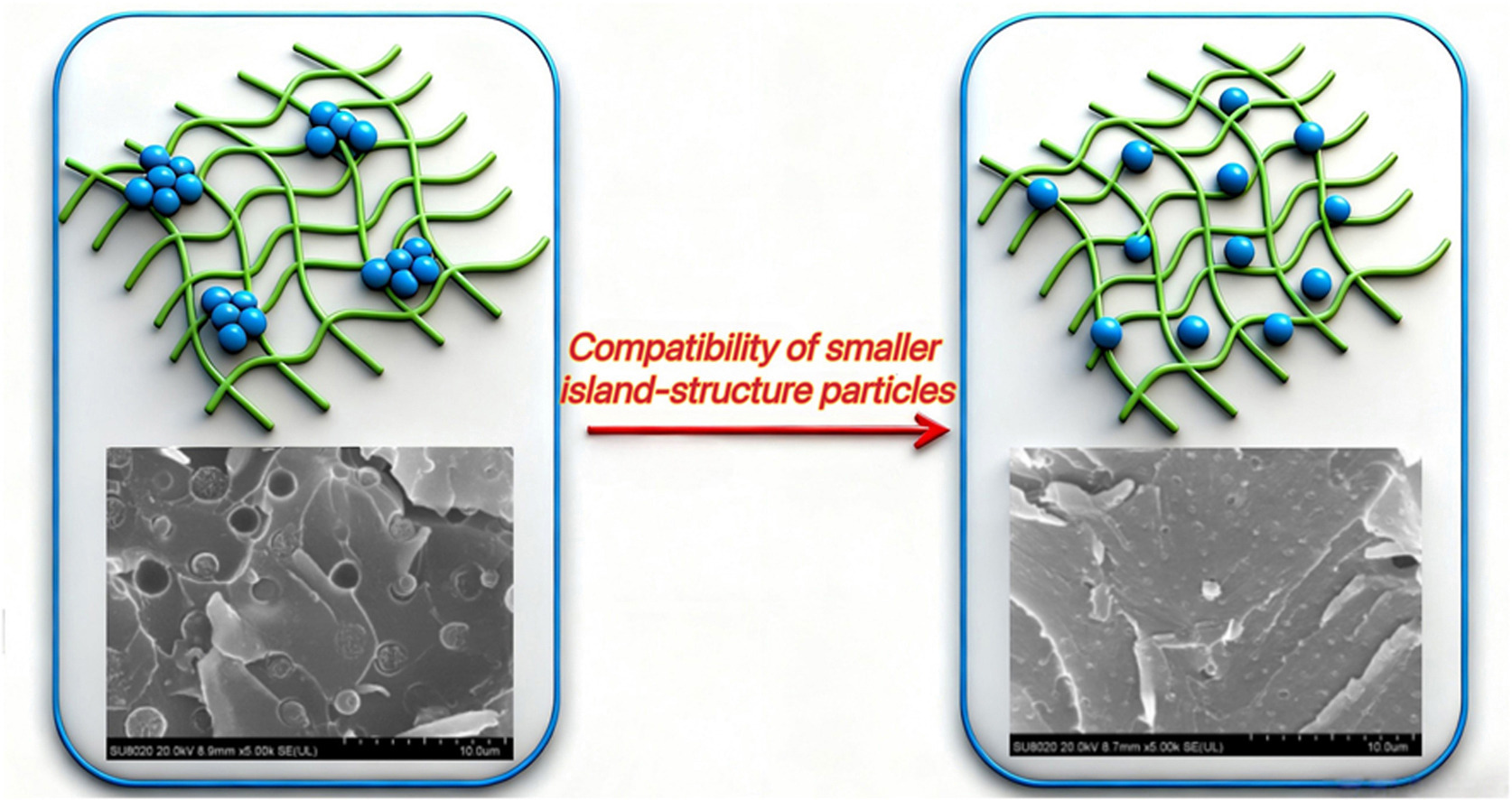
• The toughening mechanism of BDM resin modified by PPENK particles has been revealed.
Abstract
The 4,4′-bismaleimidodiphenyl-methane (BDM) resin, as one of the most important thermoset resin, exhibits poor toughness, which prevents it from adapting to high technical requirements and hinder its further development. Novel poly (phthalazinone ether nitrile ketone)s (PPENK) with twisted, non-coplanar phthalazinone units and highly polar cyano side groups into the main chain of poly (aryl ether ketone) molecules were synthesized and used to modify the blends of BDM/diallyl bisphenol A (DABPA). The thermal and mechanical properties of modified BDM resin have been investigated thoroughly. The role of cyano group content of PPENK on the mechanical properties of modified BDM resin has been recognized. The impact strength of modified BDM resin reached up to 26.25 kJ/m2, and the glass transition temperature can still maintain in a high level, in the range of 280–291 °C, indicating the excellent thermal properties of modified BDM resin. Moreover, the island-structure particles have been analyzed and the toughening mechanism of BDM resin modified by PPENK particles has been revealed. This work provides a new strategy for design of high-performance thermoplastic toughening agents for BDM resin with improved toughness and thermal properties.
Graphical abstract
Keywords
Poly(phthalazinone ether nitrile ketone); Thermoplastic resin; BDM resin; Mechanism of toughening; Thermal properties
文章导读