
期刊文章
过刊浏览
- Volumes 108-119 (2025)
-
Volumes 96-107 (2025)
-
Volume 107
Pages 1-376 (December 2025)
-
Volume 106
Pages 1-336 (November 2025)
-
Volume 105
Pages 1-356 (October 2025)
-
Volume 104
Pages 1-332 (September 2025)
-
Volume 103
Pages 1-314 (August 2025)
-
Volume 102
Pages 1-276 (July 2025)
-
Volume 101
Pages 1-166 (June 2025)
-
Volume 100
Pages 1-256 (May 2025)
-
Volume 99
Pages 1-242 (April 2025)
-
Volume 98
Pages 1-288 (March 2025)
-
Volume 97
Pages 1-256 (February 2025)
-
Volume 96
Pages 1-340 (January 2025)
-
Volume 107
-
Volumes 84-95 (2024)
-
Volume 95
Pages 1-392 (December 2024)
-
Volume 94
Pages 1-400 (November 2024)
-
Volume 93
Pages 1-376 (October 2024)
-
Volume 92
Pages 1-316 (September 2024)
-
Volume 91
Pages 1-378 (August 2024)
-
Volume 90
Pages 1-580 (July 2024)
-
Volume 89
Pages 1-278 (June 2024)
-
Volume 88
Pages 1-350 (May 2024)
-
Volume 87
Pages 1-338 (April 2024)
-
Volume 86
Pages 1-312 (March 2024)
-
Volume 85
Pages 1-334 (February 2024)
-
Volume 84
Pages 1-308 (January 2024)
-
Volume 95
-
Volumes 72-83 (2023)
-
Volume 83
Pages 1-258 (December 2023)
-
Volume 82
Pages 1-204 (November 2023)
-
Volume 81
Pages 1-188 (October 2023)
-
Volume 80
Pages 1-202 (September 2023)
-
Volume 79
Pages 1-172 (August 2023)
-
Volume 78
Pages 1-146 (July 2023)
-
Volume 77
Pages 1-152 (June 2023)
-
Volume 76
Pages 1-176 (May 2023)
-
Volume 75
Pages 1-228 (April 2023)
-
Volume 74
Pages 1-200 (March 2023)
-
Volume 73
Pages 1-138 (February 2023)
-
Volume 72
Pages 1-144 (January 2023)
-
Volume 83
-
Volumes 60-71 (2022)
-
Volume 71
Pages 1-108 (December 2022)
-
Volume 70
Pages 1-106 (November 2022)
-
Volume 69
Pages 1-122 (October 2022)
-
Volume 68
Pages 1-124 (September 2022)
-
Volume 67
Pages 1-102 (August 2022)
-
Volume 66
Pages 1-112 (July 2022)
-
Volume 65
Pages 1-138 (June 2022)
-
Volume 64
Pages 1-186 (May 2022)
-
Volume 63
Pages 1-124 (April 2022)
-
Volume 62
Pages 1-104 (March 2022)
-
Volume 61
Pages 1-120 (February 2022)
-
Volume 60
Pages 1-124 (January 2022)
-
Volume 71
- Volumes 54-59 (2021)
- Volumes 48-53 (2020)
- Volumes 42-47 (2019)
- Volumes 36-41 (2018)
- Volumes 30-35 (2017)
- Volumes 24-29 (2016)
- Volumes 18-23 (2015)
- Volumes 12-17 (2014)
- Volume 11 (2013)
- Volume 10 (2012)
- Volume 9 (2011)
- Volume 8 (2010)
- Volume 7 (2009)
- Volume 6 (2008)
- Volume 5 (2007)
- Volume 4 (2006)
- Volume 3 (2005)
- Volume 2 (2004)
- Volume 1 (2003)
Volume 109
Luo, R., Tan, X., Tang, R., An, N., & Sun, H. (2026). Hydrodynamic conditions governing the initiation of buried particles in viscous debris flows. Particuology, 109, 238-246. https://doi.org/10.1016/j.partic.2026.01.002
Hydrodynamic conditions governing the initiation of buried particles in viscous debris flows
Rui Luo a, Xionghuan Tan a, Renjie Tang b, Ni An b, Hongyue Sun a *
a Ocean College, Zhejiang University, Zhoushan, 316000, China
b Department of Civil Engineering, Zhejiang University, Hangzhou, 310058, China
10.1016/j.partic.2026.01.002
Volume 109,
February 2026,
Pages 238-246
Received 11 September 2025, Revised 1 November 2025, Accepted 5 January 2026, Available online 8 January 2026, Version of Record 14 January 2026.
E-mail:
shy@zju.edu.cn
Highlights
• This study proposes a new model for the initiation of buried particles in viscous debris flows.
• Sensitivity tests show slurry density has the strongest effect on critical velocity.
• Sensitivity tests show fluid behavior index has the weakest effect on critical velocity.
• The proposed model is applicable in engineering for optimizing rock-water separation methods.
Abstract
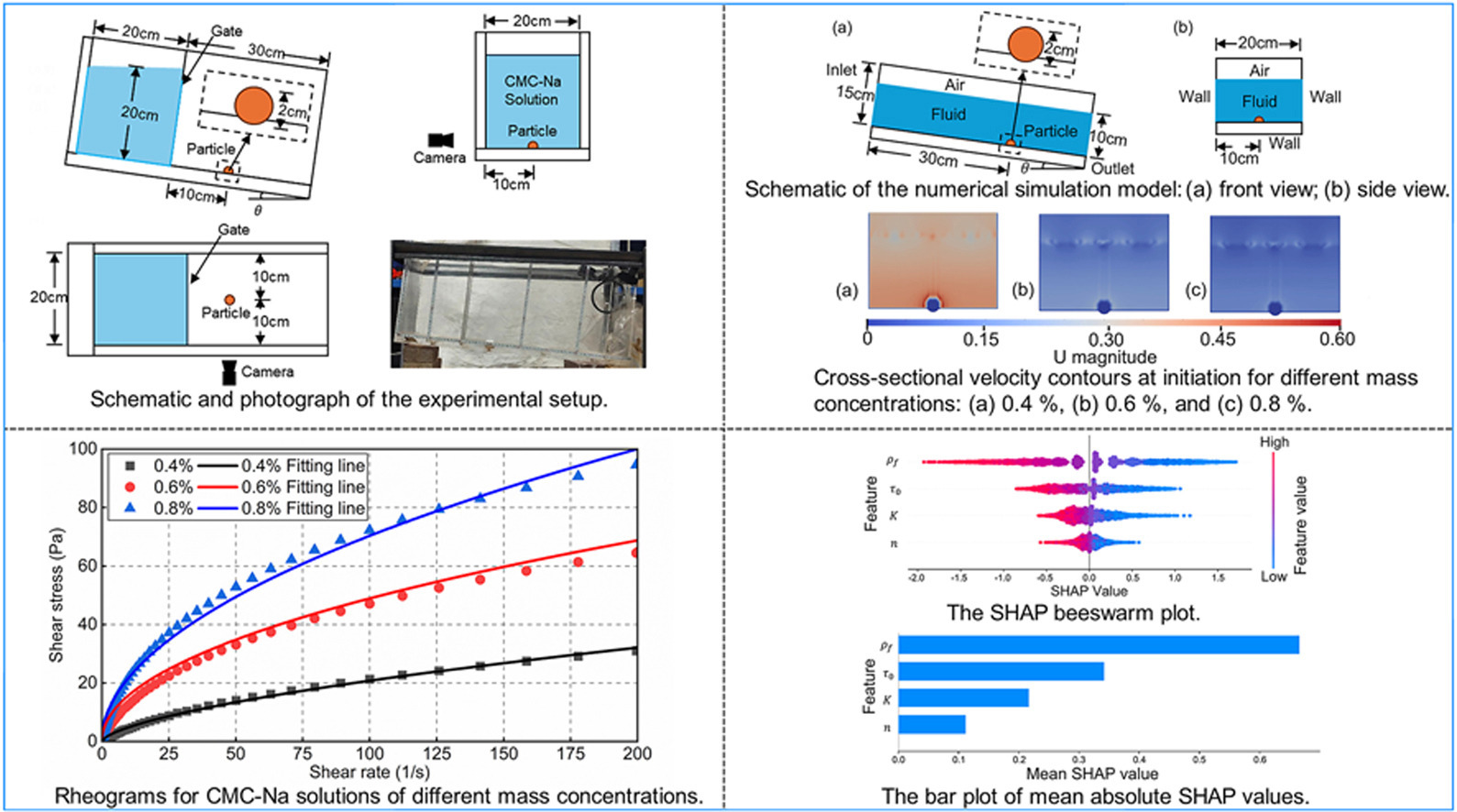
Debris flows, a common natural disaster, cause annual casualties and property damage downstream. In mountainous watersheds, short-duration heavy rainfall generates significant hydraulic conditions in debris flow channels. The specified conditions trigger the mobilization of loose sediment, leading to the amplification effect that can ultimately overwhelm downstream mitigation measures. This study considers the influence of the fluid properties of viscous debris flow slurries on the forces exerted on buried coarse particles, aiming to accurately reflect real-world conditions and offer theoretical support for the amplification effect. A novel relationship was established between the initiation of motion for buried coarse particles and flow conditions, thereby broadening the applicability of existing models. The reliability of the model is assessed from two perspectives: comparison with physical model experiments and comparison with numerical simulations. A sensitivity analysis on the fluid property parameters of the debris flow slurry revealed that slurry density has the greatest impact on the cross-sectional initiation velocity for particle initiation, followed by fluid yield stress, fluid consistency index, and fluid behavior index, with the latter having the least influence.
Graphical abstract
Keywords
Viscous debris flow; Buried coarse particles; Rolling initiation; Critical flow velocity; Cross-sectional velocity; CFD-DEM
文章导读