
期刊文章
过刊浏览
- Volumes 108-119 (2025)
-
Volumes 96-107 (2025)
-
Volume 107
Pages 1-376 (December 2025)
-
Volume 106
Pages 1-336 (November 2025)
-
Volume 105
Pages 1-356 (October 2025)
-
Volume 104
Pages 1-332 (September 2025)
-
Volume 103
Pages 1-314 (August 2025)
-
Volume 102
Pages 1-276 (July 2025)
-
Volume 101
Pages 1-166 (June 2025)
-
Volume 100
Pages 1-256 (May 2025)
-
Volume 99
Pages 1-242 (April 2025)
-
Volume 98
Pages 1-288 (March 2025)
-
Volume 97
Pages 1-256 (February 2025)
-
Volume 96
Pages 1-340 (January 2025)
-
Volume 107
-
Volumes 84-95 (2024)
-
Volume 95
Pages 1-392 (December 2024)
-
Volume 94
Pages 1-400 (November 2024)
-
Volume 93
Pages 1-376 (October 2024)
-
Volume 92
Pages 1-316 (September 2024)
-
Volume 91
Pages 1-378 (August 2024)
-
Volume 90
Pages 1-580 (July 2024)
-
Volume 89
Pages 1-278 (June 2024)
-
Volume 88
Pages 1-350 (May 2024)
-
Volume 87
Pages 1-338 (April 2024)
-
Volume 86
Pages 1-312 (March 2024)
-
Volume 85
Pages 1-334 (February 2024)
-
Volume 84
Pages 1-308 (January 2024)
-
Volume 95
-
Volumes 72-83 (2023)
-
Volume 83
Pages 1-258 (December 2023)
-
Volume 82
Pages 1-204 (November 2023)
-
Volume 81
Pages 1-188 (October 2023)
-
Volume 80
Pages 1-202 (September 2023)
-
Volume 79
Pages 1-172 (August 2023)
-
Volume 78
Pages 1-146 (July 2023)
-
Volume 77
Pages 1-152 (June 2023)
-
Volume 76
Pages 1-176 (May 2023)
-
Volume 75
Pages 1-228 (April 2023)
-
Volume 74
Pages 1-200 (March 2023)
-
Volume 73
Pages 1-138 (February 2023)
-
Volume 72
Pages 1-144 (January 2023)
-
Volume 83
-
Volumes 60-71 (2022)
-
Volume 71
Pages 1-108 (December 2022)
-
Volume 70
Pages 1-106 (November 2022)
-
Volume 69
Pages 1-122 (October 2022)
-
Volume 68
Pages 1-124 (September 2022)
-
Volume 67
Pages 1-102 (August 2022)
-
Volume 66
Pages 1-112 (July 2022)
-
Volume 65
Pages 1-138 (June 2022)
-
Volume 64
Pages 1-186 (May 2022)
-
Volume 63
Pages 1-124 (April 2022)
-
Volume 62
Pages 1-104 (March 2022)
-
Volume 61
Pages 1-120 (February 2022)
-
Volume 60
Pages 1-124 (January 2022)
-
Volume 71
- Volumes 54-59 (2021)
- Volumes 48-53 (2020)
- Volumes 42-47 (2019)
- Volumes 36-41 (2018)
- Volumes 30-35 (2017)
- Volumes 24-29 (2016)
- Volumes 18-23 (2015)
- Volumes 12-17 (2014)
- Volume 11 (2013)
- Volume 10 (2012)
- Volume 9 (2011)
- Volume 8 (2010)
- Volume 7 (2009)
- Volume 6 (2008)
- Volume 5 (2007)
- Volume 4 (2006)
- Volume 3 (2005)
- Volume 2 (2004)
- Volume 1 (2003)
Volume 109
Yang, L., Chen, X., Zhang, K., Wu, Y., Li, P., & Zhou, J. (2026). Reducing particle aggregation and pressure drop in vertical hydraulic transport through swirling flow optimization. Particuology, 109, 258-269. https://doi.org/10.1016/j.partic.2025.12.010
Reducing particle aggregation and pressure drop in vertical hydraulic transport through swirling flow optimization
Lele Yang a, Xiaodong Chen a, Ke Zhang a, Yue Wu a, Peng Li b *, Jianhou Zhou c
a School of Civil Engineering and Transportation, South China University of Technology, Guangzhou, 510641, China
b Institute of Mechanics, Chinese Academy of Sciences, Beijing, 100190, China
c Guangzhou Marine Geological Survey, Guangzhou, 510075, China
10.1016/j.partic.2025.12.010
Volume 109,
February 2026,
Pages 258-269
Received 9 June 2025, Revised 13 October 2025, Accepted 12 December 2025, Available online 2 January 2026, Version of Record 14 January 2026.
E-mail:
lipeng@imech.ac.cn
Highlights
• A novel deflector vane-type swirl generator for deep-sea mining swirl flow transport is proposed.
• A horizontal dispersion coefficient is proposed to quantify lateral dispersion of particles.
• Vane angle significantly impacts particle dispersion and pressure drop, while vane count and radius have lesser effects.
Abstract
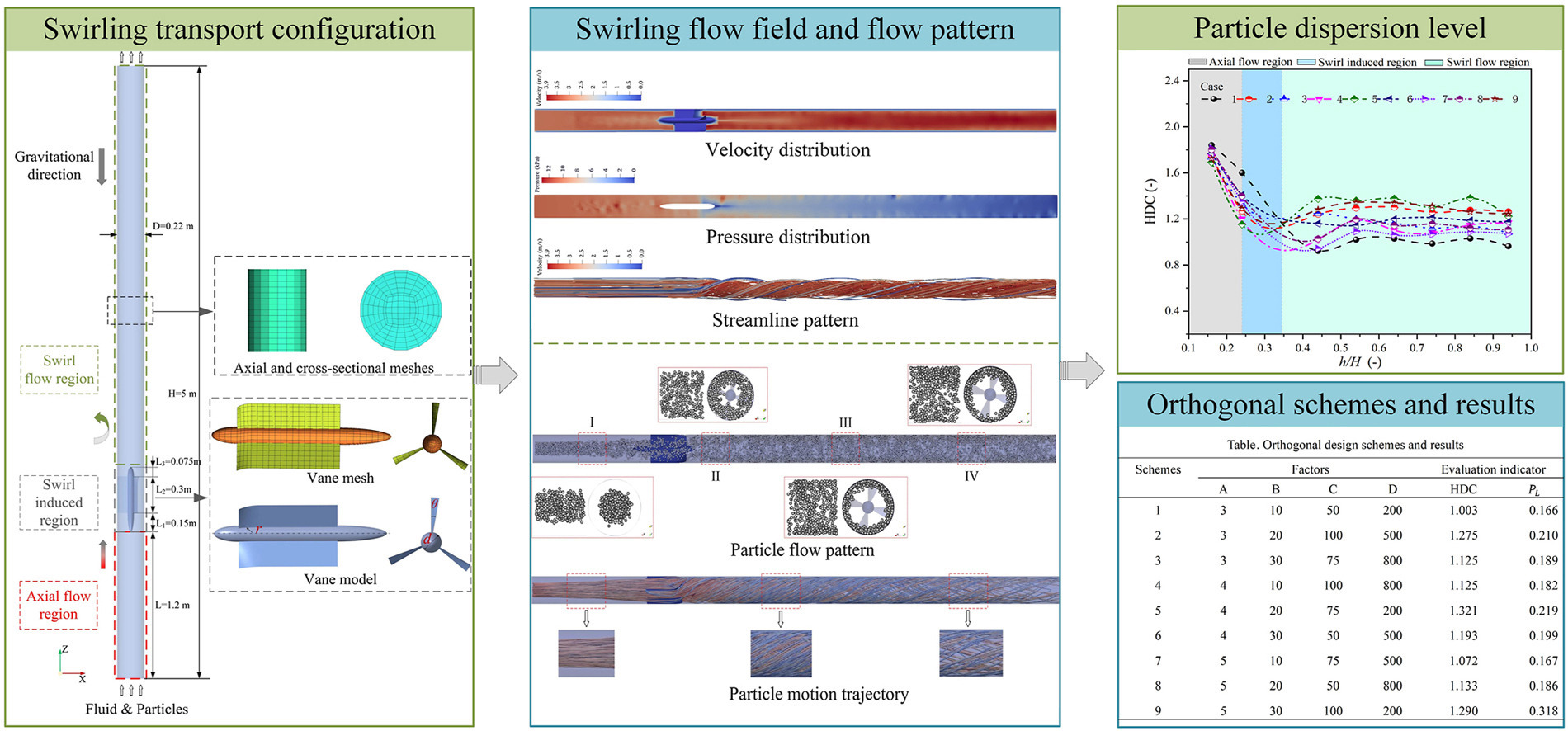
In vertical hydraulic conveyance for deep-sea mining, localized particle aggregation can occur due to multiple factors, resulting in increased concentration and degrade transport performance. To mitigate this issue, this study proposes a novel deflector vane-type swirl generator with a simple structure that generates swirling flow without additional operations. A combined computational fluid dynamics (CFD) and discrete element method (DEM) has been used to numerically simulate liquid-solid swirling flow in a vertical pipe featuring the vane. Subsequently, an orthogonal design method was applied to evaluate the effects of vane number, vane angle, vane radius, and hub diameter on transport behavior, using the horizontal dispersion coefficient and pressure drop as performance indicators. The results demonstrate that the vane angle is the most influential factor for both particle dispersion and pressure loss, whereas vane number and vane radius have comparatively minor effects. Moreover, increasing the vane angle and hub diameter strengthens the swirl intensity, promotes particle accumulation near the pipe wall, and thereby increases the horizontal dispersion coefficient. The results offer insights that can inform the enhancement of the efficiency and safety of vertical hydraulic transport.
Graphical abstract
Keywords
Swirling flow; CFD-DEM; Particle dispersion; Pressure drop; Vertical pipe
文章导读