
期刊文章
过刊浏览
- Volumes 108-119 (2025)
-
Volumes 96-107 (2025)
-
Volume 107
Pages 1-376 (December 2025)
-
Volume 106
Pages 1-336 (November 2025)
-
Volume 105
Pages 1-356 (October 2025)
-
Volume 104
Pages 1-332 (September 2025)
-
Volume 103
Pages 1-314 (August 2025)
-
Volume 102
Pages 1-276 (July 2025)
-
Volume 101
Pages 1-166 (June 2025)
-
Volume 100
Pages 1-256 (May 2025)
-
Volume 99
Pages 1-242 (April 2025)
-
Volume 98
Pages 1-288 (March 2025)
-
Volume 97
Pages 1-256 (February 2025)
-
Volume 96
Pages 1-340 (January 2025)
-
Volume 107
-
Volumes 84-95 (2024)
-
Volume 95
Pages 1-392 (December 2024)
-
Volume 94
Pages 1-400 (November 2024)
-
Volume 93
Pages 1-376 (October 2024)
-
Volume 92
Pages 1-316 (September 2024)
-
Volume 91
Pages 1-378 (August 2024)
-
Volume 90
Pages 1-580 (July 2024)
-
Volume 89
Pages 1-278 (June 2024)
-
Volume 88
Pages 1-350 (May 2024)
-
Volume 87
Pages 1-338 (April 2024)
-
Volume 86
Pages 1-312 (March 2024)
-
Volume 85
Pages 1-334 (February 2024)
-
Volume 84
Pages 1-308 (January 2024)
-
Volume 95
-
Volumes 72-83 (2023)
-
Volume 83
Pages 1-258 (December 2023)
-
Volume 82
Pages 1-204 (November 2023)
-
Volume 81
Pages 1-188 (October 2023)
-
Volume 80
Pages 1-202 (September 2023)
-
Volume 79
Pages 1-172 (August 2023)
-
Volume 78
Pages 1-146 (July 2023)
-
Volume 77
Pages 1-152 (June 2023)
-
Volume 76
Pages 1-176 (May 2023)
-
Volume 75
Pages 1-228 (April 2023)
-
Volume 74
Pages 1-200 (March 2023)
-
Volume 73
Pages 1-138 (February 2023)
-
Volume 72
Pages 1-144 (January 2023)
-
Volume 83
-
Volumes 60-71 (2022)
-
Volume 71
Pages 1-108 (December 2022)
-
Volume 70
Pages 1-106 (November 2022)
-
Volume 69
Pages 1-122 (October 2022)
-
Volume 68
Pages 1-124 (September 2022)
-
Volume 67
Pages 1-102 (August 2022)
-
Volume 66
Pages 1-112 (July 2022)
-
Volume 65
Pages 1-138 (June 2022)
-
Volume 64
Pages 1-186 (May 2022)
-
Volume 63
Pages 1-124 (April 2022)
-
Volume 62
Pages 1-104 (March 2022)
-
Volume 61
Pages 1-120 (February 2022)
-
Volume 60
Pages 1-124 (January 2022)
-
Volume 71
- Volumes 54-59 (2021)
- Volumes 48-53 (2020)
- Volumes 42-47 (2019)
- Volumes 36-41 (2018)
- Volumes 30-35 (2017)
- Volumes 24-29 (2016)
- Volumes 18-23 (2015)
- Volumes 12-17 (2014)
- Volume 11 (2013)
- Volume 10 (2012)
- Volume 9 (2011)
- Volume 8 (2010)
- Volume 7 (2009)
- Volume 6 (2008)
- Volume 5 (2007)
- Volume 4 (2006)
- Volume 3 (2005)
- Volume 2 (2004)
- Volume 1 (2003)
Volume 109
Zhu, Z., Zhang, Q., Zhang, Y., Liao, Y., Qiu, Q., Chen, Z., & Li, S. (2026). Key factors in liquid-route synthesis of photovoltaic front-side silver micro-powder: Particle growth modeling coupled with CFD. Particuology, 109, 270-281. https://doi.org/10.1016/j.partic.2025.12.008
Key factors in liquid-route synthesis of photovoltaic front-side silver micro-powder: Particle growth modeling coupled with CFD
Zepeng Zhu a, Qian Zhang b *, Yiyang Zhang c *, Yaqin Liao b, Qingqing Qiu b, Zhong Chen b, Shuiqing Li a
a Department of Energy and Power Engineering, Tsinghua University, Beijing, China
b Dongfang Electric Academy of Science and Technology Co. Ltd, Chengdu, China
c Institute of Nuclear and New Energy Technology, Tsinghua University, Beijing, China
10.1016/j.partic.2025.12.008
Volume 109,
February 2026,
Pages 270-281
Received 31 July 2025, Revised 9 December 2025, Accepted 10 December 2025, Available online 2 January 2026, Version of Record 16 January 2026.
E-mail:
zhangq9916@dongfang.com; zhangyiyang@mail.tsinghua.edu.cn
Highlights
• A CFD-PBM model for front-side silver micro-powder synthesis considering flow, reaction, particle growth is proposed.
• Dominant periods of growth processes and their effects on silver powder synthesis are analyzed.
• Controlling hierarchy of key factors linking synthesis conditions to output size distribution is elucidated.
• Suggestions for adjusting synthesis are proposed according to parametric studies of input conditions.
Abstract
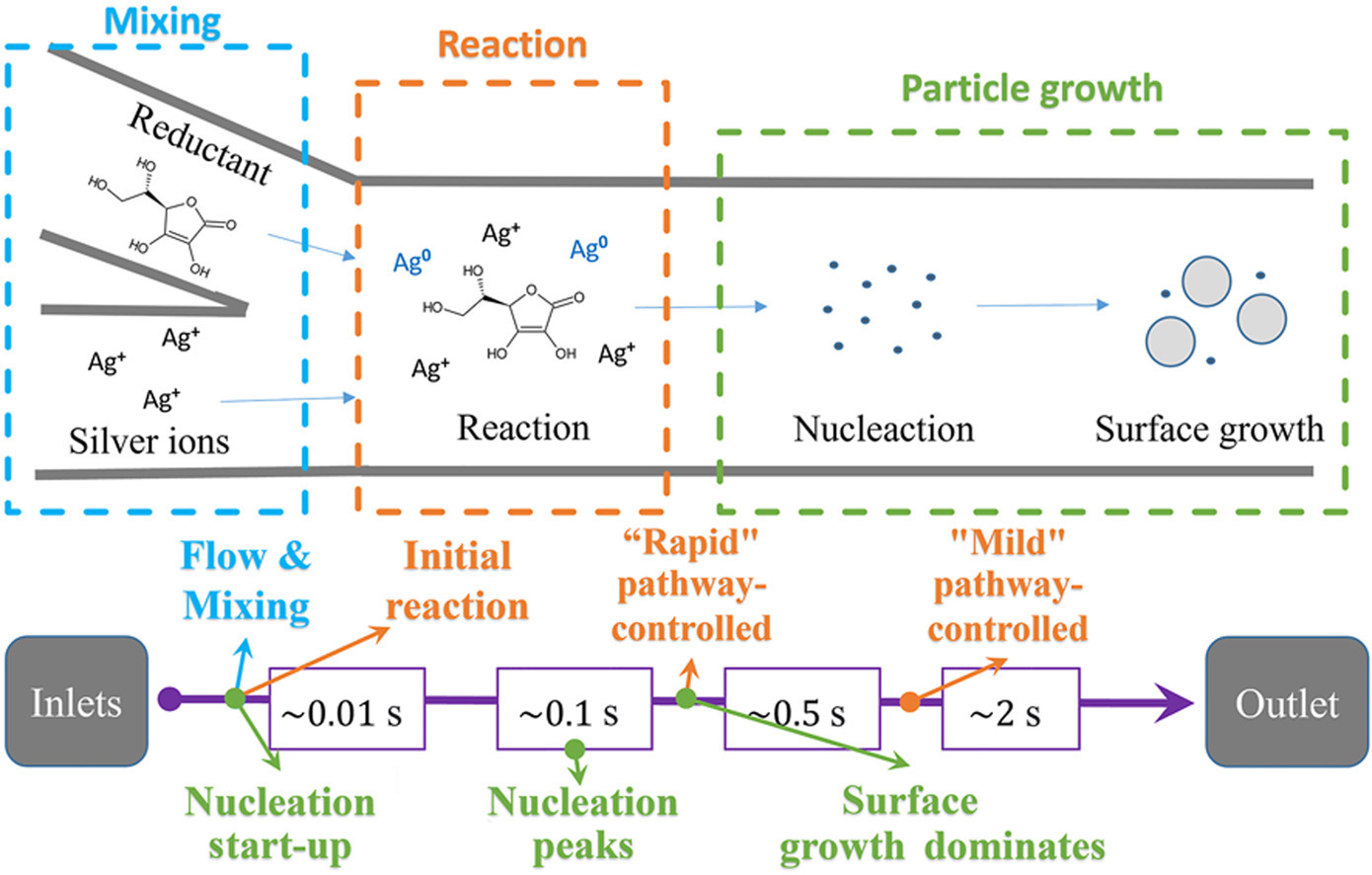
The performance of photovoltaic cell grids critically depends on the quality of front silver paste, which is significantly influenced by the particle size of the silver powder. Liquid-route continuous synthesis is a highly promising option for the silver micro-powder production. To identify the key factors in synthesis processes impacting on the particle size of the final product, a comprehensive understanding of the continuous liquid-route reduction synthesis mechanisms is required. This study presents a coupled CFD-PBM framework of silver micro-powder synthesis that incorporates flow dynamics, chemical reactions, nucleation, and surface growth processes. The results indicate that the initial reduction rate influences the nucleation of silver powder formation, thereby determining the number of final products. The reduction rate of following stage affects the surface growth, ultimately determining the average size of the products. In a synthesis system with a fixed total reducible silver content, a high initial reduction rate tends to a larger number of smaller silver powder particles produced. Particularly in the ascorbic acid-silver nitrate reduction system, the pH value is a critical factor controlling the distribution of reaction rates. The findings reveal how the reduction rate regulates the final particle size through its influence on nucleation and growth processes, providing insights into controlling powder particle size characteristics by manipulating reaction rates within the continuous synthesis system.
Graphical abstract
Keywords
Zepeng Zhu a, Qian Zhang b *, Yiyang Zhang c *, Yaqin Liao b, Qingqing Qiu b, Zhong Chen b, Shuiqing Li a
文章导读