
期刊文章
过刊浏览
- Volumes 108-119 (2025)
-
Volumes 96-107 (2025)
-
Volume 107
Pages 1-376 (December 2025)
-
Volume 106
Pages 1-336 (November 2025)
-
Volume 105
Pages 1-356 (October 2025)
-
Volume 104
Pages 1-332 (September 2025)
-
Volume 103
Pages 1-314 (August 2025)
-
Volume 102
Pages 1-276 (July 2025)
-
Volume 101
Pages 1-166 (June 2025)
-
Volume 100
Pages 1-256 (May 2025)
-
Volume 99
Pages 1-242 (April 2025)
-
Volume 98
Pages 1-288 (March 2025)
-
Volume 97
Pages 1-256 (February 2025)
-
Volume 96
Pages 1-340 (January 2025)
-
Volume 107
-
Volumes 84-95 (2024)
-
Volume 95
Pages 1-392 (December 2024)
-
Volume 94
Pages 1-400 (November 2024)
-
Volume 93
Pages 1-376 (October 2024)
-
Volume 92
Pages 1-316 (September 2024)
-
Volume 91
Pages 1-378 (August 2024)
-
Volume 90
Pages 1-580 (July 2024)
-
Volume 89
Pages 1-278 (June 2024)
-
Volume 88
Pages 1-350 (May 2024)
-
Volume 87
Pages 1-338 (April 2024)
-
Volume 86
Pages 1-312 (March 2024)
-
Volume 85
Pages 1-334 (February 2024)
-
Volume 84
Pages 1-308 (January 2024)
-
Volume 95
-
Volumes 72-83 (2023)
-
Volume 83
Pages 1-258 (December 2023)
-
Volume 82
Pages 1-204 (November 2023)
-
Volume 81
Pages 1-188 (October 2023)
-
Volume 80
Pages 1-202 (September 2023)
-
Volume 79
Pages 1-172 (August 2023)
-
Volume 78
Pages 1-146 (July 2023)
-
Volume 77
Pages 1-152 (June 2023)
-
Volume 76
Pages 1-176 (May 2023)
-
Volume 75
Pages 1-228 (April 2023)
-
Volume 74
Pages 1-200 (March 2023)
-
Volume 73
Pages 1-138 (February 2023)
-
Volume 72
Pages 1-144 (January 2023)
-
Volume 83
-
Volumes 60-71 (2022)
-
Volume 71
Pages 1-108 (December 2022)
-
Volume 70
Pages 1-106 (November 2022)
-
Volume 69
Pages 1-122 (October 2022)
-
Volume 68
Pages 1-124 (September 2022)
-
Volume 67
Pages 1-102 (August 2022)
-
Volume 66
Pages 1-112 (July 2022)
-
Volume 65
Pages 1-138 (June 2022)
-
Volume 64
Pages 1-186 (May 2022)
-
Volume 63
Pages 1-124 (April 2022)
-
Volume 62
Pages 1-104 (March 2022)
-
Volume 61
Pages 1-120 (February 2022)
-
Volume 60
Pages 1-124 (January 2022)
-
Volume 71
- Volumes 54-59 (2021)
- Volumes 48-53 (2020)
- Volumes 42-47 (2019)
- Volumes 36-41 (2018)
- Volumes 30-35 (2017)
- Volumes 24-29 (2016)
- Volumes 18-23 (2015)
- Volumes 12-17 (2014)
- Volume 11 (2013)
- Volume 10 (2012)
- Volume 9 (2011)
- Volume 8 (2010)
- Volume 7 (2009)
- Volume 6 (2008)
- Volume 5 (2007)
- Volume 4 (2006)
- Volume 3 (2005)
- Volume 2 (2004)
- Volume 1 (2003)
Volume 109
Wu, X., Zhang, M., Wang, C., Wan, C., Zheng, P., Han, Z., . . . Xu, G. (2026). Shale oil hydro-upgrading over NiMo/Al2O3 with H2-rich gas from methanol steam reforming. Particuology, 109, 292-301. https://doi.org/10.1016/j.partic.2025.12.011
Shale oil hydro-upgrading over NiMo/Al2O3 with H2-rich gas from methanol steam reforming
Xiaoyu Wu a b, Mengjuan Zhang a b *, Chao Wang a b c *, Chenhong Wan a b, Peng Zheng a b, Zhennan Han a b, Xin Jia a b, Zhanguo Zhang a b, Guangwen Xu a b *
a Key Laboratory of Resources Chemicals and Materials (Shenyang University of Chemical Technology), Ministry of Education, Shenyang, 110142, China
b College of Chemical Engineering, Shenyang University of Chemical Technology, Shenyang, 110142, China
c School of Environmental and Safety Engineering, Liaoning Petrochemical University, Fushun, 113001, China
10.1016/j.partic.2025.12.011
Volume 109,
February 2026,
Pages 292-301
Received 24 October 2025, Revised 11 December 2025, Accepted 12 December 2025, Available online 2 January 2026, Version of Record 17 January 2026.
E-mail:
zhangmengjuan@syuct.edu.cn; wangchao@lnpu.edu.cn; gwxu@syuct.edu.cn
Highlights
• As-Generated H2-rich gas produced from methanol steam reforming is directly used for shale oil hydro-upgrading.
• Sulfur content in upgraded shale oil meets the required standard of marine oil.
• Steam in H2-rich gas can reduce carbon deposition on catalyst during hydrogenation of heavy oil.
• Direct integration of methanol steam reforming and shale oil hydro-upgrading is technically feasible.
Abstract
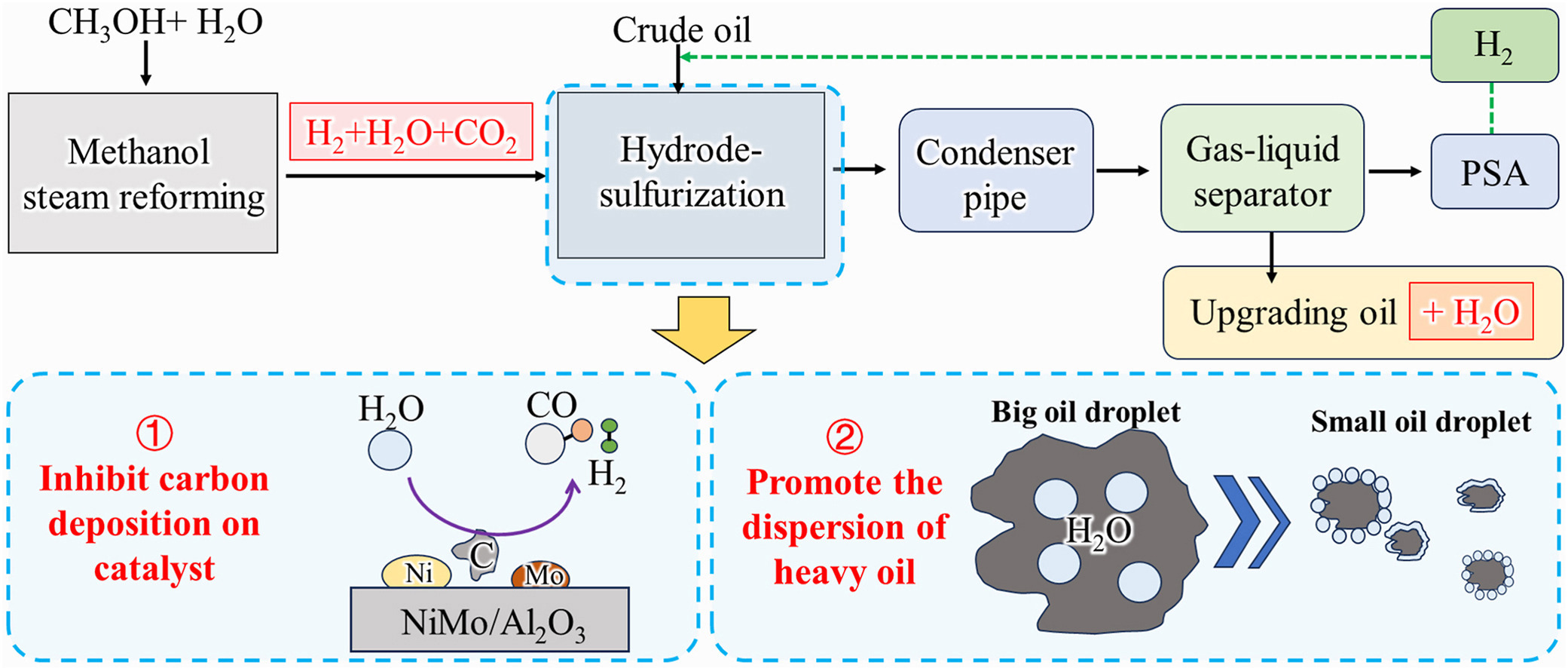
This article investigated the hydrodesulfurization of shale oil over NiMo/Al2O3 catalyst in a fixed bed reactor downstream a methanol steam reformer that provides H2-rich gas containing CO2 and steam. Under the optimal conditions of hydrogenation, say, at 380 °C, 4 MPa, a gas/oil volume ratio of 600:1, and an oil hourly space velocity of 4.0 h−1, the sulfur content in the upgraded shale oil varied around 4400 ppm, showing a sulfur removal efficiency above 66 % and the satisfaction of the international standard for marine fuel oil (ISO 8217). The oil exhibited significant improvement on quality, including enhanced calorific value, reduced density and viscosity, increased fraction of light oil, and decreased proportion of heavy oil. Through characterization of catalysts, it was found that steam in H2-rich gas did not significantly affect hydrodesulfurization efficiency. The presence of steam not only promoted hydrocracking of heavy fractions but reduced also carbon deposition on the catalyst during hydro-processing. A 125-h continuous test on stability of performance further corroborated the technical feasibility of the investigated process, establishing essentially a practical pathway to upgrade shale oil by using the as-generated methanol-reformed gas without removal of its containing CO2 and steam as the hydrogen source.
Graphical abstract
Keywords
Shale oil; Catalytic hydrodesulfurization; Methanol steam reforming; CO2-Containing H2; Marian fuel oil
文章导读