
期刊文章
过刊浏览
- Volumes 108-119 (2025)
-
Volumes 96-107 (2025)
-
Volume 107
Pages 1-376 (December 2025)
-
Volume 106
Pages 1-336 (November 2025)
-
Volume 105
Pages 1-356 (October 2025)
-
Volume 104
Pages 1-332 (September 2025)
-
Volume 103
Pages 1-314 (August 2025)
-
Volume 102
Pages 1-276 (July 2025)
-
Volume 101
Pages 1-166 (June 2025)
-
Volume 100
Pages 1-256 (May 2025)
-
Volume 99
Pages 1-242 (April 2025)
-
Volume 98
Pages 1-288 (March 2025)
-
Volume 97
Pages 1-256 (February 2025)
-
Volume 96
Pages 1-340 (January 2025)
-
Volume 107
-
Volumes 84-95 (2024)
-
Volume 95
Pages 1-392 (December 2024)
-
Volume 94
Pages 1-400 (November 2024)
-
Volume 93
Pages 1-376 (October 2024)
-
Volume 92
Pages 1-316 (September 2024)
-
Volume 91
Pages 1-378 (August 2024)
-
Volume 90
Pages 1-580 (July 2024)
-
Volume 89
Pages 1-278 (June 2024)
-
Volume 88
Pages 1-350 (May 2024)
-
Volume 87
Pages 1-338 (April 2024)
-
Volume 86
Pages 1-312 (March 2024)
-
Volume 85
Pages 1-334 (February 2024)
-
Volume 84
Pages 1-308 (January 2024)
-
Volume 95
-
Volumes 72-83 (2023)
-
Volume 83
Pages 1-258 (December 2023)
-
Volume 82
Pages 1-204 (November 2023)
-
Volume 81
Pages 1-188 (October 2023)
-
Volume 80
Pages 1-202 (September 2023)
-
Volume 79
Pages 1-172 (August 2023)
-
Volume 78
Pages 1-146 (July 2023)
-
Volume 77
Pages 1-152 (June 2023)
-
Volume 76
Pages 1-176 (May 2023)
-
Volume 75
Pages 1-228 (April 2023)
-
Volume 74
Pages 1-200 (March 2023)
-
Volume 73
Pages 1-138 (February 2023)
-
Volume 72
Pages 1-144 (January 2023)
-
Volume 83
-
Volumes 60-71 (2022)
-
Volume 71
Pages 1-108 (December 2022)
-
Volume 70
Pages 1-106 (November 2022)
-
Volume 69
Pages 1-122 (October 2022)
-
Volume 68
Pages 1-124 (September 2022)
-
Volume 67
Pages 1-102 (August 2022)
-
Volume 66
Pages 1-112 (July 2022)
-
Volume 65
Pages 1-138 (June 2022)
-
Volume 64
Pages 1-186 (May 2022)
-
Volume 63
Pages 1-124 (April 2022)
-
Volume 62
Pages 1-104 (March 2022)
-
Volume 61
Pages 1-120 (February 2022)
-
Volume 60
Pages 1-124 (January 2022)
-
Volume 71
- Volumes 54-59 (2021)
- Volumes 48-53 (2020)
- Volumes 42-47 (2019)
- Volumes 36-41 (2018)
- Volumes 30-35 (2017)
- Volumes 24-29 (2016)
- Volumes 18-23 (2015)
- Volumes 12-17 (2014)
- Volume 11 (2013)
- Volume 10 (2012)
- Volume 9 (2011)
- Volume 8 (2010)
- Volume 7 (2009)
- Volume 6 (2008)
- Volume 5 (2007)
- Volume 4 (2006)
- Volume 3 (2005)
- Volume 2 (2004)
- Volume 1 (2003)
Volume 109
Tavanaei, A., Rieder, D. R., Baltussen, M. W., Buist, K. A., & Kuipers, J. A. M. (2026). Particle-resolved CFD study of liquid axial penetration and lateral spreading in an ordered trickle bed reactor. Particuology, 109, 302-311. https://doi.org/10.1016/j.partic.2025.12.025
Particle-resolved CFD study of liquid axial penetration and lateral spreading in an ordered trickle bed reactor (Open Access)
A. Tavanaei a, D.R. Rieder a b, M.W. Baltussen a *, K.A. Buist a, J.A.M. Kuipers a
a Department of Chemical Engineering and Chemistry, Eindhoven University of Technology, P.O. Box 513, 5600 MB, Eindhoven, the Netherlands
b Department of Mechanical Engineering, Eindhoven University of Technology, P.O. Box 513, 5600 MB Eindhoven, the Netherlands
10.1016/j.partic.2025.12.025
Volume 109,
February 2026,
Pages 302-311
Received 8 October 2025, Revised 20 December 2025, Accepted 28 December 2025, Available online 12 January 2026, Version of Record 28 January 2026.
E-mail:
m.w.baltussen@tue.nl
Highlights
• Systematic study of wetting characteristics of trickle bed reactors.
• Computational fluid dynamics study for wetting in trickle beds.
• Determined the contributing forces that drive the wetting in trickle bed reactors.
• Dominate force in axial spreading of the liquid is gravity.
• Gas flow is a dominant factor in the lateral spreading.
Abstract
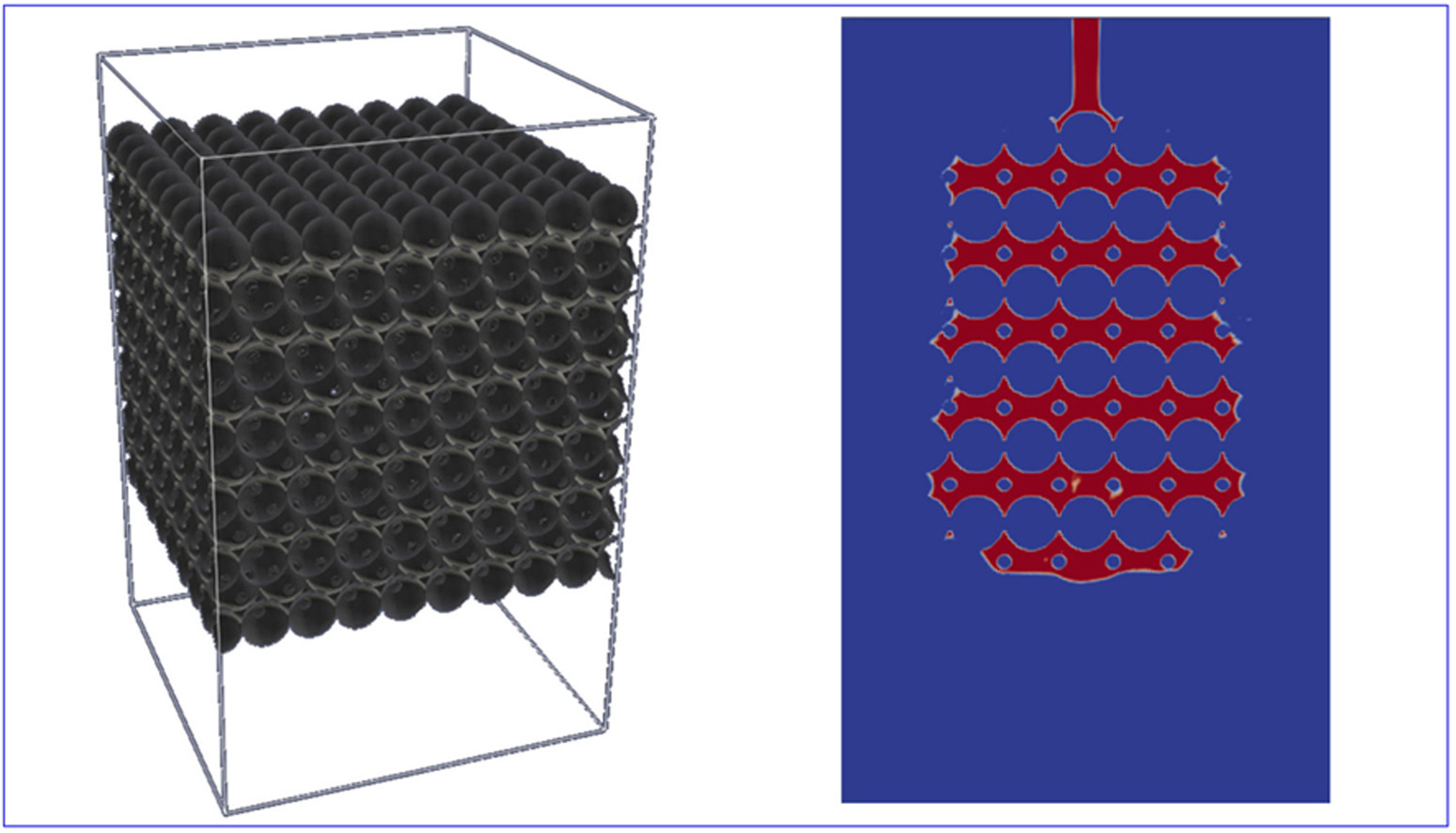
Trickle bed reactors are frequently applied in the chemical process industries for gas-liquid-solid contacting. The performance of these reactors is sensitively influenced by the hydrodynamics. This study focuses on investigating the complex interaction between the gas and liquid phases in these reactors. Specifically, the effects of inlet liquid flux, surface wettability, and gas velocity on lateral spreading and axial penetration of the liquid are explored. An ordered trickle bed is used to reduce the effects of the configuration of the particles on these parameters. Using Direct Numerical Simulation (DNS), we determined that the lateral spreading and axial penetration are enhanced with an increased liquid flux, as expected. Interestingly, the initial liquid inertia, represented by the liquid jet velocity, has limited influence on both lateral spreading and axial penetration in the ordered bed, while the gravitational force is the dominant factor for the axial penetration. Furthermore, the contact angle has minimal impact on lateral spreading, indicating the presence of an additional force restricting spreading. Notably, the gas velocity is identified as a crucial factor influencing lateral spreading, as high velocities prevent the capillary forces from spreading the liquid. These insights in the contributing forces on the spreading behaviour in trickle bed reactors facilitate an improved reactor design and optimization.
Graphical abstract
Keywords
Trickle bed; Liquid distribution; Direct numerical simulation; Volume of fluid
文章导读