
期刊文章
过刊浏览
- Volumes 108-119 (2025)
-
Volumes 96-107 (2025)
-
Volume 107
Pages 1-376 (December 2025)
-
Volume 106
Pages 1-336 (November 2025)
-
Volume 105
Pages 1-356 (October 2025)
-
Volume 104
Pages 1-332 (September 2025)
-
Volume 103
Pages 1-314 (August 2025)
-
Volume 102
Pages 1-276 (July 2025)
-
Volume 101
Pages 1-166 (June 2025)
-
Volume 100
Pages 1-256 (May 2025)
-
Volume 99
Pages 1-242 (April 2025)
-
Volume 98
Pages 1-288 (March 2025)
-
Volume 97
Pages 1-256 (February 2025)
-
Volume 96
Pages 1-340 (January 2025)
-
Volume 107
-
Volumes 84-95 (2024)
-
Volume 95
Pages 1-392 (December 2024)
-
Volume 94
Pages 1-400 (November 2024)
-
Volume 93
Pages 1-376 (October 2024)
-
Volume 92
Pages 1-316 (September 2024)
-
Volume 91
Pages 1-378 (August 2024)
-
Volume 90
Pages 1-580 (July 2024)
-
Volume 89
Pages 1-278 (June 2024)
-
Volume 88
Pages 1-350 (May 2024)
-
Volume 87
Pages 1-338 (April 2024)
-
Volume 86
Pages 1-312 (March 2024)
-
Volume 85
Pages 1-334 (February 2024)
-
Volume 84
Pages 1-308 (January 2024)
-
Volume 95
-
Volumes 72-83 (2023)
-
Volume 83
Pages 1-258 (December 2023)
-
Volume 82
Pages 1-204 (November 2023)
-
Volume 81
Pages 1-188 (October 2023)
-
Volume 80
Pages 1-202 (September 2023)
-
Volume 79
Pages 1-172 (August 2023)
-
Volume 78
Pages 1-146 (July 2023)
-
Volume 77
Pages 1-152 (June 2023)
-
Volume 76
Pages 1-176 (May 2023)
-
Volume 75
Pages 1-228 (April 2023)
-
Volume 74
Pages 1-200 (March 2023)
-
Volume 73
Pages 1-138 (February 2023)
-
Volume 72
Pages 1-144 (January 2023)
-
Volume 83
-
Volumes 60-71 (2022)
-
Volume 71
Pages 1-108 (December 2022)
-
Volume 70
Pages 1-106 (November 2022)
-
Volume 69
Pages 1-122 (October 2022)
-
Volume 68
Pages 1-124 (September 2022)
-
Volume 67
Pages 1-102 (August 2022)
-
Volume 66
Pages 1-112 (July 2022)
-
Volume 65
Pages 1-138 (June 2022)
-
Volume 64
Pages 1-186 (May 2022)
-
Volume 63
Pages 1-124 (April 2022)
-
Volume 62
Pages 1-104 (March 2022)
-
Volume 61
Pages 1-120 (February 2022)
-
Volume 60
Pages 1-124 (January 2022)
-
Volume 71
- Volumes 54-59 (2021)
- Volumes 48-53 (2020)
- Volumes 42-47 (2019)
- Volumes 36-41 (2018)
- Volumes 30-35 (2017)
- Volumes 24-29 (2016)
- Volumes 18-23 (2015)
- Volumes 12-17 (2014)
- Volume 11 (2013)
- Volume 10 (2012)
- Volume 9 (2011)
- Volume 8 (2010)
- Volume 7 (2009)
- Volume 6 (2008)
- Volume 5 (2007)
- Volume 4 (2006)
- Volume 3 (2005)
- Volume 2 (2004)
- Volume 1 (2003)
Volume 110
Chen, J., Chen, K., Li, D., Zhao, Z., Zhuravkov, M., Siarhei, L., & Jiang, W. (2026). Investigation into nanoparticle fluidization characteristics with electrostatic force-modified population balance model. Particuology, 110, 14-27. https://doi.org/10.1016/j.partic.2026.01.003
Investigation into nanoparticle fluidization characteristics with electrostatic force-modified population balance model
Juhui Chen a *, Ke Chen a, Dan Li a, Zhirui Zhao a, Michael Zhuravkov b c, Lapatsin Siarhei b c, Wenrui Jiang c
a School of Mechanical and Power Engineering, Harbin University of Science and Technology, Harbin, 150080, China
b Heilongjiang Key Laboratory for International Cooperation on Gear Transmission of Maritime and Air Equipment, Harbin, 150001, China
c School of Mechatronics Engineering, Harbin Institute of Technology, Harbin, 150001, China
10.1016/j.partic.2026.01.003
Volume 110,
March 2026,
Pages 14-27
Received 22 November 2025, Revised 24 December 2025, Accepted 4 January 2026, Available online 10 January 2026, Version of Record 20 January 2026.
E-mail:
chenjuhui@hrbust.edu.cn; b0222li@126.com
Highlights
• A population balance model modified based on electrostatic forces is proposed.
• The modified PBM values align with the experimental data.
• Analysis of electrostatic force impact on aggregate diameter distribution.
• Nanoparticle aggregation, aggregate diameter, and pressure drop were analyzed.
Abstract
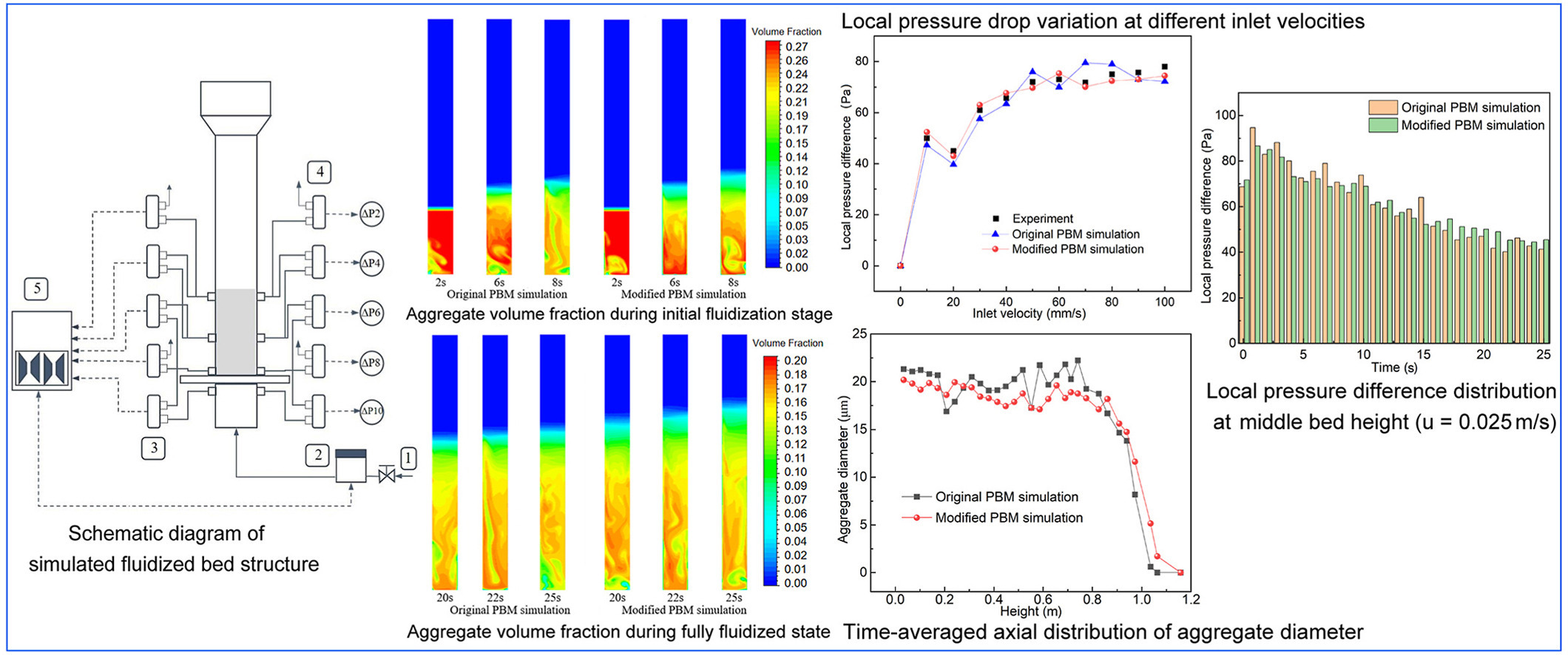
Within the two-fluid model framework integrated with particle dynamics theory, this study explicitly incorporates interparticle electrostatic forces to derive formulas for aggregation and breakage kernels of nanoparticle aggregates. Accordingly, an electrostatic-force-modified Population Balance Model (PBM) is proposed to track and characterize nanoparticle aggregation and breakage processes. To quantify the evolution of aggregate volume fractions and diameters, the flow characteristics of SiO2 nanoparticles in a microfluidized bed are numerically investigated. The results demonstrate that the modified PBM enhances the dispersion of aggregates and improves fluidization quality. The electrostatic force increases with growing aggregate diameter. When nanoparticles enter the fully fluidized stage, the synergistic interplay among electrostatic repulsion, Brownian diffusion, and turbulent forces collectively regulates aggregate formation and breakage. This leads to a more organized spatial distribution of aggregates and a gradual reduction in local pressure drop fluctuations over time. Furthermore, the bed pressure difference increases significantly under the combined influence of gas velocity and electrostatic forces.
Graphical abstract
Keywords
Modified PBM; Aggregation and breakage; Electrostatic force; Microfluidized bed
文章导读