
期刊文章
过刊浏览
- Volumes 108-119 (2025)
-
Volumes 96-107 (2025)
-
Volume 107
Pages 1-376 (December 2025)
-
Volume 106
Pages 1-336 (November 2025)
-
Volume 105
Pages 1-356 (October 2025)
-
Volume 104
Pages 1-332 (September 2025)
-
Volume 103
Pages 1-314 (August 2025)
-
Volume 102
Pages 1-276 (July 2025)
-
Volume 101
Pages 1-166 (June 2025)
-
Volume 100
Pages 1-256 (May 2025)
-
Volume 99
Pages 1-242 (April 2025)
-
Volume 98
Pages 1-288 (March 2025)
-
Volume 97
Pages 1-256 (February 2025)
-
Volume 96
Pages 1-340 (January 2025)
-
Volume 107
-
Volumes 84-95 (2024)
-
Volume 95
Pages 1-392 (December 2024)
-
Volume 94
Pages 1-400 (November 2024)
-
Volume 93
Pages 1-376 (October 2024)
-
Volume 92
Pages 1-316 (September 2024)
-
Volume 91
Pages 1-378 (August 2024)
-
Volume 90
Pages 1-580 (July 2024)
-
Volume 89
Pages 1-278 (June 2024)
-
Volume 88
Pages 1-350 (May 2024)
-
Volume 87
Pages 1-338 (April 2024)
-
Volume 86
Pages 1-312 (March 2024)
-
Volume 85
Pages 1-334 (February 2024)
-
Volume 84
Pages 1-308 (January 2024)
-
Volume 95
-
Volumes 72-83 (2023)
-
Volume 83
Pages 1-258 (December 2023)
-
Volume 82
Pages 1-204 (November 2023)
-
Volume 81
Pages 1-188 (October 2023)
-
Volume 80
Pages 1-202 (September 2023)
-
Volume 79
Pages 1-172 (August 2023)
-
Volume 78
Pages 1-146 (July 2023)
-
Volume 77
Pages 1-152 (June 2023)
-
Volume 76
Pages 1-176 (May 2023)
-
Volume 75
Pages 1-228 (April 2023)
-
Volume 74
Pages 1-200 (March 2023)
-
Volume 73
Pages 1-138 (February 2023)
-
Volume 72
Pages 1-144 (January 2023)
-
Volume 83
-
Volumes 60-71 (2022)
-
Volume 71
Pages 1-108 (December 2022)
-
Volume 70
Pages 1-106 (November 2022)
-
Volume 69
Pages 1-122 (October 2022)
-
Volume 68
Pages 1-124 (September 2022)
-
Volume 67
Pages 1-102 (August 2022)
-
Volume 66
Pages 1-112 (July 2022)
-
Volume 65
Pages 1-138 (June 2022)
-
Volume 64
Pages 1-186 (May 2022)
-
Volume 63
Pages 1-124 (April 2022)
-
Volume 62
Pages 1-104 (March 2022)
-
Volume 61
Pages 1-120 (February 2022)
-
Volume 60
Pages 1-124 (January 2022)
-
Volume 71
- Volumes 54-59 (2021)
- Volumes 48-53 (2020)
- Volumes 42-47 (2019)
- Volumes 36-41 (2018)
- Volumes 30-35 (2017)
- Volumes 24-29 (2016)
- Volumes 18-23 (2015)
- Volumes 12-17 (2014)
- Volume 11 (2013)
- Volume 10 (2012)
- Volume 9 (2011)
- Volume 8 (2010)
- Volume 7 (2009)
- Volume 6 (2008)
- Volume 5 (2007)
- Volume 4 (2006)
- Volume 3 (2005)
- Volume 2 (2004)
- Volume 1 (2003)
Volume 111
Kang, H., Xu, B., Wu, X., Gao, Q., Li, R., Li, S., . . . Lu, W. (2026). A highly efficient and stable phyllosilicate-derived Ni catalyst particles for isophthalonitrile hydrogenation to m-xylylenediamine. Particuology, 111, 214-222. https://doi.org/10.1016/j.partic.2026.02.007
A highly efficient and stable phyllosilicate-derived Ni catalyst particles for isophthalonitrile hydrogenation to m-xylylenediamine
Hui Kang a b, Bing Xu b, Xin Wu b, Qiaoli Gao b, Rui Li b, Shuntao Li a b, Jingbo Ma b, Hongju Li b, Qiang Chen b c, Shaojie Li b c, Yuda Zhang b, Xuepeng Wang d, Yuefeng Liu c, Xingkun Chen d *, Yuhong Kang a *, Wei Lu b c *
a Yulin Key Laboratory of Low-Carbon Refining Utilization on Heavy-Carbon Resources, Shaanxi Key Laboratory of Low Metamorphic Coal Clean Utilization, School of Chemistry and Chemical Engineering, Yulin University, Yulin, 719000, China
b Shaanxi Key Laboratory of Clean Energy Technology Utilization, Yulin Branch, Dalian National Laboratory for Clean Energy, Chinese Academy of Sciences, Yulin, 719199, China
c Dalian National Laboratory for Clean Energy, Dalian Institute of Chemical Physics, Chinese Academy of Sciences, Dalian, 116023, China
d Hangzhou Institute of Advanced Studies, Zhejiang Normal University, Hangzhou, 311231, China
10.1016/j.partic.2026.02.007
Volume 111,
April 2026,
Pages 214-222
Received 4 December 2025, Revised 3 February 2026, Accepted 7 February 2026, Available online 12 February 2026, Version of Record 4 March 2026.
E-mail:
cxklned@zjnu.cn; yhkang2014@163.com; luwei@dnlyl.ac.cn
Highlights
• A Ni/SiO2-AE catalyst with high IPN hydrogenation activity and good stability.
• Phyllosilicate-derived process results in high Ni dispersion on the SiO2 substrate.
• A continuous route for IPN hydrogenation to produce m-XDA in a fixed-bed using granular Ni catalysts is provided.
Abstract
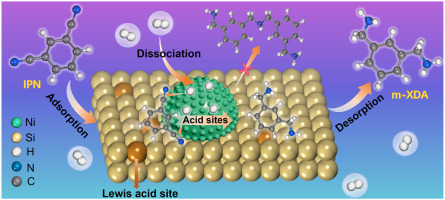
Hydrogenation of nitriles to primary amines has attracted significant attention, and tuning its selectivity remains a challenge due to the easy occurrence of side reactions. Herein, a phyllosilicate-derived Ni/SiO2 catalyst was prepared to selectively hydrogenate isophthalonitrile (IPN) to m-xylylenediamine (m-XDA), achieving 100% conversion and at most 98.1% selectivity under mild reaction conditions of 80 °C and 5 MPa in a 1100 h run. Mechanism investigation suggests that Ni2SiO4 first grows on the SiO2 substrate during the ammonia evaporation step and then decomposed in the reduction step to form a Ni/SiO2-AE catalyst with high Ni dispersion. The strong interaction between Ni0 and SiO2 substrate invests the Ni/SiO2-AE catalyst with robust durability, and the abundant amount of Lewis acid sites facilitates the adsorption of IPN and the Brønsted acid promotes its hydrogenation by the H2 adsorbed on the adjacent Ni nanoparticle in a bifunctional manner.
Graphical abstract
Keywords
Selective hydrogenation; Isophthalonitrile; Ammonia evaporation; Ni catalyst
文章导读