
期刊文章
过刊浏览
- Volumes 108-119 (2025)
-
Volumes 96-107 (2025)
-
Volume 107
Pages 1-376 (December 2025)
-
Volume 106
Pages 1-336 (November 2025)
-
Volume 105
Pages 1-356 (October 2025)
-
Volume 104
Pages 1-332 (September 2025)
-
Volume 103
Pages 1-314 (August 2025)
-
Volume 102
Pages 1-276 (July 2025)
-
Volume 101
Pages 1-166 (June 2025)
-
Volume 100
Pages 1-256 (May 2025)
-
Volume 99
Pages 1-242 (April 2025)
-
Volume 98
Pages 1-288 (March 2025)
-
Volume 97
Pages 1-256 (February 2025)
-
Volume 96
Pages 1-340 (January 2025)
-
Volume 107
-
Volumes 84-95 (2024)
-
Volume 95
Pages 1-392 (December 2024)
-
Volume 94
Pages 1-400 (November 2024)
-
Volume 93
Pages 1-376 (October 2024)
-
Volume 92
Pages 1-316 (September 2024)
-
Volume 91
Pages 1-378 (August 2024)
-
Volume 90
Pages 1-580 (July 2024)
-
Volume 89
Pages 1-278 (June 2024)
-
Volume 88
Pages 1-350 (May 2024)
-
Volume 87
Pages 1-338 (April 2024)
-
Volume 86
Pages 1-312 (March 2024)
-
Volume 85
Pages 1-334 (February 2024)
-
Volume 84
Pages 1-308 (January 2024)
-
Volume 95
-
Volumes 72-83 (2023)
-
Volume 83
Pages 1-258 (December 2023)
-
Volume 82
Pages 1-204 (November 2023)
-
Volume 81
Pages 1-188 (October 2023)
-
Volume 80
Pages 1-202 (September 2023)
-
Volume 79
Pages 1-172 (August 2023)
-
Volume 78
Pages 1-146 (July 2023)
-
Volume 77
Pages 1-152 (June 2023)
-
Volume 76
Pages 1-176 (May 2023)
-
Volume 75
Pages 1-228 (April 2023)
-
Volume 74
Pages 1-200 (March 2023)
-
Volume 73
Pages 1-138 (February 2023)
-
Volume 72
Pages 1-144 (January 2023)
-
Volume 83
-
Volumes 60-71 (2022)
-
Volume 71
Pages 1-108 (December 2022)
-
Volume 70
Pages 1-106 (November 2022)
-
Volume 69
Pages 1-122 (October 2022)
-
Volume 68
Pages 1-124 (September 2022)
-
Volume 67
Pages 1-102 (August 2022)
-
Volume 66
Pages 1-112 (July 2022)
-
Volume 65
Pages 1-138 (June 2022)
-
Volume 64
Pages 1-186 (May 2022)
-
Volume 63
Pages 1-124 (April 2022)
-
Volume 62
Pages 1-104 (March 2022)
-
Volume 61
Pages 1-120 (February 2022)
-
Volume 60
Pages 1-124 (January 2022)
-
Volume 71
- Volumes 54-59 (2021)
- Volumes 48-53 (2020)
- Volumes 42-47 (2019)
- Volumes 36-41 (2018)
- Volumes 30-35 (2017)
- Volumes 24-29 (2016)
- Volumes 18-23 (2015)
- Volumes 12-17 (2014)
- Volume 11 (2013)
- Volume 10 (2012)
- Volume 9 (2011)
- Volume 8 (2010)
- Volume 7 (2009)
- Volume 6 (2008)
- Volume 5 (2007)
- Volume 4 (2006)
- Volume 3 (2005)
- Volume 2 (2004)
- Volume 1 (2003)
Volume 111
Song, G., Tong, L., Meng, L., Song, L., Zhang, L., Zhao, W., . . . Gong, J. (2026). Model-based crystallization strategy of viscous systems for biomass crystal production with anti-caking function. Particuology, 111, 241-252. https://doi.org/10.1016/j.partic.2026.01.032
Model-based crystallization strategy of viscous systems for biomass crystal production with anti-caking function
Gaolong Song a, Li Tong c, Lingdi Meng d, Linjin Song a, Leida Zhang b, Wei Zhao b, Songgu Wu a c, Mingyang Chen a c *, Mingxuan Li a *, Junbo Gong a c
a State Key Laboratory of Chemical Engineering, School of Chemical Engineering and Technology, Tianjin University, Tianjin, 300072, China
b Shandong Fuyang Biotechnology Co., Ltd., Dezhou, 253100, China
c Institute of Shaoxing, Tianjin University, Shaoxing, 312300, China
d School of Synthetic Biology and Biomanufacturing, Tianjin University, China
10.1016/j.partic.2026.01.032
Volume 111,
April 2026,
Pages 241-252
Received 5 November 2025, Revised 22 January 2026, Accepted 27 January 2026, Available online 6 February 2026, Version of Record 11 March 2026.
E-mail:
chenmingyang@tju.edu.cn; 1021207191@tju.edu.cn
Highlights
• Decoupling of nucleation growth using a two-step crystallization strategy.
• Modeling the crystal caking cycle and the crystallization process.
• The cooling curve aligns better with crystal growth rates at varying temperatures.
• Narrow particle size distribution, homogenized lactone crystals.
Abstract
The crystallization separation of biomass chemical crystals in high-viscosity aqueous solutions has long been a major challenge in the field of biomass refining. Inappropriate crystallization strategies render the prepared biomass prone to caking and subsequent deterioration. To address this challenge, a tailored model-based two-stage crystallization strategy for viscous systems was developed for anti-caking bio-based derivative crystal production. The first stage focused on nucleation to prepare seed crystals with good dispersion in viscous solutions, while the second stage inhibits nucleation to design the crystal product size. Meanwhile, a temperature-governed crystallization kinetic model and a humidity-driven caking model were coupled to develop a crystallization-caking feedback regulation framework, enabling direct generation of optimal crystallization trajectories based on predefined anti-caking targets. In the crystallization of glucono delta-lactone (GDL), compared with the previous anti-caking crystallization strategies, the crystal D50 obtained by the crystallization strategy for viscous systems developed in this study increased from 414 to 486 μm, and the deviation of crystal products from the target particle size decreased from 17.2% to 2.8%. While the anti-caking performance has improved from 27 to 48 days, the design efficiency has also increased by an order of magnitude.
Graphical abstract
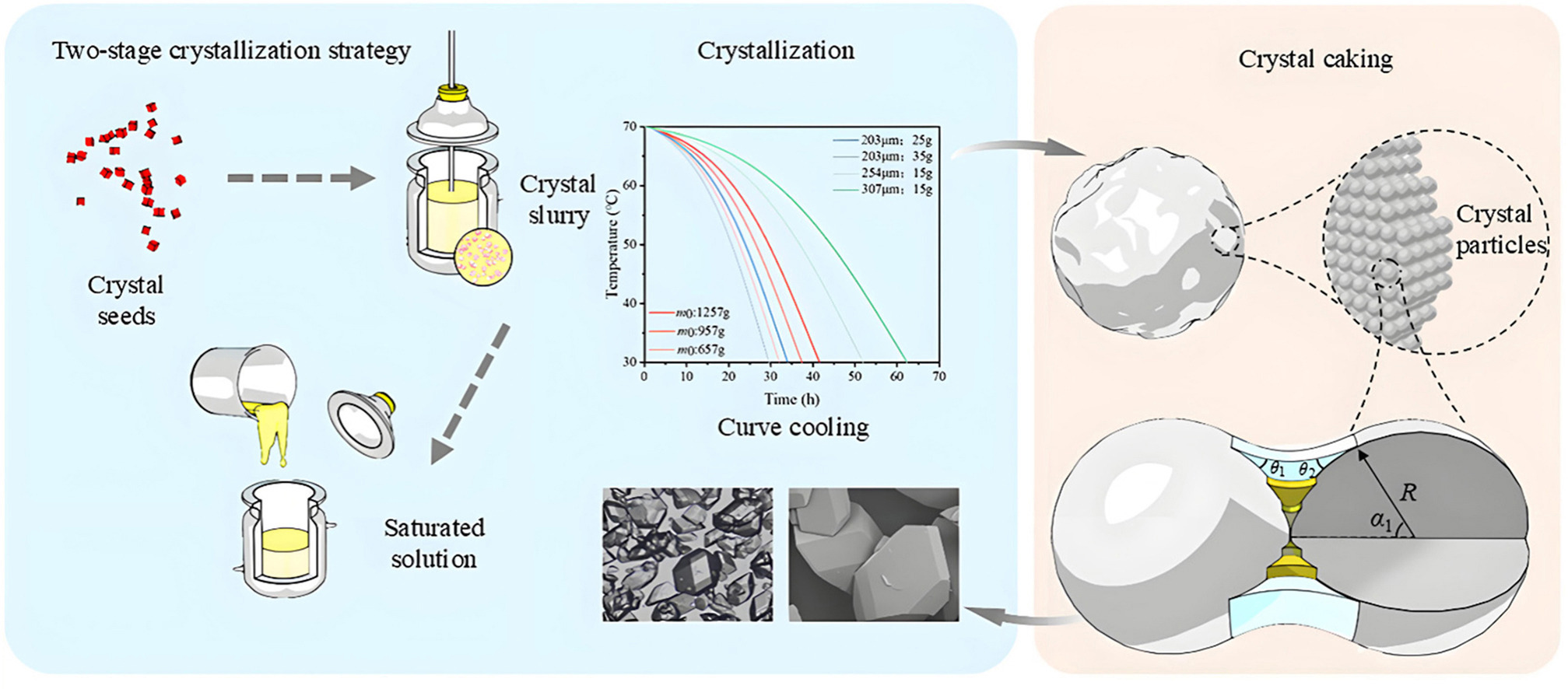
Keywords
Crystallization model; Particle size control; Crystal caking; Bio-based crystal
文章导读