
期刊文章
过刊浏览
- Volumes 108-119 (2025)
-
Volumes 96-107 (2025)
-
Volume 107
Pages 1-376 (December 2025)
-
Volume 106
Pages 1-336 (November 2025)
-
Volume 105
Pages 1-356 (October 2025)
-
Volume 104
Pages 1-332 (September 2025)
-
Volume 103
Pages 1-314 (August 2025)
-
Volume 102
Pages 1-276 (July 2025)
-
Volume 101
Pages 1-166 (June 2025)
-
Volume 100
Pages 1-256 (May 2025)
-
Volume 99
Pages 1-242 (April 2025)
-
Volume 98
Pages 1-288 (March 2025)
-
Volume 97
Pages 1-256 (February 2025)
-
Volume 96
Pages 1-340 (January 2025)
-
Volume 107
-
Volumes 84-95 (2024)
-
Volume 95
Pages 1-392 (December 2024)
-
Volume 94
Pages 1-400 (November 2024)
-
Volume 93
Pages 1-376 (October 2024)
-
Volume 92
Pages 1-316 (September 2024)
-
Volume 91
Pages 1-378 (August 2024)
-
Volume 90
Pages 1-580 (July 2024)
-
Volume 89
Pages 1-278 (June 2024)
-
Volume 88
Pages 1-350 (May 2024)
-
Volume 87
Pages 1-338 (April 2024)
-
Volume 86
Pages 1-312 (March 2024)
-
Volume 85
Pages 1-334 (February 2024)
-
Volume 84
Pages 1-308 (January 2024)
-
Volume 95
-
Volumes 72-83 (2023)
-
Volume 83
Pages 1-258 (December 2023)
-
Volume 82
Pages 1-204 (November 2023)
-
Volume 81
Pages 1-188 (October 2023)
-
Volume 80
Pages 1-202 (September 2023)
-
Volume 79
Pages 1-172 (August 2023)
-
Volume 78
Pages 1-146 (July 2023)
-
Volume 77
Pages 1-152 (June 2023)
-
Volume 76
Pages 1-176 (May 2023)
-
Volume 75
Pages 1-228 (April 2023)
-
Volume 74
Pages 1-200 (March 2023)
-
Volume 73
Pages 1-138 (February 2023)
-
Volume 72
Pages 1-144 (January 2023)
-
Volume 83
-
Volumes 60-71 (2022)
-
Volume 71
Pages 1-108 (December 2022)
-
Volume 70
Pages 1-106 (November 2022)
-
Volume 69
Pages 1-122 (October 2022)
-
Volume 68
Pages 1-124 (September 2022)
-
Volume 67
Pages 1-102 (August 2022)
-
Volume 66
Pages 1-112 (July 2022)
-
Volume 65
Pages 1-138 (June 2022)
-
Volume 64
Pages 1-186 (May 2022)
-
Volume 63
Pages 1-124 (April 2022)
-
Volume 62
Pages 1-104 (March 2022)
-
Volume 61
Pages 1-120 (February 2022)
-
Volume 60
Pages 1-124 (January 2022)
-
Volume 71
- Volumes 54-59 (2021)
- Volumes 48-53 (2020)
- Volumes 42-47 (2019)
- Volumes 36-41 (2018)
- Volumes 30-35 (2017)
- Volumes 24-29 (2016)
- Volumes 18-23 (2015)
- Volumes 12-17 (2014)
- Volume 11 (2013)
- Volume 10 (2012)
- Volume 9 (2011)
- Volume 8 (2010)
- Volume 7 (2009)
- Volume 6 (2008)
- Volume 5 (2007)
- Volume 4 (2006)
- Volume 3 (2005)
- Volume 2 (2004)
- Volume 1 (2003)
Volume 111
Tyslik, M., & Schiemann, M. (2026). Experimental investigation of thermal radiation propagation in bulks of varying porosity. Particuology, 111, 264-273. https://doi.org/10.1016/j.partic.2026.02.015
Experimental investigation of thermal radiation propagation in bulks of varying porosity (Open Access)
Matthias Tyslik *, Martin Schiemann
Institute of Energy Plant Technology, Ruhr-University Bochum, 44780, Bochum, Germany
10.1016/j.partic.2026.02.015
Volume 111,
April 2026,
Pages 264-273
Received 29 October 2025, Revised 6 February 2026, Accepted 25 February 2026, Available online 6 March 2026, Version of Record 13 March 2026.
E-mail:
tyslik@leat.rub.de
Highlights
• Experimental investigation of bulk porosity effects on thermal radiation transport.
• Infrared and UV techniques visualize radiation fields within the particle bulk.
• A simplified view factor is used to quantify bulk porosity effects on radiative transport.
• Obtained experimental data serve as validation basis for numerical radiation models.
Abstract
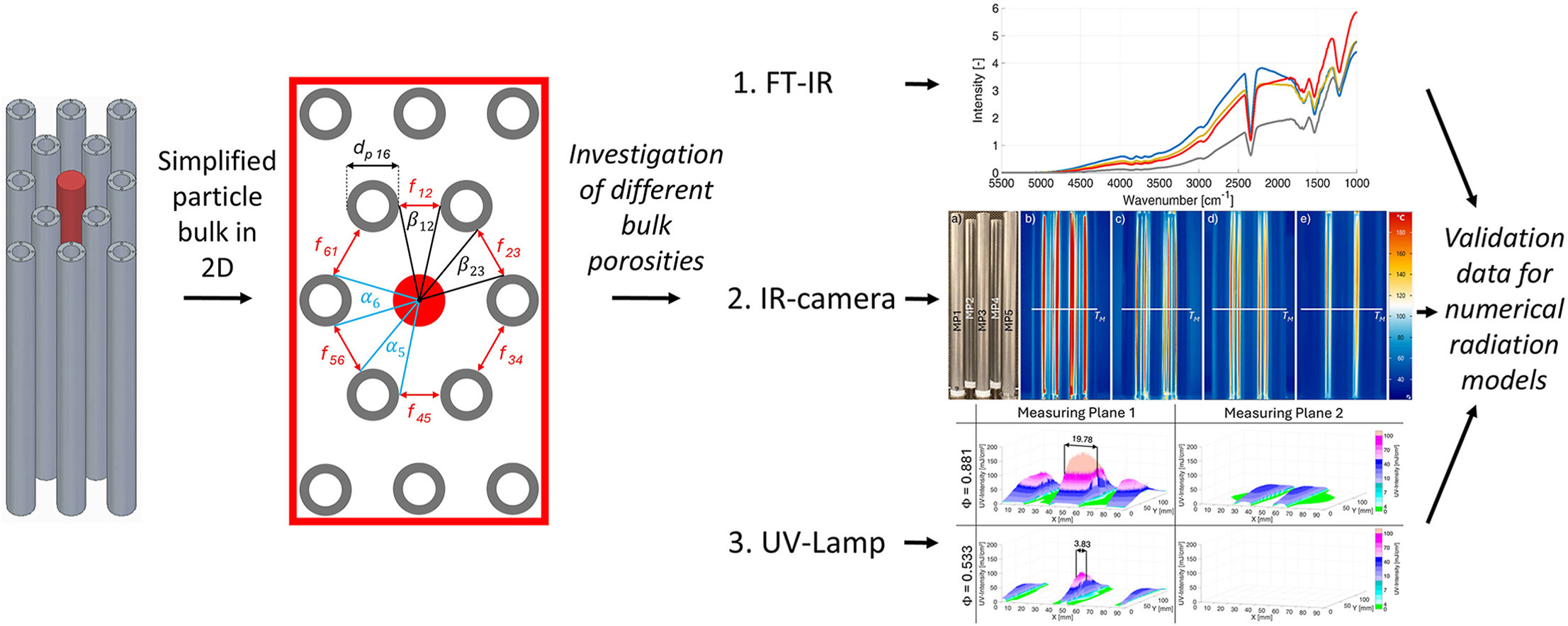
Radiative heat transfer plays a central role in many technical systems, amongst others in the processing and thermal treatment of particle bulks. For a detailed understanding of radiation phenomena in these applications and to build a basic data set for radiation model development, an experimental setup has been adapted to investigate radiative heat transfer in simplified packed beds. Hollow stainless-steel rods of different diameters represent 2D particle assemblies with varying bulk porosities. Thermal radiation is captured using an infrared camera and a Fourier Transform Infrared Spectrometer, with temperature fields validated via thermocouples embedded in the steel rods. UV sensitive foils additionally enable direct visualization of radiative transport within the rod arrangement. The results reveal a significant overlap between intrinsic thermal emission and reflected radiation, especially for highly reflective surfaces like stainless steel. Measurements with UV-sensitive foil help to separate reflections from thermal self-emittance. Furthermore, a clear correlation is observed between bulk porosity and the transported thermal radiation. These results underline the dependence of radiation transport on geometric parameters such as the particle diameter and bulk porosity. The experimental data therefore provides a detailed validation basis for numerical radiation transport models.
Graphical abstract
Keywords
Thermal radiation; Spectral reflections; Fourier-transform infrared spectroscopy; View factor
文章导读