
期刊文章
过刊浏览
- Volumes 108-119 (2025)
-
Volumes 96-107 (2025)
-
Volume 107
Pages 1-376 (December 2025)
-
Volume 106
Pages 1-336 (November 2025)
-
Volume 105
Pages 1-356 (October 2025)
-
Volume 104
Pages 1-332 (September 2025)
-
Volume 103
Pages 1-314 (August 2025)
-
Volume 102
Pages 1-276 (July 2025)
-
Volume 101
Pages 1-166 (June 2025)
-
Volume 100
Pages 1-256 (May 2025)
-
Volume 99
Pages 1-242 (April 2025)
-
Volume 98
Pages 1-288 (March 2025)
-
Volume 97
Pages 1-256 (February 2025)
-
Volume 96
Pages 1-340 (January 2025)
-
Volume 107
-
Volumes 84-95 (2024)
-
Volume 95
Pages 1-392 (December 2024)
-
Volume 94
Pages 1-400 (November 2024)
-
Volume 93
Pages 1-376 (October 2024)
-
Volume 92
Pages 1-316 (September 2024)
-
Volume 91
Pages 1-378 (August 2024)
-
Volume 90
Pages 1-580 (July 2024)
-
Volume 89
Pages 1-278 (June 2024)
-
Volume 88
Pages 1-350 (May 2024)
-
Volume 87
Pages 1-338 (April 2024)
-
Volume 86
Pages 1-312 (March 2024)
-
Volume 85
Pages 1-334 (February 2024)
-
Volume 84
Pages 1-308 (January 2024)
-
Volume 95
-
Volumes 72-83 (2023)
-
Volume 83
Pages 1-258 (December 2023)
-
Volume 82
Pages 1-204 (November 2023)
-
Volume 81
Pages 1-188 (October 2023)
-
Volume 80
Pages 1-202 (September 2023)
-
Volume 79
Pages 1-172 (August 2023)
-
Volume 78
Pages 1-146 (July 2023)
-
Volume 77
Pages 1-152 (June 2023)
-
Volume 76
Pages 1-176 (May 2023)
-
Volume 75
Pages 1-228 (April 2023)
-
Volume 74
Pages 1-200 (March 2023)
-
Volume 73
Pages 1-138 (February 2023)
-
Volume 72
Pages 1-144 (January 2023)
-
Volume 83
-
Volumes 60-71 (2022)
-
Volume 71
Pages 1-108 (December 2022)
-
Volume 70
Pages 1-106 (November 2022)
-
Volume 69
Pages 1-122 (October 2022)
-
Volume 68
Pages 1-124 (September 2022)
-
Volume 67
Pages 1-102 (August 2022)
-
Volume 66
Pages 1-112 (July 2022)
-
Volume 65
Pages 1-138 (June 2022)
-
Volume 64
Pages 1-186 (May 2022)
-
Volume 63
Pages 1-124 (April 2022)
-
Volume 62
Pages 1-104 (March 2022)
-
Volume 61
Pages 1-120 (February 2022)
-
Volume 60
Pages 1-124 (January 2022)
-
Volume 71
- Volumes 54-59 (2021)
- Volumes 48-53 (2020)
- Volumes 42-47 (2019)
- Volumes 36-41 (2018)
- Volumes 30-35 (2017)
- Volumes 24-29 (2016)
- Volumes 18-23 (2015)
- Volumes 12-17 (2014)
- Volume 11 (2013)
- Volume 10 (2012)
- Volume 9 (2011)
- Volume 8 (2010)
- Volume 7 (2009)
- Volume 6 (2008)
- Volume 5 (2007)
- Volume 4 (2006)
- Volume 3 (2005)
- Volume 2 (2004)
- Volume 1 (2003)
Volume 111
Zhan, H., Xu, H., Li, L., de Picado-Santos, L. G., Segundo, I. R., Ji, W., . . . Tan, Y. (2026). Dynamics of filler particles in asphalt mastic under thermal cycling: A Nano-CT study of migration and rotation. Particuology, 111, 274-292. https://doi.org/10.1016/j.partic.2026.02.018
Dynamics of filler particles in asphalt mastic under thermal cycling: A Nano-CT study of migration and rotation
He Zhan a b, Huining Xu a *, Lin Li c, Luis Guilherme de Picado-Santos b, Iran Rocha Segundo b, Weidong Ji a, Jinqi Feng a, Yiqiu Tan a
a School of Transportation Science and Engineering, Harbin Institute of Technology, Harbin, 150090, China
b CERIS, Instituto Superior Técnico, Universidade de Lisboa, Lisbon, 1049-001, Portugal
c China Academy of Transportation Sciences, Beijing, 100029, China
10.1016/j.partic.2026.02.018
Volume 111,
April 2026,
Pages 274-292
Received 8 December 2025, Revised 25 January 2026, Accepted 14 February 2026, Available online 6 March 2026, Version of Record 13 March 2026.
E-mail:
xuhn@hit.edu.cn
Highlights
• A hierarchical 3-tier dispersion architecture (Filling-Matrix-Skeleton) was identified in asphalt mastic by Nano-CT.
• Thermal cycling destabilizes the uniform three-tier dispersed microstructure of asphalt mastic.
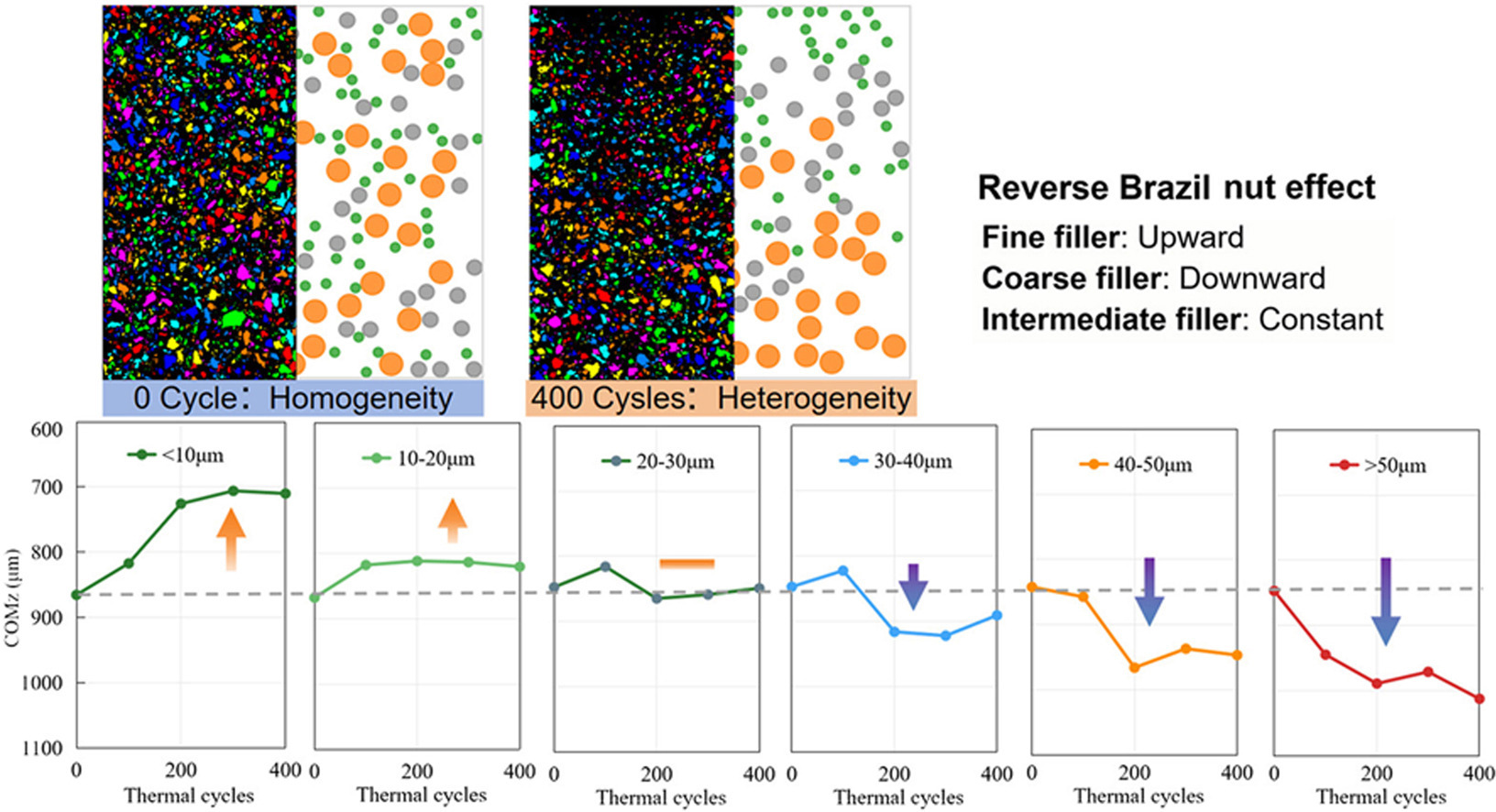
• Thermal cycling triggers size-selective filler particles redistribution consistent with a reverse Brazil nut effect.
• Voronoi analysis quantifies the shift from near-uniform packing to stratified, agglomerated morphology.
• A thermal ratchet-gravity framework parameterized by oscillatory Péclet number captures stratification evolution.
Abstract
Asphalt mastic is a concentrated particle-filled viscoelastic composite whose microstructure critically influences asphalt pavement mechanical behavior. Conventional models treat asphalt mastic as a homogeneous continuum, inferring thermal-fatigue behavior primarily from bulk rheology and leaving thermally driven particle dynamics and microstructural instabilities poorly quantified. In this study, accelerated thermal cycling is combined with high-resolution 3D Nano-CT and Voronoi analysis to track size-dependent filler kinematics (migration and rotation) and the evolution of packing heterogeneity. The results reveal a hierarchical three-tier dispersion architecture: Filling-Matrix-Skeleton, in which fine particles preferentially occupy and fill interstitial spaces, intermediate particles dominate the load-transfer matrix, and coarse particles constitute a load-bearing skeleton. Thermal cycling destabilizes the initially quasi-uniform dispersion, inducing size-selective redistribution consistent with the reverse Brazil nut effect (RBNE). Specifically, the coarse fraction (>30 μm) exhibits a net downward migration of 43-165 μm, while fine particles preferentially enrich the upper region. Voronoi analysis quantifies this structural degradation, revealing that the coefficient of variation for coarse-particle packing surged from 63.3% to 135.4%, marking a transition from near-uniform packing to through-thickness stratification. The resulting “coarse-bottom, fine-top” architecture comprises a load-bearing lower skeleton and a fine-rich upper crowding zone with enhanced agglomeration. These observations support a gravity-thermal ratchet competition framework for migration in highly viscous media and provide particle-scale evidence to inform durability-oriented material selection and microstructure-guided asphalt mastic design.
Graphical abstract
Keywords
Asphalt mastic; Thermal cycling; Nano-CT; Filler particle migration; Voronoi analysis; Reverse Brazil nut effect
文章导读