
期刊文章
过刊浏览
- Volumes 108-119 (2025)
-
Volumes 96-107 (2025)
-
Volume 107
Pages 1-376 (December 2025)
-
Volume 106
Pages 1-336 (November 2025)
-
Volume 105
Pages 1-356 (October 2025)
-
Volume 104
Pages 1-332 (September 2025)
-
Volume 103
Pages 1-314 (August 2025)
-
Volume 102
Pages 1-276 (July 2025)
-
Volume 101
Pages 1-166 (June 2025)
-
Volume 100
Pages 1-256 (May 2025)
-
Volume 99
Pages 1-242 (April 2025)
-
Volume 98
Pages 1-288 (March 2025)
-
Volume 97
Pages 1-256 (February 2025)
-
Volume 96
Pages 1-340 (January 2025)
-
Volume 107
-
Volumes 84-95 (2024)
-
Volume 95
Pages 1-392 (December 2024)
-
Volume 94
Pages 1-400 (November 2024)
-
Volume 93
Pages 1-376 (October 2024)
-
Volume 92
Pages 1-316 (September 2024)
-
Volume 91
Pages 1-378 (August 2024)
-
Volume 90
Pages 1-580 (July 2024)
-
Volume 89
Pages 1-278 (June 2024)
-
Volume 88
Pages 1-350 (May 2024)
-
Volume 87
Pages 1-338 (April 2024)
-
Volume 86
Pages 1-312 (March 2024)
-
Volume 85
Pages 1-334 (February 2024)
-
Volume 84
Pages 1-308 (January 2024)
-
Volume 95
-
Volumes 72-83 (2023)
-
Volume 83
Pages 1-258 (December 2023)
-
Volume 82
Pages 1-204 (November 2023)
-
Volume 81
Pages 1-188 (October 2023)
-
Volume 80
Pages 1-202 (September 2023)
-
Volume 79
Pages 1-172 (August 2023)
-
Volume 78
Pages 1-146 (July 2023)
-
Volume 77
Pages 1-152 (June 2023)
-
Volume 76
Pages 1-176 (May 2023)
-
Volume 75
Pages 1-228 (April 2023)
-
Volume 74
Pages 1-200 (March 2023)
-
Volume 73
Pages 1-138 (February 2023)
-
Volume 72
Pages 1-144 (January 2023)
-
Volume 83
-
Volumes 60-71 (2022)
-
Volume 71
Pages 1-108 (December 2022)
-
Volume 70
Pages 1-106 (November 2022)
-
Volume 69
Pages 1-122 (October 2022)
-
Volume 68
Pages 1-124 (September 2022)
-
Volume 67
Pages 1-102 (August 2022)
-
Volume 66
Pages 1-112 (July 2022)
-
Volume 65
Pages 1-138 (June 2022)
-
Volume 64
Pages 1-186 (May 2022)
-
Volume 63
Pages 1-124 (April 2022)
-
Volume 62
Pages 1-104 (March 2022)
-
Volume 61
Pages 1-120 (February 2022)
-
Volume 60
Pages 1-124 (January 2022)
-
Volume 71
- Volumes 54-59 (2021)
- Volumes 48-53 (2020)
- Volumes 42-47 (2019)
- Volumes 36-41 (2018)
- Volumes 30-35 (2017)
- Volumes 24-29 (2016)
- Volumes 18-23 (2015)
- Volumes 12-17 (2014)
- Volume 11 (2013)
- Volume 10 (2012)
- Volume 9 (2011)
- Volume 8 (2010)
- Volume 7 (2009)
- Volume 6 (2008)
- Volume 5 (2007)
- Volume 4 (2006)
- Volume 3 (2005)
- Volume 2 (2004)
- Volume 1 (2003)
Volume 111
So, M., Kim, B., Jo, Y., & Kang, S.-W. (2026). Mechanistic insights into the coupled frictional behavior of a spherical-platelet heterogeneous nanoparticle pair in PAO lubrication via molecular dynamics simulations. Particuology, 111, 293-302. https://doi.org/10.1016/j.partic.2026.02.017
Mechanistic insights into the coupled frictional behavior of a spherical-platelet heterogeneous nanoparticle pair in PAO lubrication via molecular dynamics simulations
Minseo So, Beomjoon Kim, Youngwoo Jo, Seok-Won Kang *
Department of Automotive Engineering, Yeungnam University, 280 Daehak-ro, Gyeongsan, Gyeongbuk 38541, Republic of Korea
10.1016/j.partic.2026.02.017
Volume 111,
April 2026,
Pages 293-302
Received 17 November 2025, Revised 30 January 2026, Accepted 14 February 2026, Available online 6 March 2026, Version of Record 13 March 2026.
E-mail:
swkang@yu.ac.kr
Highlights
• MD analysis elucidates PAO tribological behavior with TiO2 at a MoS2-coated interface.
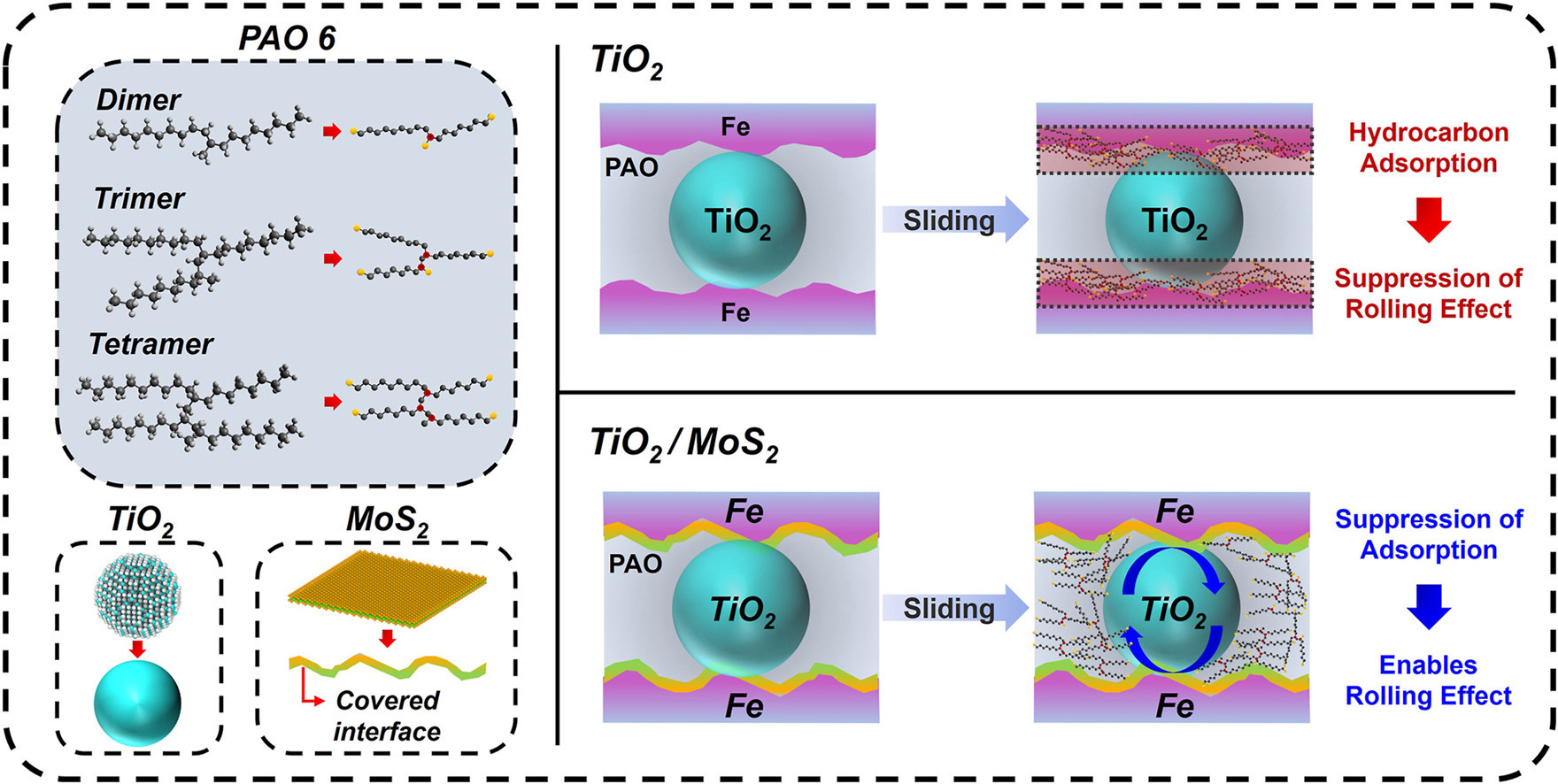
• The MoS2-coated interface sustains spherical nanoparticle rolling.
• TiO2 alone fails to sustain rolling in PAO under sliding conditions.
• PAO–interface interactions are weaker on MoS2 than on Fe surfaces.
• Reduced adsorption facilitates TiO2 rolling and lowers the COF.
Abstract
In this study, atomistic molecular dynamics simulations are conducted under boundary-lubrication conditions to isolate the specific role of MoS2 by comparing PAO 6 containing spherical TiO2 nanoparticles with PAO 6 containing TiO2/MoS2 hybrid nanoparticles between Fe substrates. The simulations quantify the friction/normal forces, coefficient of friction (COF), interfacial interaction energies, and hydrocarbon number density within the adsorption layer. A single TiO2 particle exhibits rolling during the early stage of rolling-dominated dynamics but progressively loses rolling thereafter when it cannot sufficiently displace the adjacent PAO layer. By contrast, the TiO2/MoS2 system sustains rolling throughout the simulation and maintains a lower COF at later stages, thus resulting in an overall 6.06% reduction in the average COF compared with the TiO2 model. The mechanistic discriminator is interfacial adsorption: Relative to TiO2 alone, the MoS2-containing model shows ≈3× weaker PAO–Fe interactions, ≈32% lower interfacial PAO number density, and ≈29% fewer adsorbed chains in the interfacial layer, thus indicating reduced crowding and improved interfacial mobility. These results establish a unified view in which MoS2 predominantly governs the interfacial separation/chemistry (adsorption moderation) while TiO2 serves as a rolling spacer. Synergistically, they stabilize friction in PAO. Overall, this study provides mechanistic insights into friction reduction by spherical TiO2 nanoparticles operating at MoS2-modified metal interfaces in hydrocarbon-based lubricants, and elucidates how interfacial adsorption governs rolling persistence and, consequently, macroscopic tribological performance.
Graphical abstract
Keywords
Friction characteristics; Heterogeneous nanoparticle pair; Hydrocarbon adsorption; Molecular dynamics; Polyalphaolefin
文章导读