
期刊文章
过刊浏览
- Volumes 108-119 (2025)
-
Volumes 96-107 (2025)
-
Volume 107
Pages 1-376 (December 2025)
-
Volume 106
Pages 1-336 (November 2025)
-
Volume 105
Pages 1-356 (October 2025)
-
Volume 104
Pages 1-332 (September 2025)
-
Volume 103
Pages 1-314 (August 2025)
-
Volume 102
Pages 1-276 (July 2025)
-
Volume 101
Pages 1-166 (June 2025)
-
Volume 100
Pages 1-256 (May 2025)
-
Volume 99
Pages 1-242 (April 2025)
-
Volume 98
Pages 1-288 (March 2025)
-
Volume 97
Pages 1-256 (February 2025)
-
Volume 96
Pages 1-340 (January 2025)
-
Volume 107
-
Volumes 84-95 (2024)
-
Volume 95
Pages 1-392 (December 2024)
-
Volume 94
Pages 1-400 (November 2024)
-
Volume 93
Pages 1-376 (October 2024)
-
Volume 92
Pages 1-316 (September 2024)
-
Volume 91
Pages 1-378 (August 2024)
-
Volume 90
Pages 1-580 (July 2024)
-
Volume 89
Pages 1-278 (June 2024)
-
Volume 88
Pages 1-350 (May 2024)
-
Volume 87
Pages 1-338 (April 2024)
-
Volume 86
Pages 1-312 (March 2024)
-
Volume 85
Pages 1-334 (February 2024)
-
Volume 84
Pages 1-308 (January 2024)
-
Volume 95
-
Volumes 72-83 (2023)
-
Volume 83
Pages 1-258 (December 2023)
-
Volume 82
Pages 1-204 (November 2023)
-
Volume 81
Pages 1-188 (October 2023)
-
Volume 80
Pages 1-202 (September 2023)
-
Volume 79
Pages 1-172 (August 2023)
-
Volume 78
Pages 1-146 (July 2023)
-
Volume 77
Pages 1-152 (June 2023)
-
Volume 76
Pages 1-176 (May 2023)
-
Volume 75
Pages 1-228 (April 2023)
-
Volume 74
Pages 1-200 (March 2023)
-
Volume 73
Pages 1-138 (February 2023)
-
Volume 72
Pages 1-144 (January 2023)
-
Volume 83
-
Volumes 60-71 (2022)
-
Volume 71
Pages 1-108 (December 2022)
-
Volume 70
Pages 1-106 (November 2022)
-
Volume 69
Pages 1-122 (October 2022)
-
Volume 68
Pages 1-124 (September 2022)
-
Volume 67
Pages 1-102 (August 2022)
-
Volume 66
Pages 1-112 (July 2022)
-
Volume 65
Pages 1-138 (June 2022)
-
Volume 64
Pages 1-186 (May 2022)
-
Volume 63
Pages 1-124 (April 2022)
-
Volume 62
Pages 1-104 (March 2022)
-
Volume 61
Pages 1-120 (February 2022)
-
Volume 60
Pages 1-124 (January 2022)
-
Volume 71
- Volumes 54-59 (2021)
- Volumes 48-53 (2020)
- Volumes 42-47 (2019)
- Volumes 36-41 (2018)
- Volumes 30-35 (2017)
- Volumes 24-29 (2016)
- Volumes 18-23 (2015)
- Volumes 12-17 (2014)
- Volume 11 (2013)
- Volume 10 (2012)
- Volume 9 (2011)
- Volume 8 (2010)
- Volume 7 (2009)
- Volume 6 (2008)
- Volume 5 (2007)
- Volume 4 (2006)
- Volume 3 (2005)
- Volume 2 (2004)
- Volume 1 (2003)
Volume 111
Aghamohammadi, H., & Torabian, M. (2026). Advances in 3D Si-graphene nanocomposites for Li-ion battery anodes with enhanced stability and rate capability. Particuology, 111, 303-326. https://doi.org/10.1016/j.partic.2026.02.011
Advances in 3D Si-graphene nanocomposites for Li-ion battery anodes with enhanced stability and rate capability
Hamed Aghamohammadi a *, Mahdi Torabian b
a Department of Advanced Materials and New Technologies, Iranian Research Organization for Science and Technology (IROST), Tehran, Iran
b Department of Chemistry, Materials and Chemical Engineering, Politecnico di Milano, Piazza Leonardo da Vinci 32, 20133, Milan, Italy
10.1016/j.partic.2026.02.011
Volume 111,
April 2026,
Pages 303-326
Received 9 December 2025, Revised 28 January 2026, Accepted 9 February 2026, Available online 12 February 2026, Version of Record 20 March 2026.
E-mail:
aghamohammadi@irost.ir; hamed.aghamohammadi@outlook.com
Highlights
• A comprehensive review is conducted on the 3D Si-graphene nanocomposite anode materials for LIBs.
• Synthesis methods, electrochemical performance, and influencing factors of 3D Si-graphene composites are given.
• Mechanisms for improving the electrochemical performance of 3D Si-graphene are reviewed.
Abstract
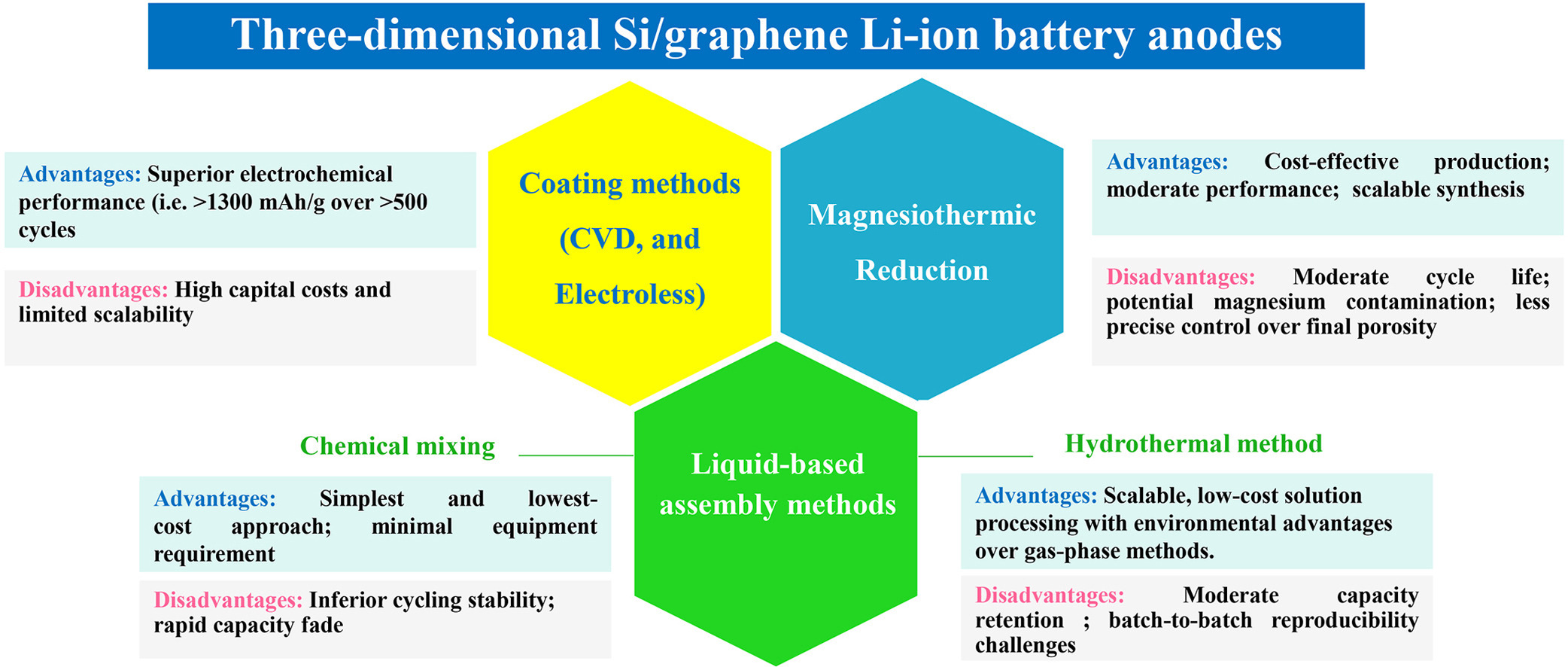
Lithium-ion batteries (LIBs) are widely used in electronic devices and are becoming increasingly important components of renewable energy storage systems. The development of advanced electrode materials with high energy density is essential for fulfilling the growing performance demands of LIBs in everyday applications. Silicon-based anode materials, due to their remarkably high specific capacity compared with conventional graphite electrodes, are being extensively investigated for application in next-generation LIBs. However, the huge volume changes of silicon anodes during charge/discharge cycles have restricted their commercialization. Recent works have shown that the formation of 3D Si/graphene composites offers superior performance compared to 2D architectures due to their increased surface area, enhanced electron/ion transport properties, and better mechanical support. This comprehensive review highlights the potential of 3D Si/graphene composites as LIB anodes, covering synthesis procedures, optimal parameters, morphology/structure, and electrochemical performance. By identifying existing research gaps and providing future perspectives, this work aims to advance the fundamental understanding and practical realization of 3D Si–graphene nanocomposites for high-performance LIB anodes and related energy storage technologies.
Graphical abstract
Keywords
Silicon anodes; Composite; Graphene; Li-ion batteries; 3D Si-graphene nanocomposites
文章导读