
期刊文章
过刊浏览
- Volumes 108-119 (2025)
-
Volumes 96-107 (2025)
-
Volume 107
Pages 1-376 (December 2025)
-
Volume 106
Pages 1-336 (November 2025)
-
Volume 105
Pages 1-356 (October 2025)
-
Volume 104
Pages 1-332 (September 2025)
-
Volume 103
Pages 1-314 (August 2025)
-
Volume 102
Pages 1-276 (July 2025)
-
Volume 101
Pages 1-166 (June 2025)
-
Volume 100
Pages 1-256 (May 2025)
-
Volume 99
Pages 1-242 (April 2025)
-
Volume 98
Pages 1-288 (March 2025)
-
Volume 97
Pages 1-256 (February 2025)
-
Volume 96
Pages 1-340 (January 2025)
-
Volume 107
-
Volumes 84-95 (2024)
-
Volume 95
Pages 1-392 (December 2024)
-
Volume 94
Pages 1-400 (November 2024)
-
Volume 93
Pages 1-376 (October 2024)
-
Volume 92
Pages 1-316 (September 2024)
-
Volume 91
Pages 1-378 (August 2024)
-
Volume 90
Pages 1-580 (July 2024)
-
Volume 89
Pages 1-278 (June 2024)
-
Volume 88
Pages 1-350 (May 2024)
-
Volume 87
Pages 1-338 (April 2024)
-
Volume 86
Pages 1-312 (March 2024)
-
Volume 85
Pages 1-334 (February 2024)
-
Volume 84
Pages 1-308 (January 2024)
-
Volume 95
-
Volumes 72-83 (2023)
-
Volume 83
Pages 1-258 (December 2023)
-
Volume 82
Pages 1-204 (November 2023)
-
Volume 81
Pages 1-188 (October 2023)
-
Volume 80
Pages 1-202 (September 2023)
-
Volume 79
Pages 1-172 (August 2023)
-
Volume 78
Pages 1-146 (July 2023)
-
Volume 77
Pages 1-152 (June 2023)
-
Volume 76
Pages 1-176 (May 2023)
-
Volume 75
Pages 1-228 (April 2023)
-
Volume 74
Pages 1-200 (March 2023)
-
Volume 73
Pages 1-138 (February 2023)
-
Volume 72
Pages 1-144 (January 2023)
-
Volume 83
-
Volumes 60-71 (2022)
-
Volume 71
Pages 1-108 (December 2022)
-
Volume 70
Pages 1-106 (November 2022)
-
Volume 69
Pages 1-122 (October 2022)
-
Volume 68
Pages 1-124 (September 2022)
-
Volume 67
Pages 1-102 (August 2022)
-
Volume 66
Pages 1-112 (July 2022)
-
Volume 65
Pages 1-138 (June 2022)
-
Volume 64
Pages 1-186 (May 2022)
-
Volume 63
Pages 1-124 (April 2022)
-
Volume 62
Pages 1-104 (March 2022)
-
Volume 61
Pages 1-120 (February 2022)
-
Volume 60
Pages 1-124 (January 2022)
-
Volume 71
- Volumes 54-59 (2021)
- Volumes 48-53 (2020)
- Volumes 42-47 (2019)
- Volumes 36-41 (2018)
- Volumes 30-35 (2017)
- Volumes 24-29 (2016)
- Volumes 18-23 (2015)
- Volumes 12-17 (2014)
- Volume 11 (2013)
- Volume 10 (2012)
- Volume 9 (2011)
- Volume 8 (2010)
- Volume 7 (2009)
- Volume 6 (2008)
- Volume 5 (2007)
- Volume 4 (2006)
- Volume 3 (2005)
- Volume 2 (2004)
- Volume 1 (2003)
Volume 112
Yan, Y., Sun, S., Wei, J., Shubo, A., Xiao, F., & Tu, G. (2026). In situ arsenic immobilization via oxidative co-precipitation and integrated P204-based impurity removal coupled with crystallization for the production of battery-grade NiSO4·6H2O. Particuology, 112, 11-23. https://doi.org/10.1016/j.partic.2026.02.022
In situ arsenic immobilization via oxidative co-precipitation and integrated P204-based impurity removal coupled with crystallization for the production of battery-grade NiSO4·6H2O
Yaoyu Yan a b c, Shuchen Sun a b c *, Jing Wei a b c, A. Shubo a b c, Faxin Xiao a b c, Ganfeng Tu a b c
a School of Metallurgy, Northeastern University, Shenyang, 110819, China
b Key Laboratory for Recycling of Nonferrous Metal Resources (Shenyang), Shenyang, 110819, China
c Key Laboratory for Ecological Metallurgy of Multimetallic Mineral (Ministry of Education), Northeastern University, Shenyang, 110819, China
10.1016/j.partic.2026.02.022
Volume 112,
May 2026,
Pages 11-23
Received 6 January 2026, Revised 31 January 2026, Accepted 14 February 2026, Available online 6 March 2026, Version of Record 13 March 2026.
E-mail:
sunsc@smm.neu.edu.cn
Highlights
• A compact purification-crystallization route upgrades crude NiSO4 liquors to battery-grade NiSO4·6H2O.
• Iron-assisted oxidative pretreatment achieved efficient arsenic fixation via Fe–As co-precipitation with low Ni loss.
• Condensed solvent extraction and organic-phase recycling to fit the character limit without losing the technical specifics.
• Changed phase-pure to pure and slightly streamlined the verification methods to ensure it fit comfortably under limit.
Abstract
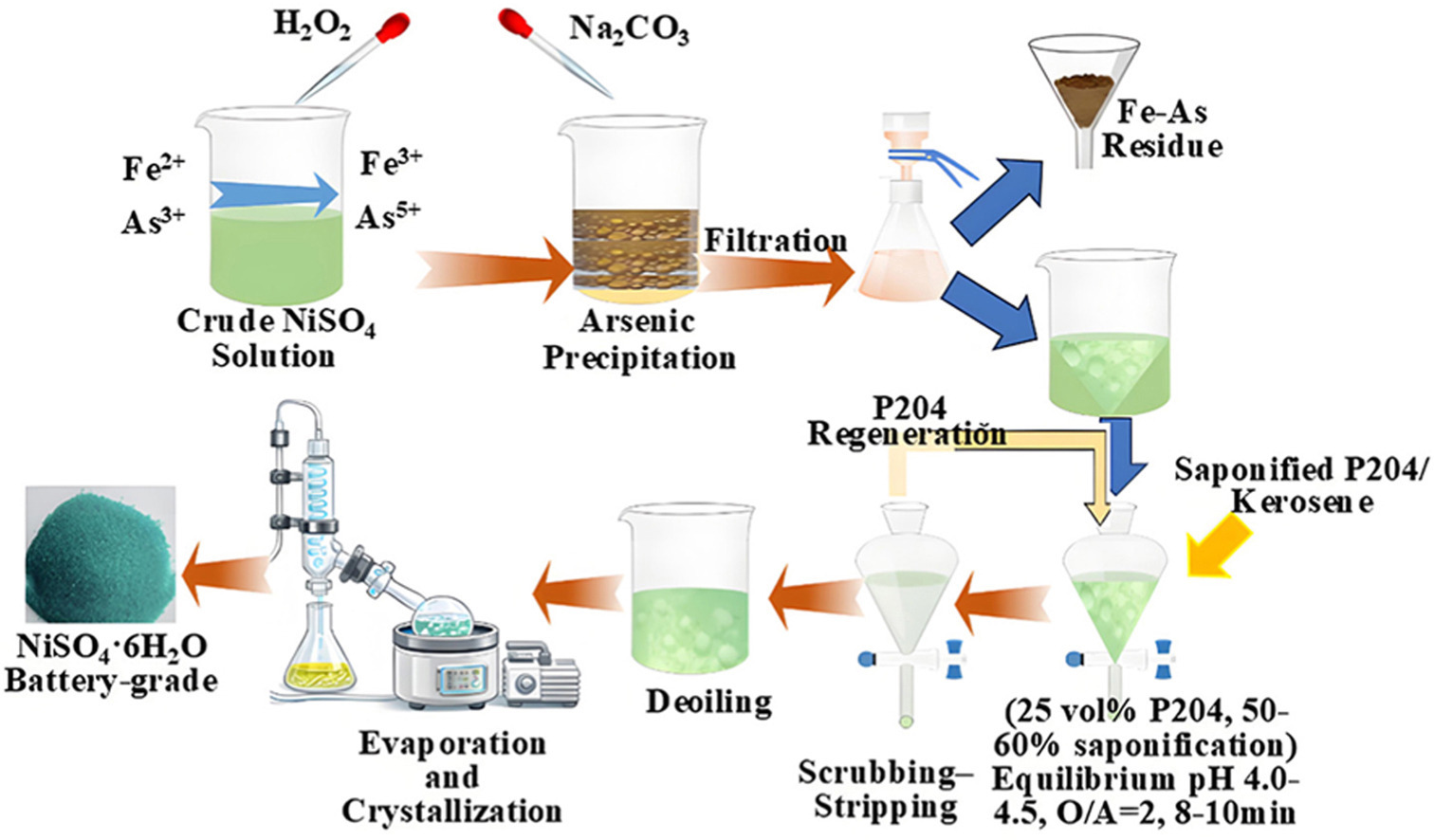
Targeting the high arsenic risk and complex impurity matrix of crude nickel sulfate liquor generated as a by-product from electrolytic copper de-nickelization, this study validates a short, crystallization-compatible purification route integrating oxidative arsenic co-precipitation, single-extractant P204 (D2EHPA) solvent extraction, and evaporative crystallization. Endogenous iron served as an arsenic-scavenging carrier; under 1.3 × theoretical H2O2, endpoint pH 4–5, and 50 °C, As and Fe removals reached 99.7% and 98.9%, respectively, with an apparent Ni loss of 3–10%. Under the optimized extraction window (25 vol% P204, equilibrium pH 4.0–4.5, O/A = 2.0, 50–60% saponification, 8–10 min), Zn and Cu were reduced from 2.15 to 0.16 g L−1 to 0.092 and 0.006 g L−1 (>95% removal) while keeping Ni co-extraction below 5%; scrubbing/stripping (0.15/1.0 mol L−1 H2SO4) enabled organic-phase regeneration. After deoiling, crystallization produced NiSO4·6H2O, confirmed by XRD and SEM–EDS. The product contained 22.15 wt% Ni (specification ≥22.08 wt%) with Cu 0.00005 wt%, Zn 0.00028 wt%, and Fe 0.00042 wt%, all below the battery-grade limits (HG/T 5919—2021). Overall, this work demonstrates a crystallization-compatible route using endogenous-iron-assisted arsenic immobilization/removal via oxidative co-precipitation and a single P204 loop for Zn/Cu removal with suppressed Ni co-extraction, enabling battery-grade NiSO4·6H2O within defined operating windows.
Graphical abstract
Keywords
Crude nickel sulfate; Arsenic immobilization; P204 (D2EHPA); Solvent extraction; Battery-grade NiSO4·6H2O
文章导读