
期刊文章
过刊浏览
- Volumes 108-119 (2025)
-
Volumes 96-107 (2025)
-
Volume 107
Pages 1-376 (December 2025)
-
Volume 106
Pages 1-336 (November 2025)
-
Volume 105
Pages 1-356 (October 2025)
-
Volume 104
Pages 1-332 (September 2025)
-
Volume 103
Pages 1-314 (August 2025)
-
Volume 102
Pages 1-276 (July 2025)
-
Volume 101
Pages 1-166 (June 2025)
-
Volume 100
Pages 1-256 (May 2025)
-
Volume 99
Pages 1-242 (April 2025)
-
Volume 98
Pages 1-288 (March 2025)
-
Volume 97
Pages 1-256 (February 2025)
-
Volume 96
Pages 1-340 (January 2025)
-
Volume 107
-
Volumes 84-95 (2024)
-
Volume 95
Pages 1-392 (December 2024)
-
Volume 94
Pages 1-400 (November 2024)
-
Volume 93
Pages 1-376 (October 2024)
-
Volume 92
Pages 1-316 (September 2024)
-
Volume 91
Pages 1-378 (August 2024)
-
Volume 90
Pages 1-580 (July 2024)
-
Volume 89
Pages 1-278 (June 2024)
-
Volume 88
Pages 1-350 (May 2024)
-
Volume 87
Pages 1-338 (April 2024)
-
Volume 86
Pages 1-312 (March 2024)
-
Volume 85
Pages 1-334 (February 2024)
-
Volume 84
Pages 1-308 (January 2024)
-
Volume 95
-
Volumes 72-83 (2023)
-
Volume 83
Pages 1-258 (December 2023)
-
Volume 82
Pages 1-204 (November 2023)
-
Volume 81
Pages 1-188 (October 2023)
-
Volume 80
Pages 1-202 (September 2023)
-
Volume 79
Pages 1-172 (August 2023)
-
Volume 78
Pages 1-146 (July 2023)
-
Volume 77
Pages 1-152 (June 2023)
-
Volume 76
Pages 1-176 (May 2023)
-
Volume 75
Pages 1-228 (April 2023)
-
Volume 74
Pages 1-200 (March 2023)
-
Volume 73
Pages 1-138 (February 2023)
-
Volume 72
Pages 1-144 (January 2023)
-
Volume 83
-
Volumes 60-71 (2022)
-
Volume 71
Pages 1-108 (December 2022)
-
Volume 70
Pages 1-106 (November 2022)
-
Volume 69
Pages 1-122 (October 2022)
-
Volume 68
Pages 1-124 (September 2022)
-
Volume 67
Pages 1-102 (August 2022)
-
Volume 66
Pages 1-112 (July 2022)
-
Volume 65
Pages 1-138 (June 2022)
-
Volume 64
Pages 1-186 (May 2022)
-
Volume 63
Pages 1-124 (April 2022)
-
Volume 62
Pages 1-104 (March 2022)
-
Volume 61
Pages 1-120 (February 2022)
-
Volume 60
Pages 1-124 (January 2022)
-
Volume 71
- Volumes 54-59 (2021)
- Volumes 48-53 (2020)
- Volumes 42-47 (2019)
- Volumes 36-41 (2018)
- Volumes 30-35 (2017)
- Volumes 24-29 (2016)
- Volumes 18-23 (2015)
- Volumes 12-17 (2014)
- Volume 11 (2013)
- Volume 10 (2012)
- Volume 9 (2011)
- Volume 8 (2010)
- Volume 7 (2009)
- Volume 6 (2008)
- Volume 5 (2007)
- Volume 4 (2006)
- Volume 3 (2005)
- Volume 2 (2004)
- Volume 1 (2003)
Volume 112
Hahne, J., Meitzner, C., Zeller, L. M., Jie, H., Bück, A., & Herz, F. (2026). Experimental and DEM analysis of transverse particle motion in a rotary drum with segment internals. Particuology, 112, 24-35. https://doi.org/10.1016/j.partic.2026.02.023
Experimental and DEM analysis of transverse particle motion in a rotary drum with segment internals (Open Access)
Jannes Hahne a *, Claudia Meitzner a, Linus Matz Zeller a, Haozhi Jie a, Andreas Bück b, Fabian Herz a
a Applied Biosciences and Process Engineering, Anhalt University of Applied Sciences, Bernburger Str. 55, Köthen, 06366, Germany
b Thermal Process Engineering, Otto von Guericke University Magdeburg, Universitätsplatz 2, 39106, Magdeburg, Germany
10.1016/j.partic.2026.02.023
Volume 112,
May 2026,
Pages 24-35
Received 28 November 2025, Revised 2 February 2026, Accepted 24 February 2026, Available online 7 March 2026, Version of Record 14 March 2026.
E-mail:
jannes.hahne@hs-anhalt.de
Highlights
• Segment internals reduce average bed surface velocities by over 60 % compared to conventional rotary drums.
• Maximum particle velocities are reduced by approximately 50 %, indicating potential for gentler processing.
• Distinct active/passive particle layers typically observed in conventional rotary drums are eliminated.
• Compared to conventional rotary kilns, segment internals create additional particle–wall heat transfer surfaces.
• Higher filling degrees and rotational speeds increase the average rate of contact surface length.
Abstract
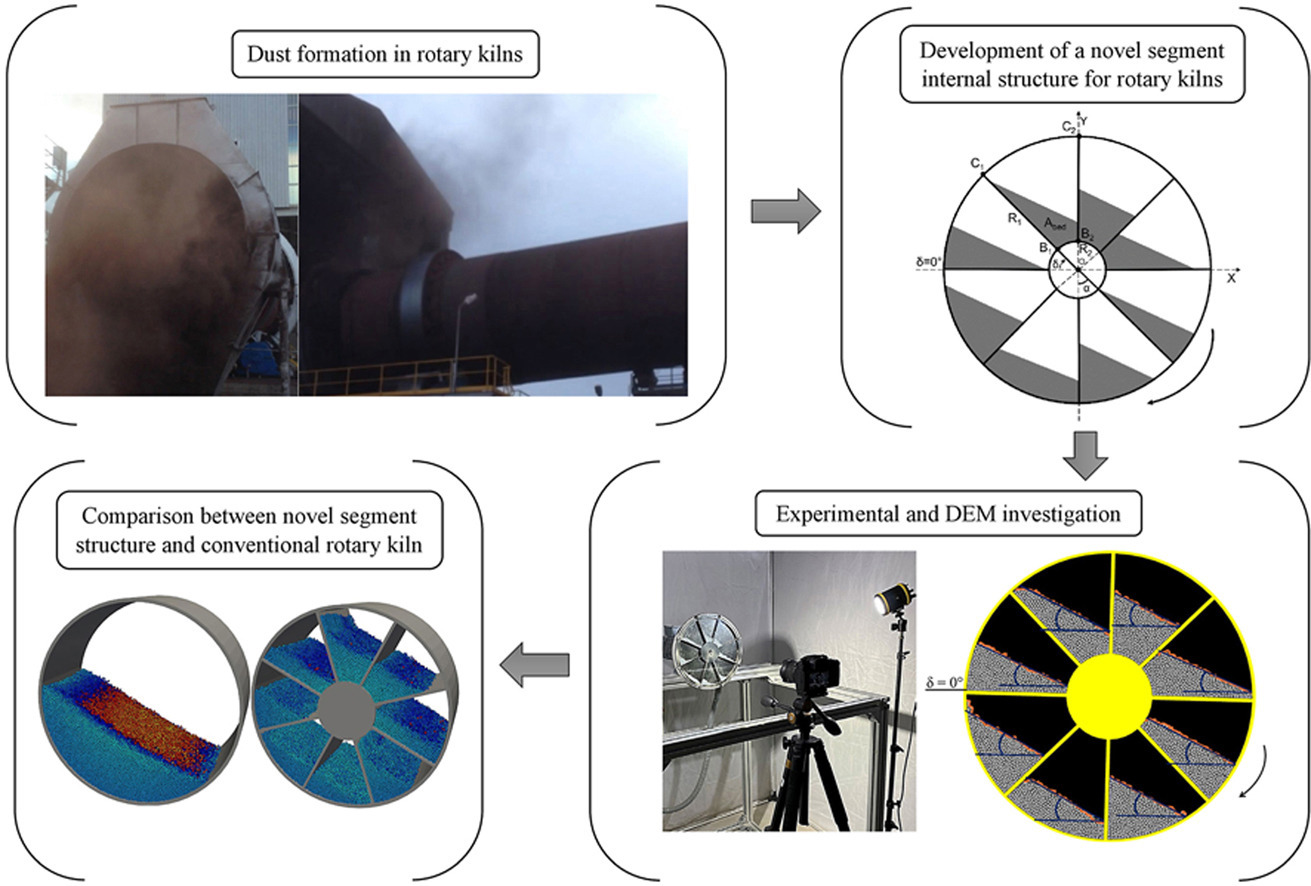
Rotary kilns are essential for thermal and mechanical treatment of various bulk materials in different industries. They enable high throughput rates, continuous mixing and controlled process conditions. Heat transfer is enhanced through installation of internals often leading to particle abrasion and dust formation. To address this issue, a new internals design featuring a cross section has been developed, dividing it into several smaller, separate segments. This design increases the particle-wall and free bed interfaces which improves the heat transfer while reducing the mechanical stress on the particles. Experiments were conducted in rotary drums with diameters of 300 mm and 500 mm to analyze the particle motion. Glass and polypropylene beads with particle diameters ranging from 2 mm to 4 mm were used as test materials. A parameter study was performed for various filling degrees (5 % – 30 %) and rotational speeds (0.5–8 rpm). Additionally, the motion behavior was simulated using the discrete element method (DEM) and validated against experimental data. This approach enabled a numerical description of particle interactions, particle velocities and heat transfer-relevant surface areas. These results show the potential of employing segment internals in rotary kilns for the gentle and efficient thermal treatment of bulk materials.
Graphical abstract
Keywords
Rotary kilns; Segment internals; Particle motion; Gentle processing
文章导读