
期刊文章
过刊浏览
- Volumes 108-119 (2025)
-
Volumes 96-107 (2025)
-
Volume 107
Pages 1-376 (December 2025)
-
Volume 106
Pages 1-336 (November 2025)
-
Volume 105
Pages 1-356 (October 2025)
-
Volume 104
Pages 1-332 (September 2025)
-
Volume 103
Pages 1-314 (August 2025)
-
Volume 102
Pages 1-276 (July 2025)
-
Volume 101
Pages 1-166 (June 2025)
-
Volume 100
Pages 1-256 (May 2025)
-
Volume 99
Pages 1-242 (April 2025)
-
Volume 98
Pages 1-288 (March 2025)
-
Volume 97
Pages 1-256 (February 2025)
-
Volume 96
Pages 1-340 (January 2025)
-
Volume 107
-
Volumes 84-95 (2024)
-
Volume 95
Pages 1-392 (December 2024)
-
Volume 94
Pages 1-400 (November 2024)
-
Volume 93
Pages 1-376 (October 2024)
-
Volume 92
Pages 1-316 (September 2024)
-
Volume 91
Pages 1-378 (August 2024)
-
Volume 90
Pages 1-580 (July 2024)
-
Volume 89
Pages 1-278 (June 2024)
-
Volume 88
Pages 1-350 (May 2024)
-
Volume 87
Pages 1-338 (April 2024)
-
Volume 86
Pages 1-312 (March 2024)
-
Volume 85
Pages 1-334 (February 2024)
-
Volume 84
Pages 1-308 (January 2024)
-
Volume 95
-
Volumes 72-83 (2023)
-
Volume 83
Pages 1-258 (December 2023)
-
Volume 82
Pages 1-204 (November 2023)
-
Volume 81
Pages 1-188 (October 2023)
-
Volume 80
Pages 1-202 (September 2023)
-
Volume 79
Pages 1-172 (August 2023)
-
Volume 78
Pages 1-146 (July 2023)
-
Volume 77
Pages 1-152 (June 2023)
-
Volume 76
Pages 1-176 (May 2023)
-
Volume 75
Pages 1-228 (April 2023)
-
Volume 74
Pages 1-200 (March 2023)
-
Volume 73
Pages 1-138 (February 2023)
-
Volume 72
Pages 1-144 (January 2023)
-
Volume 83
-
Volumes 60-71 (2022)
-
Volume 71
Pages 1-108 (December 2022)
-
Volume 70
Pages 1-106 (November 2022)
-
Volume 69
Pages 1-122 (October 2022)
-
Volume 68
Pages 1-124 (September 2022)
-
Volume 67
Pages 1-102 (August 2022)
-
Volume 66
Pages 1-112 (July 2022)
-
Volume 65
Pages 1-138 (June 2022)
-
Volume 64
Pages 1-186 (May 2022)
-
Volume 63
Pages 1-124 (April 2022)
-
Volume 62
Pages 1-104 (March 2022)
-
Volume 61
Pages 1-120 (February 2022)
-
Volume 60
Pages 1-124 (January 2022)
-
Volume 71
- Volumes 54-59 (2021)
- Volumes 48-53 (2020)
- Volumes 42-47 (2019)
- Volumes 36-41 (2018)
- Volumes 30-35 (2017)
- Volumes 24-29 (2016)
- Volumes 18-23 (2015)
- Volumes 12-17 (2014)
- Volume 11 (2013)
- Volume 10 (2012)
- Volume 9 (2011)
- Volume 8 (2010)
- Volume 7 (2009)
- Volume 6 (2008)
- Volume 5 (2007)
- Volume 4 (2006)
- Volume 3 (2005)
- Volume 2 (2004)
- Volume 1 (2003)
Volume 112
Zhang, H., Lu, X., Jiang, B., Qin, C., Yu, L., Jiang, S., & Yu, C. (2026). Co-firing in pulverized coal boilers: Drag coefficient models and lateral drift of wheat straw fragments. Particuology, 112, 36-51. https://doi.org/10.1016/j.partic.2026.02.019
Co-firing in pulverized coal boilers: Drag coefficient models and lateral drift of wheat straw fragments
Haoteng Zhang, Xuying Lu, Bingyi Jiang *, Cuina Qin, Lihui Yu, Shuo Jiang, Chunjiang Yu *
State Key Laboratory of Clean Energy Utilization, Zhejiang University, Hangzhou, 310027, China
10.1016/j.partic.2026.02.019
Volume 112,
May 2026,
Pages 36-51
Received 23 November 2025, Revised 26 January 2026, Accepted 16 February 2026, Available online 6 March 2026, Version of Record 16 March 2026.
E-mail:
jiangby@zju.edu.cn; chunjiang@zju.edu.cn
Highlights
• Drag coefficient models were established for straw fragments.
• Non-uniform windward drag distribution drives particle lateral translation and rotation.
• Straw fragments do not deviate from the combustion zone during furnace flow.
• High-velocity dilute-phase pneumatic conveying is essential for straw fragments.
Abstract
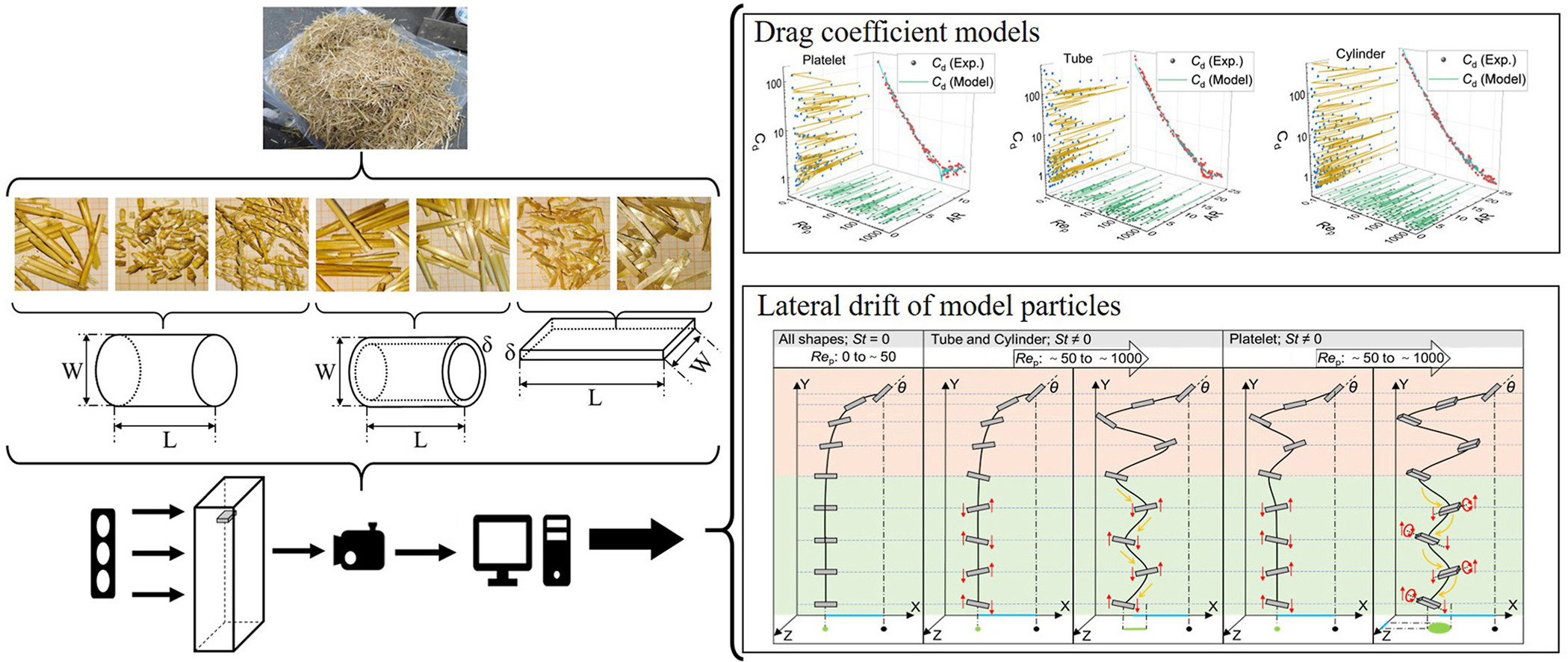
For flexible and hollow straw-like biomass, direct co-firing via preliminary crushing and pneumatic conveying represents a promising technological pathway. However, this approach faces two major challenges: the lack of accurate drag coefficient models for non-spherical, centimeter-sized straw fragments during pneumatic transport and furnace flow, and the risk of lateral drift that may cause deposition during conveying or deviation from the combustion zone. To address these issues, this study establishes dedicated drag coefficient models for rectangular platelets, circular tubes, and solid cylinders, representing typical shapes of straw fragments. These models provide essential parameters for characterizing gas-solid flow in both conveying and combustion processes. Through combined experimental and numerical simulations, the lateral drift mechanism of non-spherical particles was investigated. Results indicate that lateral translation and rotation originate from the non-uniform distribution of fluid drag along the windward surface, generating horizontal force components and torque. Based on experimental and theoretical analysis, it is proposed that high-velocity dilute-phase pneumatic conveying, distinct from pulverized coal transport, should be adopted to mitigate deposition and blockage risks during straw fragment transport. Meanwhile, the risk of unburned carbon loss due to straw fragments leaving the combustion zone was ruled out. This work provides a practical drag coefficient model for co-firing applications, preliminarily clarifies the mechanism of lateral drift, and offers crucial engineering guidance for the preliminary crushing and pneumatic conveying process of straw-based biomass.
Graphical abstract
Keywords
Pulverized coal boiler; Straw fragments; Drag coefficient; Lateral drift
文章导读