
期刊文章
过刊浏览
- Volumes 108-119 (2025)
-
Volumes 96-107 (2025)
-
Volume 107
Pages 1-376 (December 2025)
-
Volume 106
Pages 1-336 (November 2025)
-
Volume 105
Pages 1-356 (October 2025)
-
Volume 104
Pages 1-332 (September 2025)
-
Volume 103
Pages 1-314 (August 2025)
-
Volume 102
Pages 1-276 (July 2025)
-
Volume 101
Pages 1-166 (June 2025)
-
Volume 100
Pages 1-256 (May 2025)
-
Volume 99
Pages 1-242 (April 2025)
-
Volume 98
Pages 1-288 (March 2025)
-
Volume 97
Pages 1-256 (February 2025)
-
Volume 96
Pages 1-340 (January 2025)
-
Volume 107
-
Volumes 84-95 (2024)
-
Volume 95
Pages 1-392 (December 2024)
-
Volume 94
Pages 1-400 (November 2024)
-
Volume 93
Pages 1-376 (October 2024)
-
Volume 92
Pages 1-316 (September 2024)
-
Volume 91
Pages 1-378 (August 2024)
-
Volume 90
Pages 1-580 (July 2024)
-
Volume 89
Pages 1-278 (June 2024)
-
Volume 88
Pages 1-350 (May 2024)
-
Volume 87
Pages 1-338 (April 2024)
-
Volume 86
Pages 1-312 (March 2024)
-
Volume 85
Pages 1-334 (February 2024)
-
Volume 84
Pages 1-308 (January 2024)
-
Volume 95
-
Volumes 72-83 (2023)
-
Volume 83
Pages 1-258 (December 2023)
-
Volume 82
Pages 1-204 (November 2023)
-
Volume 81
Pages 1-188 (October 2023)
-
Volume 80
Pages 1-202 (September 2023)
-
Volume 79
Pages 1-172 (August 2023)
-
Volume 78
Pages 1-146 (July 2023)
-
Volume 77
Pages 1-152 (June 2023)
-
Volume 76
Pages 1-176 (May 2023)
-
Volume 75
Pages 1-228 (April 2023)
-
Volume 74
Pages 1-200 (March 2023)
-
Volume 73
Pages 1-138 (February 2023)
-
Volume 72
Pages 1-144 (January 2023)
-
Volume 83
-
Volumes 60-71 (2022)
-
Volume 71
Pages 1-108 (December 2022)
-
Volume 70
Pages 1-106 (November 2022)
-
Volume 69
Pages 1-122 (October 2022)
-
Volume 68
Pages 1-124 (September 2022)
-
Volume 67
Pages 1-102 (August 2022)
-
Volume 66
Pages 1-112 (July 2022)
-
Volume 65
Pages 1-138 (June 2022)
-
Volume 64
Pages 1-186 (May 2022)
-
Volume 63
Pages 1-124 (April 2022)
-
Volume 62
Pages 1-104 (March 2022)
-
Volume 61
Pages 1-120 (February 2022)
-
Volume 60
Pages 1-124 (January 2022)
-
Volume 71
- Volumes 54-59 (2021)
- Volumes 48-53 (2020)
- Volumes 42-47 (2019)
- Volumes 36-41 (2018)
- Volumes 30-35 (2017)
- Volumes 24-29 (2016)
- Volumes 18-23 (2015)
- Volumes 12-17 (2014)
- Volume 11 (2013)
- Volume 10 (2012)
- Volume 9 (2011)
- Volume 8 (2010)
- Volume 7 (2009)
- Volume 6 (2008)
- Volume 5 (2007)
- Volume 4 (2006)
- Volume 3 (2005)
- Volume 2 (2004)
- Volume 1 (2003)
Volume 112
Kiss, M., Nanz, T., & Bösenhofer, M. (2026). Comparison of 1D and 3D models for the thermochemical conversion of carbonaceous pulverized particles. Particuology, 112, 87-98. https://doi.org/10.1016/j.partic.2026.02.016
Comparison of 1D and 3D models for the thermochemical conversion of carbonaceous pulverized particles (Open Access)
Matthias Kiss a, Thomas Nanz a, Markus Bösenhofer b *
a K1-MET GmbH, Stahlstrasse 14, 4020, Linz, Austria
b Institute of Chemical, Environmental and Bioscience Engineering, TU Wien, Getreidemarkt 9/166, 1060, Vienna, Austria
10.1016/j.partic.2026.02.016
Volume 112,
May 2026,
Pages 87-98
Received 30 November 2025, Revised 24 February 2026, Accepted 25 February 2026, Available online 11 March 2026, Version of Record 17 March 2026.
E-mail:
markus.boesenhofer@tuwien.ac.at
Highlights
• Introduction of a 3D detailed particle model.
• Comparison of 1D and 3D particle models under realistic conversion conditions.
• Multi-scale evaluation of thermally thick particle behavior in 1D and 3D frameworks.
Abstract
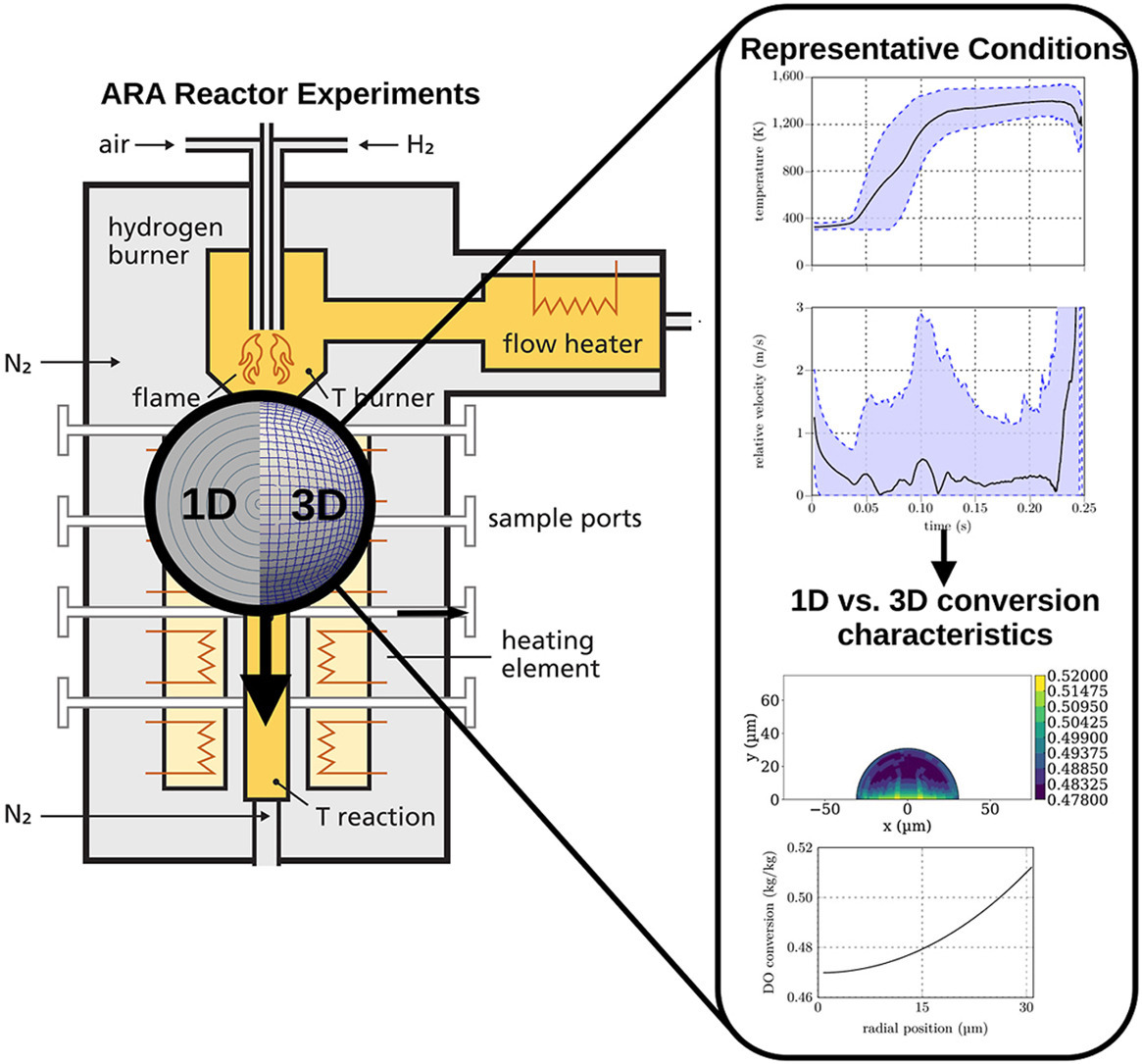
Accurate modeling of thermochemical conversion of carbonaceous particles is essential for predicting solid conversion behavior in high temperature industrial reactors. Numerically efficient 0D or 1D particle models are widely used in large-scale CFD simulations. They typically rely on simplifying assumptions regarding intra-particle heat and mass transfer and chemistry. In contrast, fully resolved 3D multi-region particle models capture detailed transport and reaction phenomena but are computationally expensive. In this study, we compare a 1D particle-resolved Lagrangian model with a detailed 3D multi-region model implemented in OpenFOAM to assess their predictive capabilities under realistic conditions. Three particle sizes and three conversion temperature profiles were analyzed. The comparison focuses on the temporal evolution of the conversion and the intra-particle states at 50% devolatilization and 50% burnout. The results indicate that the 1D and 3D model predict similar mean temperature profiles for most cases, while the mean conversion profiles differ. The results indicate that the 1D model results are biased by the employed sequential thermochemical conversion model for high temperature cases. Some of the differences might be also caused by the slightly inconsistent model settings between the 1D and 3D models. The more complex 3D model requires additional parameters and the devolatilization model from the 1D model is not supported by the 3D modeling framework.
Graphical abstract
Keywords
Particle-resolved modeling; Thermochemical conversion; Intra-particle gradients; OpenFOAM; ARA reactor
文章导读