
期刊文章
过刊浏览
- Volumes 108-119 (2025)
-
Volumes 96-107 (2025)
-
Volume 107
Pages 1-376 (December 2025)
-
Volume 106
Pages 1-336 (November 2025)
-
Volume 105
Pages 1-356 (October 2025)
-
Volume 104
Pages 1-332 (September 2025)
-
Volume 103
Pages 1-314 (August 2025)
-
Volume 102
Pages 1-276 (July 2025)
-
Volume 101
Pages 1-166 (June 2025)
-
Volume 100
Pages 1-256 (May 2025)
-
Volume 99
Pages 1-242 (April 2025)
-
Volume 98
Pages 1-288 (March 2025)
-
Volume 97
Pages 1-256 (February 2025)
-
Volume 96
Pages 1-340 (January 2025)
-
Volume 107
-
Volumes 84-95 (2024)
-
Volume 95
Pages 1-392 (December 2024)
-
Volume 94
Pages 1-400 (November 2024)
-
Volume 93
Pages 1-376 (October 2024)
-
Volume 92
Pages 1-316 (September 2024)
-
Volume 91
Pages 1-378 (August 2024)
-
Volume 90
Pages 1-580 (July 2024)
-
Volume 89
Pages 1-278 (June 2024)
-
Volume 88
Pages 1-350 (May 2024)
-
Volume 87
Pages 1-338 (April 2024)
-
Volume 86
Pages 1-312 (March 2024)
-
Volume 85
Pages 1-334 (February 2024)
-
Volume 84
Pages 1-308 (January 2024)
-
Volume 95
-
Volumes 72-83 (2023)
-
Volume 83
Pages 1-258 (December 2023)
-
Volume 82
Pages 1-204 (November 2023)
-
Volume 81
Pages 1-188 (October 2023)
-
Volume 80
Pages 1-202 (September 2023)
-
Volume 79
Pages 1-172 (August 2023)
-
Volume 78
Pages 1-146 (July 2023)
-
Volume 77
Pages 1-152 (June 2023)
-
Volume 76
Pages 1-176 (May 2023)
-
Volume 75
Pages 1-228 (April 2023)
-
Volume 74
Pages 1-200 (March 2023)
-
Volume 73
Pages 1-138 (February 2023)
-
Volume 72
Pages 1-144 (January 2023)
-
Volume 83
-
Volumes 60-71 (2022)
-
Volume 71
Pages 1-108 (December 2022)
-
Volume 70
Pages 1-106 (November 2022)
-
Volume 69
Pages 1-122 (October 2022)
-
Volume 68
Pages 1-124 (September 2022)
-
Volume 67
Pages 1-102 (August 2022)
-
Volume 66
Pages 1-112 (July 2022)
-
Volume 65
Pages 1-138 (June 2022)
-
Volume 64
Pages 1-186 (May 2022)
-
Volume 63
Pages 1-124 (April 2022)
-
Volume 62
Pages 1-104 (March 2022)
-
Volume 61
Pages 1-120 (February 2022)
-
Volume 60
Pages 1-124 (January 2022)
-
Volume 71
- Volumes 54-59 (2021)
- Volumes 48-53 (2020)
- Volumes 42-47 (2019)
- Volumes 36-41 (2018)
- Volumes 30-35 (2017)
- Volumes 24-29 (2016)
- Volumes 18-23 (2015)
- Volumes 12-17 (2014)
- Volume 11 (2013)
- Volume 10 (2012)
- Volume 9 (2011)
- Volume 8 (2010)
- Volume 7 (2009)
- Volume 6 (2008)
- Volume 5 (2007)
- Volume 4 (2006)
- Volume 3 (2005)
- Volume 2 (2004)
- Volume 1 (2003)
Volume 112
Li, Z., He, X., Chen, X., Huang, Z., & Zhou, Q. (2026). Development of the drag model for distillation columns under heterogeneous flow regime via direct numerical simulation. Particuology, 112, 111-122. https://doi.org/10.1016/j.partic.2026.02.027
Development of the drag model for distillation columns under heterogeneous flow regime via direct numerical simulation
Zhendong Li a b, Xieyu He a b, Xiao Chen a b, Zheqing Huang a b *, Qiang Zhou a b *
a School of Chemical Engineering and Technology, Xi'an Jiaotong University, Xi'an 710049, China
b Shaanxi Key Laboratory of Energy Chemical Process Intensification, Xi'an Jiaotong University, Xi'an, 710049, China
10.1016/j.partic.2026.02.027
Volume 112,
May 2026,
Pages 111-122
Received 27 December 2025, Revised 8 February 2026, Accepted 18 February 2026, Available online 11 March 2026, Version of Record 18 March 2026.
E-mail:
huangzheqing@mail.xjtu.edu.cn; zhou.590@mail.xjtu.edu.cn
Highlights
• The drag models are developed based on DNS under different flow regimes.
• The consideration of heterogeneous flow regime extends the models' applicability.
• Bubble swarm correction factor is affected by Reynolds number and gas holdup.
• The simulations of distillation columns are performed for posterior tests.
• The proposed models give good predictions under heterogeneous flow regime.
Abstract
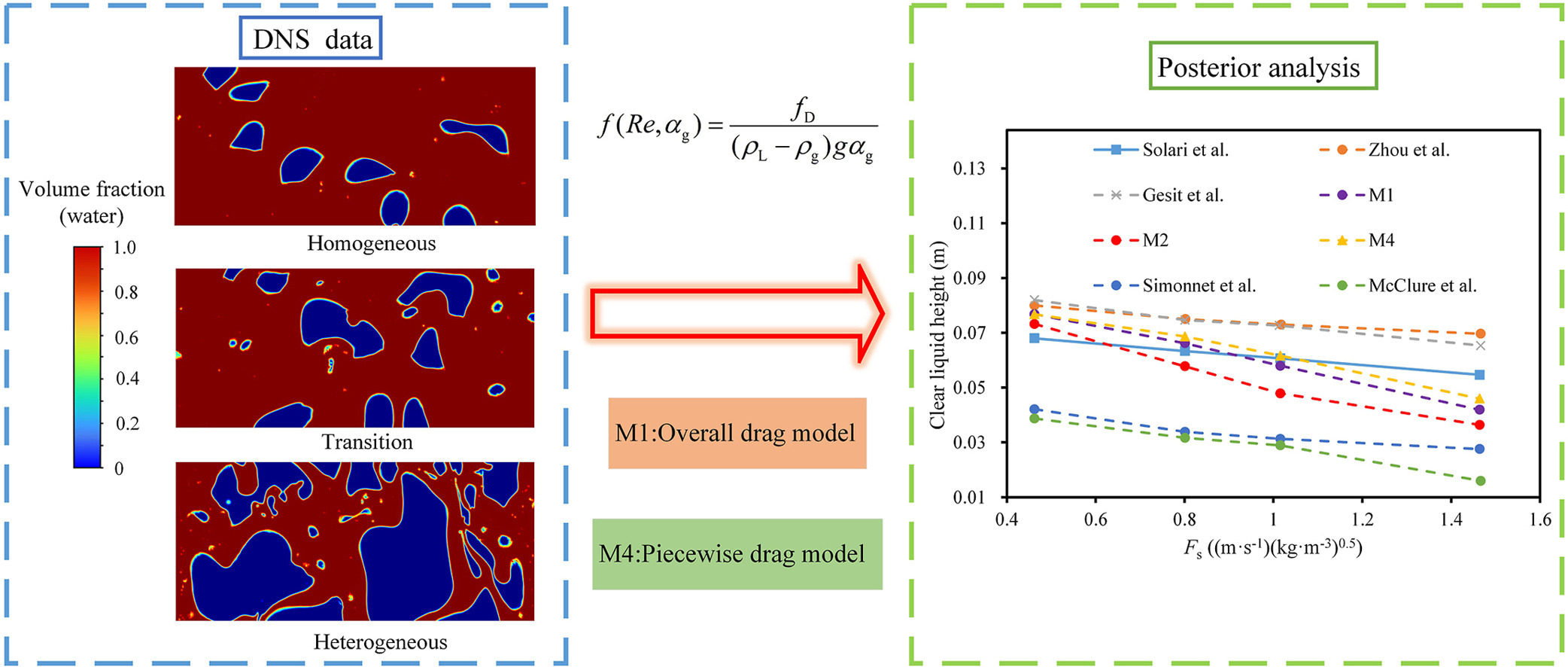
An accurate gas-liquid drag model is crucial for simulating bubble swarms in distillation columns. Under typical industrial operating conditions, distillation columns predominantly operate in the heterogeneous flow regime. To obtain reliable data under this regime, this study employs direct numerical simulation to conduct high-resolution simulations of bubble swarm dynamics at high superficial gas velocities. The drag force on the bubble swarm is calculated accurately based on the direct integration of stresses on bubble surfaces. Given the substantial differences in flow regimes—homogeneous, transition, and heterogeneous—under varying superficial gas velocities, this study develops not only an overall drag model spanning gas holdups from 0.1 to 0.6, but also a piecewise model based on flow regime characteristics. Both models describe the bubble swarm correction factor in terms of both gas holdup and Reynolds number, where the Reynolds number captures the evolution of the flow state. A posteriori validation using a two-fluid model demonstrates that, compared to other drag models, both proposed models significantly improve the prediction accuracy of the clear liquid height, particularly at the high superficial gas velocity. The piecewise model performs optimally, achieving a mean relative error of only 10.39% and 12.66% relative to experimental data.
Graphical abstract
Keywords
Distillation columns; Drag model; Direct numerical simulation; Heterogeneous; Computational fluid dynamics
文章导读