
期刊文章
过刊浏览
- Volumes 108-119 (2025)
-
Volumes 96-107 (2025)
-
Volume 107
Pages 1-376 (December 2025)
-
Volume 106
Pages 1-336 (November 2025)
-
Volume 105
Pages 1-356 (October 2025)
-
Volume 104
Pages 1-332 (September 2025)
-
Volume 103
Pages 1-314 (August 2025)
-
Volume 102
Pages 1-276 (July 2025)
-
Volume 101
Pages 1-166 (June 2025)
-
Volume 100
Pages 1-256 (May 2025)
-
Volume 99
Pages 1-242 (April 2025)
-
Volume 98
Pages 1-288 (March 2025)
-
Volume 97
Pages 1-256 (February 2025)
-
Volume 96
Pages 1-340 (January 2025)
-
Volume 107
-
Volumes 84-95 (2024)
-
Volume 95
Pages 1-392 (December 2024)
-
Volume 94
Pages 1-400 (November 2024)
-
Volume 93
Pages 1-376 (October 2024)
-
Volume 92
Pages 1-316 (September 2024)
-
Volume 91
Pages 1-378 (August 2024)
-
Volume 90
Pages 1-580 (July 2024)
-
Volume 89
Pages 1-278 (June 2024)
-
Volume 88
Pages 1-350 (May 2024)
-
Volume 87
Pages 1-338 (April 2024)
-
Volume 86
Pages 1-312 (March 2024)
-
Volume 85
Pages 1-334 (February 2024)
-
Volume 84
Pages 1-308 (January 2024)
-
Volume 95
-
Volumes 72-83 (2023)
-
Volume 83
Pages 1-258 (December 2023)
-
Volume 82
Pages 1-204 (November 2023)
-
Volume 81
Pages 1-188 (October 2023)
-
Volume 80
Pages 1-202 (September 2023)
-
Volume 79
Pages 1-172 (August 2023)
-
Volume 78
Pages 1-146 (July 2023)
-
Volume 77
Pages 1-152 (June 2023)
-
Volume 76
Pages 1-176 (May 2023)
-
Volume 75
Pages 1-228 (April 2023)
-
Volume 74
Pages 1-200 (March 2023)
-
Volume 73
Pages 1-138 (February 2023)
-
Volume 72
Pages 1-144 (January 2023)
-
Volume 83
-
Volumes 60-71 (2022)
-
Volume 71
Pages 1-108 (December 2022)
-
Volume 70
Pages 1-106 (November 2022)
-
Volume 69
Pages 1-122 (October 2022)
-
Volume 68
Pages 1-124 (September 2022)
-
Volume 67
Pages 1-102 (August 2022)
-
Volume 66
Pages 1-112 (July 2022)
-
Volume 65
Pages 1-138 (June 2022)
-
Volume 64
Pages 1-186 (May 2022)
-
Volume 63
Pages 1-124 (April 2022)
-
Volume 62
Pages 1-104 (March 2022)
-
Volume 61
Pages 1-120 (February 2022)
-
Volume 60
Pages 1-124 (January 2022)
-
Volume 71
- Volumes 54-59 (2021)
- Volumes 48-53 (2020)
- Volumes 42-47 (2019)
- Volumes 36-41 (2018)
- Volumes 30-35 (2017)
- Volumes 24-29 (2016)
- Volumes 18-23 (2015)
- Volumes 12-17 (2014)
- Volume 11 (2013)
- Volume 10 (2012)
- Volume 9 (2011)
- Volume 8 (2010)
- Volume 7 (2009)
- Volume 6 (2008)
- Volume 5 (2007)
- Volume 4 (2006)
- Volume 3 (2005)
- Volume 2 (2004)
- Volume 1 (2003)
Volume 117
Application of carbon-based materials in the positive electrode of lithium-sulfur batteries
Zhaobo Wang, Ying Song *, Lixia Zhu, Jinze Song, Xiaolei Song, Li Chen *
Key Laboratory of Advanced Structural Materials, Ministry of Education and School of Materials Science and Engineering, Changchun University of Technology, Changchun, 130012, China
10.1016/j.partic.2026.07.012
Volume 117,
October 2026,
Pages 175-193
Received 22 June 2026, Revised 14 July 2026, Accepted 17 July 2026, Available online 24 July 2026, Version of Record 4 August 2026.
E-mail:
songying2017@ccut.edu.cn;
Highlights
• Recent advances in carbon-based cathode materials for Li–S batteries are reviewed.
• Advantages of 0D, 1D, 2D and 3D carbon materials are systematically compared.
• Multiple mechanisms including confinement, adsorption and catalysis are elucidated.
• Challenges in practical applications of carbon materials are critically discussed.
• Future directions for high-performance and practical Li–S batteries are proposed.
Abstract
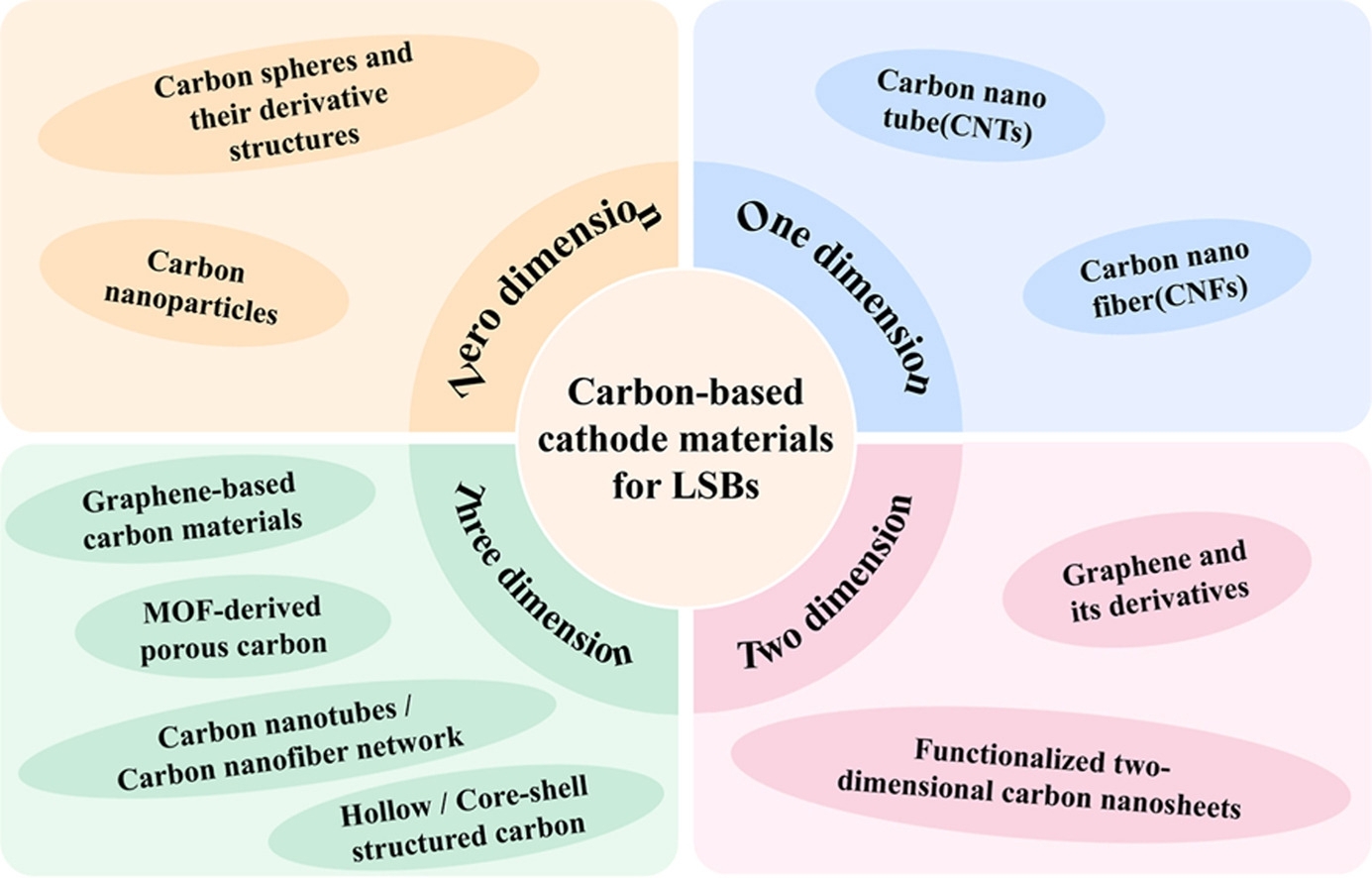
Lithium-sulfur batteries (LSBs) are considered as a promising next-generation energy storage system due to their high theoretical specific capacity (1675 mA h g−1), high energy density (2500 W h kg−1), abundant sulfur resources, and environmental friendliness. However, the poor conductivity of sulfur and its final product Li2S, the severe shuttle effect of lithium polysulfides (LiPSs), significant volume expansion, and slow redox reaction kinetics have severely limited their practical application. In recent years, carbon-based materials have shown significant application value in the cathodes of LSBs due to their excellent electrical conductivity, tunable pore structure, high specific surface area, and good chemical stability. This review focuses on the application of carbon-based materials in the cathodes of LSBs. According to the material dimension, they are classified into zero-dimensional, one-dimensional, two-dimensional, and three-dimensional (0D, 1D, 2D and 3D) carbon materials. The structural characteristics, design strategies, and their roles in enhancing conductivity, confining LiPSs, adsorbing at interfaces, and catalytic conversion of different types of carbon materials are systematically summarized. Meanwhile, the current challenges and future development directions of carbon-based materials are prospected, with the aim of providing references for the design and application of high-performance cathode materials for LSBs.
Graphical abstract
Keywords
Lithium-sulfur battery; Carbon-based materials; Sulfur cathode; Shuttle effect; Catalytic conversion
文章导读