
期刊文章
过刊浏览
- Volumes 108-119 (2025)
-
Volumes 96-107 (2025)
-
Volume 107
Pages 1-376 (December 2025)
-
Volume 106
Pages 1-336 (November 2025)
-
Volume 105
Pages 1-356 (October 2025)
-
Volume 104
Pages 1-332 (September 2025)
-
Volume 103
Pages 1-314 (August 2025)
-
Volume 102
Pages 1-276 (July 2025)
-
Volume 101
Pages 1-166 (June 2025)
-
Volume 100
Pages 1-256 (May 2025)
-
Volume 99
Pages 1-242 (April 2025)
-
Volume 98
Pages 1-288 (March 2025)
-
Volume 97
Pages 1-256 (February 2025)
-
Volume 96
Pages 1-340 (January 2025)
-
Volume 107
-
Volumes 84-95 (2024)
-
Volume 95
Pages 1-392 (December 2024)
-
Volume 94
Pages 1-400 (November 2024)
-
Volume 93
Pages 1-376 (October 2024)
-
Volume 92
Pages 1-316 (September 2024)
-
Volume 91
Pages 1-378 (August 2024)
-
Volume 90
Pages 1-580 (July 2024)
-
Volume 89
Pages 1-278 (June 2024)
-
Volume 88
Pages 1-350 (May 2024)
-
Volume 87
Pages 1-338 (April 2024)
-
Volume 86
Pages 1-312 (March 2024)
-
Volume 85
Pages 1-334 (February 2024)
-
Volume 84
Pages 1-308 (January 2024)
-
Volume 95
-
Volumes 72-83 (2023)
-
Volume 83
Pages 1-258 (December 2023)
-
Volume 82
Pages 1-204 (November 2023)
-
Volume 81
Pages 1-188 (October 2023)
-
Volume 80
Pages 1-202 (September 2023)
-
Volume 79
Pages 1-172 (August 2023)
-
Volume 78
Pages 1-146 (July 2023)
-
Volume 77
Pages 1-152 (June 2023)
-
Volume 76
Pages 1-176 (May 2023)
-
Volume 75
Pages 1-228 (April 2023)
-
Volume 74
Pages 1-200 (March 2023)
-
Volume 73
Pages 1-138 (February 2023)
-
Volume 72
Pages 1-144 (January 2023)
-
Volume 83
-
Volumes 60-71 (2022)
-
Volume 71
Pages 1-108 (December 2022)
-
Volume 70
Pages 1-106 (November 2022)
-
Volume 69
Pages 1-122 (October 2022)
-
Volume 68
Pages 1-124 (September 2022)
-
Volume 67
Pages 1-102 (August 2022)
-
Volume 66
Pages 1-112 (July 2022)
-
Volume 65
Pages 1-138 (June 2022)
-
Volume 64
Pages 1-186 (May 2022)
-
Volume 63
Pages 1-124 (April 2022)
-
Volume 62
Pages 1-104 (March 2022)
-
Volume 61
Pages 1-120 (February 2022)
-
Volume 60
Pages 1-124 (January 2022)
-
Volume 71
- Volumes 54-59 (2021)
- Volumes 48-53 (2020)
- Volumes 42-47 (2019)
- Volumes 36-41 (2018)
- Volumes 30-35 (2017)
- Volumes 24-29 (2016)
- Volumes 18-23 (2015)
- Volumes 12-17 (2014)
- Volume 11 (2013)
- Volume 10 (2012)
- Volume 9 (2011)
- Volume 8 (2010)
- Volume 7 (2009)
- Volume 6 (2008)
- Volume 5 (2007)
- Volume 4 (2006)
- Volume 3 (2005)
- Volume 2 (2004)
- Volume 1 (2003)
Volume 117
Structure of packed bed probed by Micro-Computed Tomography and Collision Guided Packing
Aashna Suneja a, Shantanu Roy a b *
a Department of Chemical Engineering, Indian Institute of Technology Delhi, New Delhi, 110016, India
b Indian Institute of Technology Delhi – Abu Dhabi, Zayed City, Abu Dhabi Emirate, United Arab Emirates
10.1016/j.partic.2026.06.042
Volume 117,
October 2026,
Pages 164-174
Received 24 February 2026, Revised 16 June 2026, Accepted 29 June 2026, Available online 10 July 2026, Version of Record 30 July 2026.
E-mail:
roys@iitdabudhabi.ac.ae
Highlights
• Probed trilobe bed structures using Micro-CT and CGP models.
• Vibrated beds achieved higher density than central pipe packing.
• Trilobe particles attenuate wall effects within two diameters.
• Trilobes form more uniform bed structures than spherical shapes.
• Orientation analysis shows particles favor horizontal positions.
Abstract
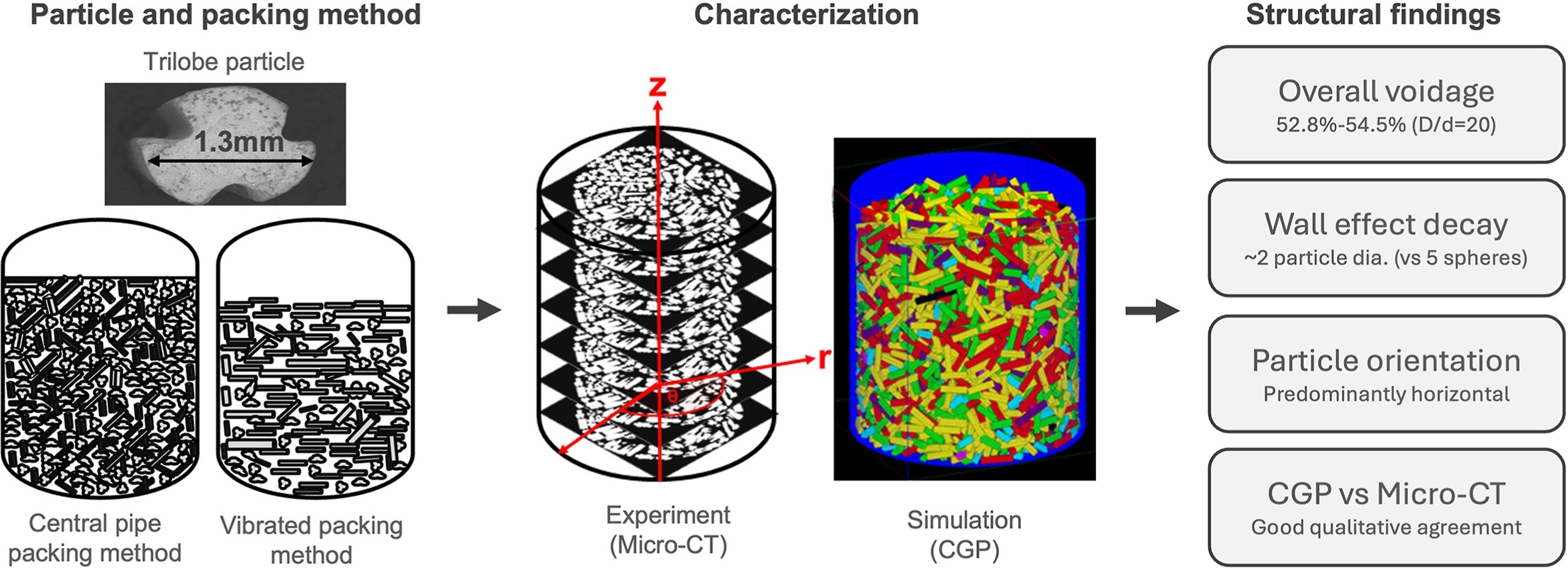
Packed beds used in trickle bed reactors for deep hydroprocessing exhibit complex internal structures that govern fluid flow, conversion, selectivity, and secondary effects such as catalyst degradation and coking. While extensive research has addressed bed structure and hydrodynamics for spherical and simple cylindrical particles, trilobe-shaped catalyst particles among the most widely used shapes in industrial hydroprocessing remain comparatively undercharacterized, particularly with respect to high-resolution bed structure measurement and particle-resolved packing simulation. In this study, the structure of laboratory-scale packed beds of trilobe-shaped catalyst particles is investigated through experimentation and modeling under two different packing methods: central pipe loading and vibrated bed packing. Bed structure is measured using Micro-Computed Tomography (Micro-CT) and characterized through appropriate metrics. The bed-packing process is modeled using Collision Guided Packing (CGP), enabling a direct comparison between experimental measurements and simulation predictions of both the packing dynamics and the final bed configuration. This work addresses a specific gap in the literature on trilobe particle bed characterization and provides a rigorous basis for understanding the impact of packing method on bed structure, with direct relevance to deep hydroprocessing applications.
Graphical abstract
Keywords
Trickle bed reactors; Trilobe catalyst particles; Micro-computed tomography; Particle orientation; Collision guided packing
文章导读