
期刊文章
过刊浏览
- Volumes 108-119 (2025)
-
Volumes 96-107 (2025)
-
Volume 107
Pages 1-376 (December 2025)
-
Volume 106
Pages 1-336 (November 2025)
-
Volume 105
Pages 1-356 (October 2025)
-
Volume 104
Pages 1-332 (September 2025)
-
Volume 103
Pages 1-314 (August 2025)
-
Volume 102
Pages 1-276 (July 2025)
-
Volume 101
Pages 1-166 (June 2025)
-
Volume 100
Pages 1-256 (May 2025)
-
Volume 99
Pages 1-242 (April 2025)
-
Volume 98
Pages 1-288 (March 2025)
-
Volume 97
Pages 1-256 (February 2025)
-
Volume 96
Pages 1-340 (January 2025)
-
Volume 107
-
Volumes 84-95 (2024)
-
Volume 95
Pages 1-392 (December 2024)
-
Volume 94
Pages 1-400 (November 2024)
-
Volume 93
Pages 1-376 (October 2024)
-
Volume 92
Pages 1-316 (September 2024)
-
Volume 91
Pages 1-378 (August 2024)
-
Volume 90
Pages 1-580 (July 2024)
-
Volume 89
Pages 1-278 (June 2024)
-
Volume 88
Pages 1-350 (May 2024)
-
Volume 87
Pages 1-338 (April 2024)
-
Volume 86
Pages 1-312 (March 2024)
-
Volume 85
Pages 1-334 (February 2024)
-
Volume 84
Pages 1-308 (January 2024)
-
Volume 95
-
Volumes 72-83 (2023)
-
Volume 83
Pages 1-258 (December 2023)
-
Volume 82
Pages 1-204 (November 2023)
-
Volume 81
Pages 1-188 (October 2023)
-
Volume 80
Pages 1-202 (September 2023)
-
Volume 79
Pages 1-172 (August 2023)
-
Volume 78
Pages 1-146 (July 2023)
-
Volume 77
Pages 1-152 (June 2023)
-
Volume 76
Pages 1-176 (May 2023)
-
Volume 75
Pages 1-228 (April 2023)
-
Volume 74
Pages 1-200 (March 2023)
-
Volume 73
Pages 1-138 (February 2023)
-
Volume 72
Pages 1-144 (January 2023)
-
Volume 83
-
Volumes 60-71 (2022)
-
Volume 71
Pages 1-108 (December 2022)
-
Volume 70
Pages 1-106 (November 2022)
-
Volume 69
Pages 1-122 (October 2022)
-
Volume 68
Pages 1-124 (September 2022)
-
Volume 67
Pages 1-102 (August 2022)
-
Volume 66
Pages 1-112 (July 2022)
-
Volume 65
Pages 1-138 (June 2022)
-
Volume 64
Pages 1-186 (May 2022)
-
Volume 63
Pages 1-124 (April 2022)
-
Volume 62
Pages 1-104 (March 2022)
-
Volume 61
Pages 1-120 (February 2022)
-
Volume 60
Pages 1-124 (January 2022)
-
Volume 71
- Volumes 54-59 (2021)
- Volumes 48-53 (2020)
- Volumes 42-47 (2019)
- Volumes 36-41 (2018)
- Volumes 30-35 (2017)
- Volumes 24-29 (2016)
- Volumes 18-23 (2015)
- Volumes 12-17 (2014)
- Volume 11 (2013)
- Volume 10 (2012)
- Volume 9 (2011)
- Volume 8 (2010)
- Volume 7 (2009)
- Volume 6 (2008)
- Volume 5 (2007)
- Volume 4 (2006)
- Volume 3 (2005)
- Volume 2 (2004)
- Volume 1 (2003)
Volume 117
Experimental investigation of suspension performance and chaotic characteristics of non-Newtonian liquid-solid mixing by the Paravisc impeller
Huibo Meng *, Jiayue Liu, Wenchun Jiang, Rupeng Zhu, Deao Li, Yingzheng Meng
College of New Energy, State Key Laboratory of Heavy Oil Processing, China University of Petroleum (East China), Qingdao, 266580, China
10.1016/j.partic.2026.07.017
Volume 117,
October 2026,
Pages 207-218
Received 7 May 2026, Revised 2 July 2026, Accepted 18 July 2026, Available online 29 July 2026, Version of Record 4 August 2026.
E-mail:
huibomeng@upc.edu.cn
Highlights
• Visualization experiments on non-Newtonian liquid-solid suspensions were conducted.
• The complete off-bottom suspension condition was identified through visualization experiments.
• The nonlinear dynamic characteristics of liquid-solid suspension were revealed by LLE and MSE.
• The empirical correlation was established by a Python symbolic regression model.
Abstract
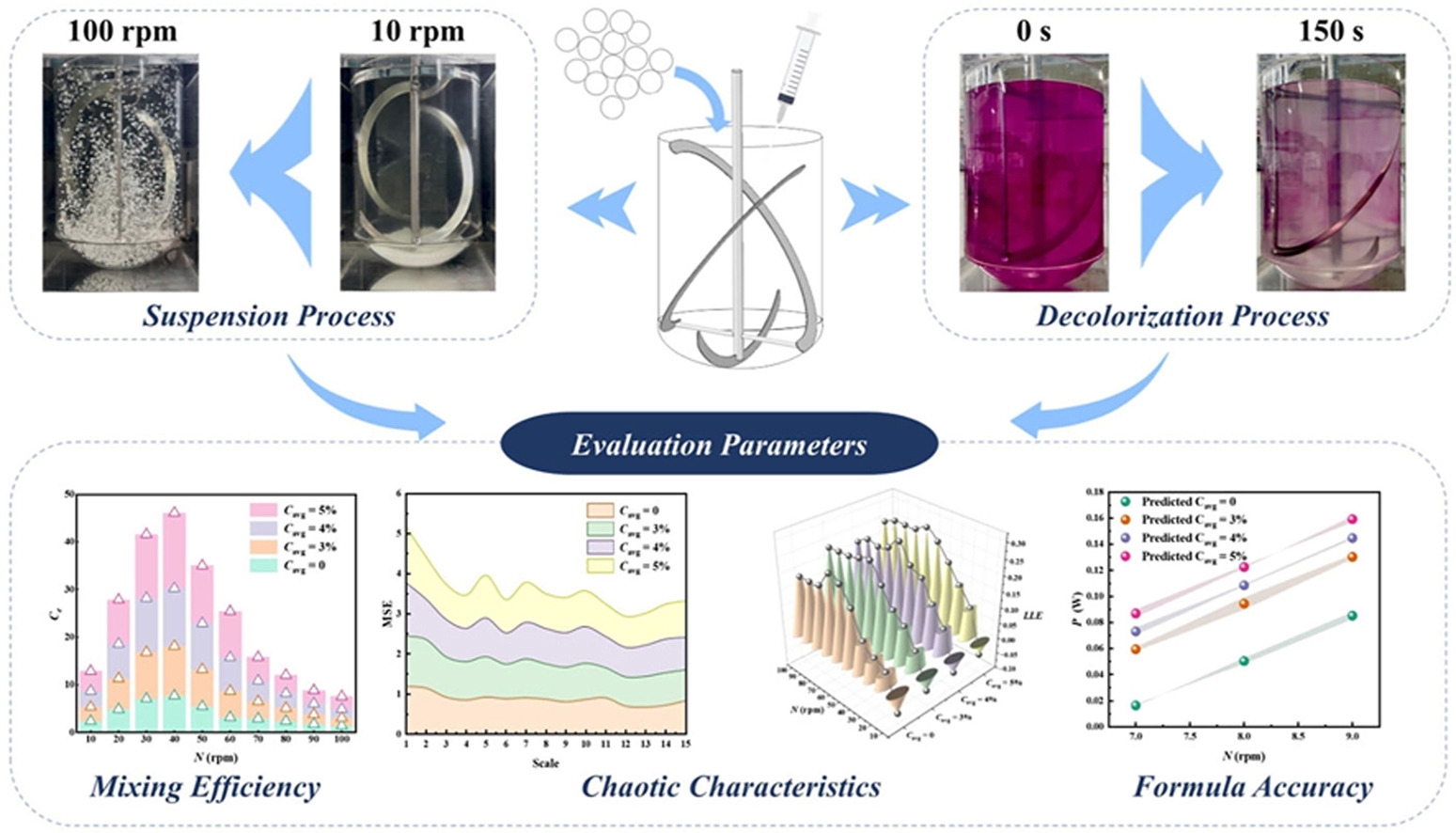
The Paravisc impeller is extensively employed in industrial mixing operations. However, its performance concerning particle suspension and chaotic mixing dynamics of non-Newtonian liquid-solid systems is inadequately characterized. This study systematically investigates the particle suspension state through visualization experiments in an elliptical-bottom stirred tank. Experiments are conducted at various rotational speeds ranging from 10 to 100 rpm and at solid hold-up values of 0%, 3%, 4%, and 5%. The critical flow regime transition from laminar to transitional flow is obtained when the Reynolds number is 78, approximately. Mixing performance is assessed by power consumption, mixing efficiency, and shear efficiency to elucidate the underlying flow structures and particle-induced energy dissipation mechanism. The results demonstrate that the particle promotes chaotic mixing when rotational speed is 60 rpm, which is smaller by 10 rpm than that in the single-phase. Furthermore, an empirical correlation among power, rotational speed, and solid hold-up is established based on the Python symbolic regression model, which demonstrates high predictive accuracy with the coefficient of determination is 0.9998, the mean absolute error is 0.0419, and the root mean square error is 0.0547. The robustness of the empirical correlation is validated across extended experiments at the rotational speeds ranging from 7 to 120 rpm. These findings provide technical guidance for optimizing mixing performance and improving energy utilization in non-Newtonian liquid-solid mixing systems agitated by the Paravisc impeller.
Graphical abstract
Keywords
Paravisc impeller; Non-Newtonian fluids; Liquid-solid suspension; Chaotic characteristics; PySR symbolic regression
文章导读